Strategy Under Uncertainty – how to sense if Apple is coming for you

In my recently released whitepaper, What if Apple makes a treadmill: or doesn’t! I described a scenario of how big tech could come in and disrupt the fitness industry as firms such as Apple and Amazon compete for dominance in the US$10T health industry. In a related piece around strategy, I described the limitations of approaches such as those espoused in Playing to Win (published by HBR in 2013). These limitations are essentially the premise that strategy can be conceived through a linear deterministic approach drawing on industrial economic concepts popularized by Michael Porter. Porters concepts were developed in a very different time.

So what approach is most suitable in dynamic and uncertain environments? The answer to this question will depend upon your view of strategy. If your view is similar to what you may have learned on some MBA course which revolves around finding a unique position in the market that leads to sustainable competitive advantage – in the words of Yoda, you need to unlearn what you have learned. That in itself is a strategy as it infers that organizational culture and mental models play a definitive role in what strategy is and how it is carried out.

In an era of shareholder returns and the holy grail of managing lag indicators (such as earnings) fueled by toxic ‘strategy’ mechanisms such as yearly budgeting processes, the time is here for a re-think for most organizations.

Culture is Strategy

If there is one topic that can get me going it is culture. How many managers and organizations emphasize the importance of culture in firm performance without really:

  1. Understanding what it is
  2. Paying more than lip service to it, especially when pesky quarterly targets take over
  3. Making any effort to actually study culture and develop it within their firm

In other words, there is a lot more rhetoric than real action. Even worse, in the language of Chris Argyris (former Harvard professor and author of Overcoming Organizational Defenses), most organizations have huge gaps between espoused values and theories in use (think Douglas McGregor’s Theory X and Y). Political oligarchy has become so entrenched in most organizations that they have seriously failed to tap the collective wisdom of the crowd. Removing the CEO won’t help but addressing the mental models and culture of the firm will. You may not know when you have reached this state but a good sign is when your most passionate and vocal employees become quiet.

Culture is often considered some gooey abstract concept that is some magical property which high performing organizations are able to capture and others not. It may be true that some firms have great cultures and others do not but it is hardly an unknowable or untestable concept. The features of a high performing culture have been clearly operationalized and delineated. Some of these are well articulated in the book by Doshi and McGregor, Primed to Perform. Much more is available in the literature on innovation and market oriented cultures.

The elements of a high performing culture are a market, knowledge and learning orientation. As Peter Drucker once said, ‘Culture eats strategy for breakfast’. I will go further. Strategy is the how, it is action not declaration, hence your culture is your strategy as it is the how of achieving objectives.

A marketing culture is as much a mind-set as anything else; it is an organizational culture that should pervade the entire organization, and people within a firm should realize that any organization is a customer satisfying entity. Since the ‘re-birth’ of the marketing concept prompted by the writings of such people as Frederick Webster in 1988, marketing has once again been placed as an important consideration for organizational performance. This is good and bad. There is a substantial difference between the trappings of marketing (such as having a person designated as a marketer) and the substance of marketing, which is concerned with the value that is created for the customer. A market orientation can be defined according to the two seminal works in this area by Kohli and Jaworski, and Narver and Slater. These academics have done much to operationalize the implementation of the marketing concept in the form of market orientation.

According to Kohli and Jaworski (1990):

market orientation is the organization wide generation of market intelligence pertaining to current and future customer needs, dissemination of the intelligence across departments, and organization wide responsiveness to it’

According to Slater and Narver (1995):

 ‘a business is market oriented when its culture is systematically and entirely committed to the continuous creation of superior customer value’

In addition, Narver and Slater (1990) state that a market orientation consists of three behavioral components of customer orientation, competitor orientation, and inter-functional co-ordination. There are several key points to take from these definitions. Market orientation is both a culture (values and beliefs about customers, a business philosophy) and a set of behaviors. That is, there is a difference between accepting the marketing concept and implementing it. Moreover, the responsibility of responding to market needs falls on the entire organization and not only on the marketing function. This type of marketing cannot be measured by traditional marketing metrics. The ROI on this is company profitability. As Tim Ambler from the London Business School proclaims, ‘it is like the ROI on eating, if you don’t do it you die!’

In relation to a knowledge orientation and learning:

 ‘a process that creates or locates knowledge and manages the sharing, dissemination and use of knowledge within the organization. When knowledge is used, learning takes place, which in turn, improves the stock of knowledge available to the firm’ (Darrach and McNaughton, 2001)

There is a huge amount of evidence that a market and knowledge orientation have the most significant impact on firm performance of any variable and directly impacts innovation capability. One must be cautious not to confuse correlation with causation and Phil Rosenzweig (in his excellent book The Halo Effect) explains the danger in this type of research, nonetheless, the evidence is instructive. Think about these buzz words that fly around boardrooms, exec meetings and popular management publications/books:

  • Nimble
  • Agile
  • Adaptable
  • Digital transformation
  • Talent management
  • Lean
  • Innovation and creativity
  • Environmental scanning and SWOT
  • Optimization and efficiency
  • Customer centric
  • Change capable
  • Live by our core values

I could go on but you get the message. For the sake of argument let’s assume all the above are relatively important depending upon the context and all critical to successful strategy development and execution. Now ask yourself a question: how is any of this doable in an effective way without the right culture? Easy answer, it isn’t. Some may say this is more about strategy execution than development to which I would argue that is a false dichotomy. Planning is not strategy. In dynamic environments, strategy is about process, doing, and learning.

Firms need to move from a know it all culture to a learn it all culture in the words of Satya Nadella (Microsoft CEO).

David J Teece (in his book Dynamic Capabilities) identifies dynamic capabilities as sensing, seizing and managing threats/transforming. He also criticizes concepts such as the five forces as being overly static in nature. His ideas highlight the very real need to consider organizational culture in the role of strategy. How can one become ‘capable’ at sensing or transforming if the culture of the organization is insulated, siloed and hierarchical?

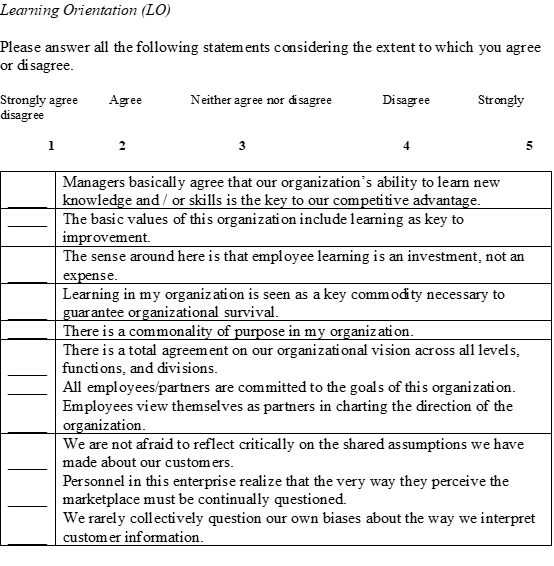
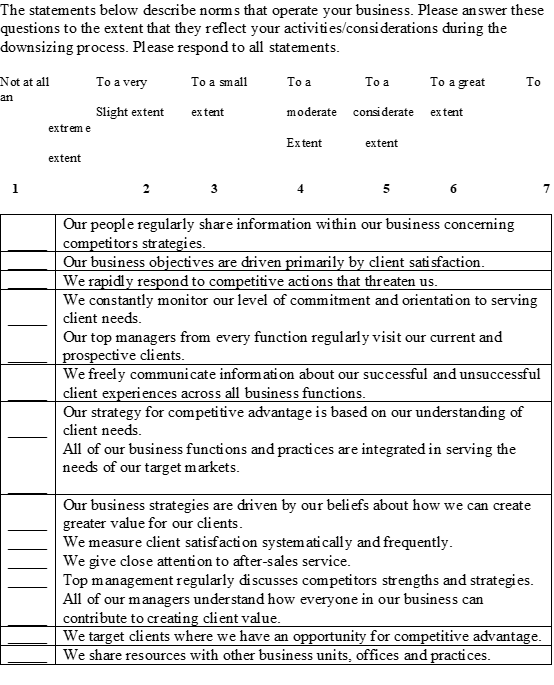
At the end of this article you will see some simple examples of inventories used for measuring market and knowledge orientations as well as sources for innovation maturity assessment.

Strategic Foresight

There are dozens of well known companies that have been disrupted by new entrants that didn’t even come from within their standard definition of industry analysis. Uber, Amazon, Apple, Airbnb, and Netflix are well known examples. Even firms which were sitting on disruptive innovations such as Kodak (digital film) and Xerox (GUI) were unable to let go of legacy business models to exploit these opportunities. Firms need to get better at ‘seeing around corners’ according to Columbia Business School Professor Rita McGrath.

Source: http://strategy-business.com/practicingstrategy ©2021 PwC. All rights reserved

Having addressed some of the key issues around changing behaviors based on culture above, we can focus on extending strategic frameworks. Getting away from the fixation on the positioning school of strategy will help. As Gary Hamel states, the forces for perpetuation are much stronger than for innovation.

Amy Webb, a professor of strategic foresight at NYU Stern School of Business, provides some unique tools for practicing strategy in uncertain environments. As founder of the Future Today Institute, she works with numerous organisations on improving their future thinking abilities. These tools can be very useful for improving strategic dialogue and getting organisations to think differently about strategy that focuses much less on traditional competitive analysis and much more on signals and technology that may lead to inflection points (among other patterns). The term was coined by Andy Grove of Intel who said that such change was 10x larger than traditional change organisations usually encountered. A good example in the health and fitness industry is probably that of Nike and their cumulative bets that eventually led to a direct to consumer model which seems to be the core of their strategy. Fortune magazine states this was most likely linked all the way back to 2001 with the release of the iPod which ended in the collaboration that led to Nike+. Like the ideas of core competencies in managing multiple external partnerships and acquisitions that played a major role in the success of NEC in the 1990s, organisations may now need to rely on a portfolio approach to business models in order to not only see coming disruptions, but to react to them.

Research by Rene Rohrbeck and Jan Oliver Schwartz (published in Technological Forecasting and Social Change) demonstrates that improved capabilities in strategic foresight can:

  1. Enhance capacity to perceive change
  2. Enhance capacity to interpret and respond to change
  3. Help influence other actors
  4. Enhance organizational learning
Source: Webb, A (2021) Tech trend report. Future Today Institute

The above diagram shows how organisations need to become ambidextrous. That is, they need to be able to manage their core business which drives revenue today and maybe 1-3 years from now whilst concurrently working on new value propositions and business models that provide future sustainability. Competitive advantages in this environment are transient and hence organisations must consider change and transformation as something which is normal and ongoing. Innovation comes in many forms and it must be tied into the overall strategy of the firm. As discussed above, a marketing culture is an antecedent to innovation. If you don’t change the culture, any efforts you make in trying to adopt innovation practices are likely to be short lived or completely futile.
Knowledge based strategies need cultures that have a strong market and learning orientation. This means that culture is no longer some mystical hard to grasp concept. It is something which is both operational and concrete. We know what a high performing culture looks like – we just need to actually start doing. Strategy is action, not declaration.

Coming Alive in Practice

Assuming your mind set has been challenged, the organization can now build the necessary culture and behaviors needed to compete and see strategy development and execution as one. Not only this, organizations can reframe the strategy process to include cannibalizing their own business before someone else does.
Another great saying from Andy Grove – “When spring comes, snow melts first at the periphery, because that is where it is most exposed”. According to Rita McGrath, for people running organizations, this has important ramifications – if snow melts from the edges, how do we make sure we see when this is happening?
In traditional organizations and theory, strategy has been considered the domain of top management and that their job is to strategize and once developed, sell the strategy and get buy in from the rest of the organization. There are problems with this type of approach. Firstly, top management are themselves immersed in the day to day management of the organisation and hence have limited capacity to scan and interpret the market. Secondly, an increasing number of industries are driven by knowledge workers, these highly intelligent and independent workers do not take well to what they perceive as an undue top down influence and control. David Maister (ex Harvard Professor), an expert in working with knowledge intensive firms, suggests that organisations take a bottom up approach to strategy meaning that people at all levels have a major say in the strategy process.
The ‘edges’ then refer to people (parts) in disparate parts of the organization (environment) that may have perspectives which are important to the strategic survival of the organization. These are often employees who are in the market every day talking with customers. They maybe geographic units in places far from the HQ that are in markets which are moving faster or differently than these closer to the domestic business. They may even be people who are not part of your organization but critical stakeholders such as distributors, partners, vendors, or of course customers. The point is, you need some type of mechanism that will get these voices heard. That won’t usually come from a typical hierarchical, siloed, and top down driven structure.
Whether structure follows strategy or the other way round becomes less of a dichotomy as now strategy and execution go hand in hand. You could follow the old school way but that will only mange the business for today. In a business model portfolio context driven by a market and innovation culture, you have no choice but to look for alternatives that can simultaneously draw on the intellectual capital of the entire firm and engage those responsible for implementing strategy on a day to day basis.
As I stated in my article, Playing to Win – the bible of strategy, should it be in your organization?, adhocracy and other self emergent systems are much better suited to the job than typical structures. In fact, toxic ‘strategy’ mechanisms such as yearly budgeting can be eliminated almost entirely by beyond budgeting approaches which involve the concepts of sociocracy. Anyone interested in the concepts of Beyond Budgeting can check out the book by Robin Fraser and Jeremy Hope.
There are many concepts and tools that can aid in bringing this new approach to life including lean start up, innovators method, agile, design thinking, bossa nova, the fifth discipline, systems thinking, cybernetics, complexity thinking, scenario planning etc. There are some great tools available now such as those developed by Strategy Tools and Strategyzer. Again, without the right culture and structure, none of these are likely to make much impact or even work as they should.
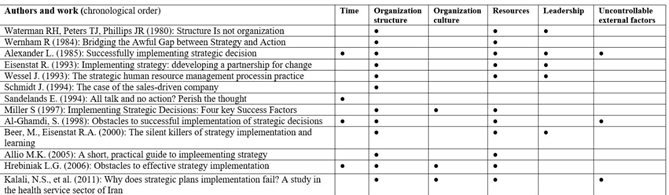
Issues in Strategy Implementation (Source: Valentina Ivančić, Faculty of Economics, University of Rijeka)

Critically, organizations need to stop thinking along the lines of everything is knowable and get used to less than concrete concepts that do not fit in with arbitrary yearly budgets, targets, or hurdle rates that have nothing to do with the future sustainability of the business. The cone approach from the Future Today Institute is a good starting point.


Source: Amy Webb, Future Today Institute

Appendix – tools and links

Market Orientation Scale

Relationship Between Knowledge Management (KM) and Marketing: impact on profitability

There is always much discussion about the role of KM, marketing and other so called support functions in traditional organizations/knowledge intensive industries, and how they impact firm performance and profitability. I highlight knowledge intensive industries as now the OECD classify the health industry as part of this group and the fitness industry is closely related. Those providing health and fitness related services can be classified as knowledge workers as the ‘product’ delivered is in the main the knowledge (both tacit and codified) that they deliver to customers. Managing knowledge workers then requires a different mind set as the intellectual capital of the firm walks out every night a facility closes its doors. It seems only a few years ago that senior executives had to be convinced to allow all staff to have internet access! That seems ridiculous now but then so is the idea that KM and marketing are functions that can be relegated to back office when it is in fact knowledge that the firm actually sells. It is also interesting to note the relationship between KM and marketing. There has been very little research on this issue. In some of the anecdotal conversations I’ve had with professionals, many have thought that knowledge is the internal domain of the firm that has nothing to do with clients whilst marketing, as usual, was about sales/promotion and hence wasn’t related to KM.

However, research sheds some light on this issue. Jenny Darroch and Rod McNaughton published a paper in the European Journal of Marketing (2003) that is the only study I am aware of that attempts to map the space of KM and marketing and their impact on innovation. The research is very interesting, but first a quick definition of terms:

  • KM – ‘a process that creates or locates knowledge and manages the sharing, dissemination and use of knowledge within the organization. When knowledge is used, learning takes place, which in turn, improves the stock of knowledge available to the firm’ (Darrach and McNaughton, 2001).
  • Marketing (as I mean it) which is a market orientation – ‘market orientation is the organization wide generation of market intelligence pertaining to current and future customer needs, dissemination of the intelligence across departments, and organization wide responsiveness to it’ (Kohli and Jaworski,1990)…and
  • ‘a business is market oriented when its culture is systematically and entirely committed to the continuous creation of superior customer value’ (Slater and Narver,1995).

Now, take a close look at the marketing definition. It is both a culture and set of behaviors that generates and shares market based information (about clients, competitors, and the environment). What you can actually see is an overlap in the KM and marketing domains since marketing is, at least in part, about the generation and sharing of knowledge about the market. From the KM definition, knowledge used about marketing would mean that learning has taken place about delivering greater value to clients. This seems intuitive but since most senior executives need convincing that KM and marketing are beneficial, the insight here is quite profound. In the study cited above (Darroch and McNaughton, 2003), the authors found that those firms with both a strong knowledge orientation (KO) and market orientation (MO) outperformed other firms in terms of both innovation and financial measures. The authors concluded that a MO was actually a sub set of a proper KO and led to superior performance.

So how does this play out in real life? The figure below identifies the relationship between KO, MO and performance. The research cited above, and in fact, over 200 studies show a similar linkage. MO and KO both influence innovation and impact firm performance directly. These factors have been shown to explain 30-50% of the variance in performance between firms. KM and marketing should not be considered back office or support functions, they should be considered front and centre as the key drivers of firm performance. Whilst we should be concerned about causation vs correlation and the Halo Effect, the interrelationships are still helpful.

What this highlights has been apparent long before Covid, apparent in other ‘black swan’ events such as the 2008 financial crisis. During times of crisis, the majority of firms cut back on ‘marketing’ as they conflate marketing with promotion. This hollows out marketing capability from a value perspective making it even harder for the organization to take advantage of any recovery in the economy. The other problem is the role that marketing actually plays in the strategic direction of a company. Most marketing people do not have a seat at the C level and are pigeon holed into tactical marketing activities such as producing brochures or other collaterals. This is a sure fire way for the voice of the customer to be mitigated in the strategy process. The status of KM is even worse. Whilst you may not need a dedicated KM person (and most firms do not have one), you do need a KM strategy and process. It is not an accident that leading knowledge intensive firms have dedicated internal practices for KM (see for example KM at McKinsey https://www.thecasecentre.org/main/products/view?id=75981 or KM and AI insight by Deloitte here).

Knowledge based strategies need cultures that have a strong market and knowledge orientation. This means that culture is no longer some mystical hard to grasp concept. It is something which is both operational and concrete. We know what a high performing culture looks like – we just need to actually start doing. Strategy is action, not declaration!

Whitepaper: What if Apple Makes a Treadmill: or doesn’t!

This is both a love story and a murder mystery. Whoever Apple decides to buy is going to swoon, the opposite is going to be true for the one that they don’t. Someone is likely to be the Nokia in this story. COVID may have accelerated the fitness industry’s focus on ‘digital’ and content in the last year or so but these trends have been going on for some time…download the full white paper

Playing to Win – the bible of strategy, should it be in your organization?

Published by HBR Press in 2013, Playing to Win (A.G Lafley and Roger L. Martin) has become the de-facto strategy handbook in many organizations.

I have also come to learn that it is indeed the go to guide used by many firms in the industry I work in (maybe why we all tend to look alike)!! To be clear, I like many aspects of the book and minds far greater than mine laud its usefulness and impact on strategic thinking. My critique is more how the central tenets of the book have been misinterpreted or misapplied.

The foundations of the book are based mainly on the positioning school of strategy popularized by Harvard professor Michael Porter (kicked off by his book Competitive Strategy in 1980). His firm, Monitor Group, was also the lead consultancy that worked with P&G when Lafley (a co author of Playing to Win), was CEO. Hardly surprising then this is the school of strategy adopted by P&G and what is described in the book.

Although I did my doctoral studies in business, this article will not be full of references or have the academic rigour some may expect, it will be opinion backed by alternative views from different knowledge bases. One of the advantages of doing an MBA from a 2nd tier school in the UK is exactly the opposite of doing an Ivy league MBA (see this damning article in Bloomberg from ex Harvard professor Shoshana Zuboff), I am exposed to different lines of thinking, namely systems thinking and cybernetics. These ideas along with the writings of Ralph Stacey and Milan Zeleny have greatly influenced my thinking.

Blown to bits – not really but a criticism of the superficial adoption of the books core message!

Let’s hope my confidence (some may say over confidence, a few may say arrogance) in addressing the weaknesses of the books core message is not subject to the Dunning Kruger effect…you be the judge.

To me, there are two stand out factors that hit you hard when reading this book. Firstly, P&G is obviously a consumer goods company and the stories are based on these experiences. Secondly, the authors hit you hard right of the bat that strategy is choice. Choice means trade offs which are the antithesis of knowledge based strategies.

Consumer goods

Let’s address the consumer goods company piece first. P&G sells undifferentiated products, as simple as that (many will argue I know). Like the perfume or beer industry, the vast majority of consumers couldn’t tell the difference between one product or another without the branding and packaging that envelop that product (and all the advertising that goes with it). The way P&G differentiates its products is through image differentiation.

This means they can spend inordinate amounts of money on promotion to ‘position’ the product in your mind without any real differentiation (see the excellent book by Al Ries and Jack Trout: Positioning) which is essentially what they did with Oil of Olay. You try doing that in the B2B world selling hardware or manufacturing equipment. Differentiation in this world is based on tangible elements that customers can actually ‘touch’ and define including product performance, after sales service, ROI, etc.

The other issues related to the stories told in this book is that they suffer from narrative fallacy (forcing links between events to make sense of these events) and hence the halo effect. In his superb book (The Halo Effect), Phil Rosenzweig identifies a number of delusions with popular management books and research. He calls this the delusion of connecting the winning dots. By looking at one data set, that of P&G, and explaining their success through the strategy processes they undertook, corrupts the data from the very start. Attribution is easy in hindsight when you are successful. Let’s not forget that Lafley wasn’t so successful in his second time around at P&G.

Strategy as choice – the positioning school

The book does an admirable job of bridging the gap between the traditional concepts of the positioning school and those more closely associated with the resource based view of the firm. They do this by addressing core capabilities and the activity systems that support them. The problem I see is that the discussion and framework in the book still sticks to a deterministic view of linear decision making more suited to stable environments. Again, if you have a broad view of approaches to strategy this is not an issue, it is the issue of how it is adopted by managers.

One of the central tenets of Playing to Win is that strategy is about choice. Choices about where to play (segments) and how to win (capabilities needed). This follows the prescriptions of Porter that strategy can be derived from an analytical process that identifies a few unique positions in the market (generic strategies, 5 forces) which a firm must then align towards. This trade off, as identified by Milan Zeleny (Strategy as Action: from Porter to anti Porter, International Journal of Strategic Decision Sciences, 2010), originates from the ideas of Pareto optimality. He goes on to say: ‘this is not efficiency…but a marginalization of the customer”. The danger of pursuing some competencies at the expense of others is those neglected competencies atrophy and all advantages are temporary.

In addition, ignoring all the issues of cognitive biases and indeed cognitive capacity, these assumptions clearly have underlying problems.

  1. The environment is knowable – the term VUCA (volatile, uncertain, complex, ambiguous) has been thrown around to the point of ubiquity but it doesn’t make it any less relevant. Many industries are facing significant upheaval and the fitness industry (the one I work in) is most likely on the edge of severe disruption if big tech continue their drive into health and fitness (Apple+, Amazon Halo and health care, Google and Fit Bit). Do managers really feel in an unknowable environment that they have all the information they need to drop on a few choices?
  2. The future – strategy has various timelines addressing the short, medium and long term. Clearly the future is unknowable and hence if you don’t think differently as Gary Hamel says, the future will always arrive as a surprise. In her recent book How to Navigate the Future, Margaret Heffernan gives a dizzying array of examples of how different types of professions and artisans rely on learning and emergence to envisage the future, not analysis.
  3. Strategy is top down – although not explicitly identified in the book, the strategy process described is a positivist one that seems to ignore the employee element. Not only does an exec team not have the monopoly on intellectual capital, in today’s dynamic environments, how can those at the top believe they have all the processing power needed to devise a viable strategy? Not only does this defy common sense, it also defies what is known as Ashby’s law of requisite variety (Ross Ashby, a British cyberneticist and systems thinker). Complexity requires equal complexity in dealing with it. That requires the collective intelligence of the whole organisation. That then requires a shift in mental models and culture, something not even addressed by the positioning school. Although not a book about strategy, the work of James Surowiecki in his book The Wisdom of Crowds, is well worth a look in terms of collective decision making.
  4. Strategy is exempt from strategy – in their 2015 book (Your Strategy Needs a Strategy), Reeves, Haanaes, and Sinha identify that strategies themselves need a strategy. They identify a strategy palette with 5 approaches: classical, adaptive, visionary, shaping, and renewal. The approach you take will depend upon the environment you are in. According to the authors, analytical approaches such as those espoused in Playing to Win are best suited to mature stable industries.
  5. Overly prescriptive – limiting yourself to certain segments or capabilities does exactly that, limits your alternative options. Strategy in changing or disrupted industries require an innovation approach often associated with start ups. This may include lean, design thinking and agile approaches. The idea is to test and validate options rapidly whilst allowing you to pivot if the market changes. Resources are not necessarily limited but bought and re-configured all the time.

Alternative views of strategy

Most authors categorize strategic approaches into 4 categories, the prescriptive approach, the emergent approach, the positioning approach (the foundation of Playing to Win) and the resource based view (RBV including core competencies and capabilities). Henry Mintzberg and colleagues go even further and identify 10 schools (in their book Strategy Safari). Mintzberg has been particularly critical of deterministic approaches (such as the positioning school) to strategy and his criticisms are well argued. Some of these arguments are mirrored in my points above.

RBV, cultural, learning and emergent approaches to strategy have a lot to offer. Whereas the positioning school is essentially an outside in top down approach accepting a priori that customers accept trade offs, these approaches are a mixture of inside and outside first thinking. More importantly they don’t take strategy as given but rather something which can emerge from the lower levels of the organization. Not only can the collective wisdom of the crowd outweigh those at the top, involving and listening to those who actually execute strategy has a huge impact on employee engagement and motivation. We know there is an empirical link between these factors and firm performance. In their latest book, Humanocracy, Gary Hamel and Michele Zanini paint a compelling picture of the end of bureaucracy and the need for more humanistic approaches to management. In my view, adhocracy and other self emergent systems are much better suited to the job than typical structures. In fact, toxic ‘strategy’ mechanisms such as yearly budgeting can be eliminated almost entirely by beyond budgeting approaches which involve the concepts of sociocracy.

Source: Zeleny, M. (2010). Strategy as Action: from Porter to anti Porter. International Journal of Strategic Decision Sciences, Vol 1, No, 1).

In the thought provoking book, Surfing the Edge of Chaos, Richard T. Pascale identifies how complexity theory is being applied to strategic thinking. He states in an MIT Sloan piece published in 1999 ‘One cannot direct a living system, only disturb it. Complex adaptive systems are characterized by weak cause-and-effect linkages… treating organizations as complex adaptive systems provides useful insight into the nature of strategic work’. That is exactly the problem with Playing to Win, it assumes cause and effect are given.

In the Lafley and Martin book, they do signify the importance of capabilities as something you choose to leverage based on your strategic analysis. This assumes that structure follows strategy. Again, this assumption doesn’t fit well with a learning approach. On p.115 of the book, the authors discuss a strategy session which leads to the creation of five core capabilities. This description of capabilities not only misses the underlying concept of capabilities as discussed in the RBV, it completely ignores the cultural elements in capabilities. David J Teece (in his book Dynamic Capabilities) identifies dynamic capabilities as sensing, seizing and managing threats/transforming. He also criticizes concepts such as the five forces as being overly static in nature. His ideas highlight the very real need to consider organizational culture in the role of strategy. How can one become ‘capable’ at sensing or transforming if the culture of the organization is insulated, siloed and hierarchical? This is barely considered in the positioning school, if at all.

It is in fact a knowledge, market and learning orientation that have a significant impact on firm performance. It may not be ‘strategy’ as most people know it but if strategy is the ‘how’ and the key source of competitive advantage (in the words of Porter), then in fact your culture is your strategy. If not, then at least we can agree with Peter Drucker when he stated that culture eats strategy for breakfast!

There are numerous examples of organizations that did not seem to have a ‘strategy’ but in fact just had alternative views of what strategy is. I could create a long list but the most well known examples would be the entry of Honda into the US motorcycle industry or the success of Toyota following multiple generic strategies at once. Some may even say that Toyota’s focus on the Toyota Production System was more about organizational effectiveness than strategy, again depending on what your view of strategy is.

To sum up

Don’t get me wrong, Playing to Win has many redeeming points and is a good read. If you understand that what you are looking at is only one part of the elephant then gorge away. What I object to is organizations adopting this book as their ‘play book’ and that this is how strategy should be approached in different contexts and the year 2021 and beyond. To be put it bluntly, it isn’t!

Toyota, Kaizen and the Fitness Industry

The business and consumer world seems to have been truly shocked by the quality problems faced by Toyota over the years and their problematic gas pedal. Over the last few decades, Toyota has become one of the leading car manufacturers in the world with a reputation that is synonymous with quality. Not only has Toyota innovated in terms of manufacturing practices, they have done so in management with concepts such as Total Quality Management (TQM), quality circles, and Kaizen (a word meaning continual incremental improvement). During this time they have become the envy of numerous organizations and touted as an example of best practice in many areas.

Unfortunately, what has happened to them has happened to many successful organizations: success breeds complacency. IBM being another prime example back in the late 80’s and 90’s. Firms that are truly leaders in their field start to believe they can do no wrong and stop listening to the people that really matter. Additionally, the factors that have led to past success (such as TQM, employee involvement, and consensus decision making for Toyota) become core rigidities instead of competencies as the market place changes and new competencies must be developed to maintain success. Large firms are naturally elephants when it comes to being nimble and this is why smaller, niche firms can often steal ground on these incumbents through faster decision making and innovation.

In the world of fitness we can see similar changes, many of these accelerated by COVID but in fact apparent long before that. An article in the Wall Street Journal during the troubled times of Toyota by a former US engineer who worked in Japan with Toyota describes a very salient fact that firm leaders should take to heart. The author of the WSJ piece, Darius Mehri, says:

Although one of the main tasks of engineers at the company was to come up with ways to improve existing product designs, I learned early on that kaizen had a fairly narrow application. It was mainly used to tweak designs to improve product performance. These techniques ensured increased market share for the company because buyers could immediately see the results of the improvements in new models. But some of the most complex engineering design processes—and the ones that tend to fail—are under the hood and out of sight of most owners…In most cases however, kaizen was driven by a fanatical emphasis on increasing market share. This policy had a dramatic impact on the work environment and the way kaizen was applied.

Likewise, the Toyota Production System involved a punishing amount of work for its employees and parts suppliers. Projects required meeting strict design and quality goals with unyielding deadlines. It was not unusual for engineers to put in 16-hour days for several months. I remember one engineer who frequently dozed off at his computer while working on an engine analysis. Working in teams where engineers would help each other with their design work helped but it was never enough. Under conditions of unrelenting overwork, it is simply too hard for engineers to produce products without design flaws and too easy for managers to hide those flaws.

Whilst I have no doubt that many manufacturers and operators in the fitness industry deliver great quality and are probably comparable in many cases, do they focus on the wrong things? As the author of the WSJ article points out, Toyota was obsessed with market share and revenues and this made the focus very narrow. Firms seem obsessed with technical quality but not customer servicing excellence. They are also obsessed with numbers that have little relevance to the future successful running of a firm and judge new innovations or concepts by the same financial thresholds they use for traditional investment.

What is needed is a change of mind set. The demands on organizations are changing. Customer demands are increasing, competition is rife and coming from non traditional sources (think Big Tech). Organizations need to realize that the factors which have created success in the past are limiting the firm’s chances for success in the future. An obsession with numbers is blinding them to the issues that create long lasting success, the main ones being a performance driven culture that is change capable and highly agile.

Strategy and strategic planning – what is it and do I need it?

Corporate strategy, business strategy, strategic planning, strategic marketing, vision, and mission – quick, can you tell the difference between them. OK, perhaps it’s an unfair question but it seems that many writers and consultants use these words so freely and without adequate explanation that most managers probably feel somewhat foolish for not knowing. In reality, many of these concepts are overlapping.

The word strategy comes from the Greek word ‘strategos’ and refers to the art of the general. In modern business, strategy is about considering the longer term future of the firm in terms of what customers you would like to serve and in what markets(and hence those you do not) and how you would like your firm to look, say in 5 years time. Much of strategy is about being effective, making the right choices and doing the right things. Strategy thinking and concepts have gone through a number of progressions in the last 40 years from what could be called highly programmatic and prescriptive schools of thought to views that see strategy as more organic, intuitive, and iterative. The western view of strategy and strategic planning as a yearly activity that in the past (at least in large corporations) was dominated by strategic planning departments (which have all but disappeared) and decisions made being basically fixed, has been infused with eastern concepts primarily stemming from Japanese management that see strategy as an evolving concept based on the unfolding of events. This view of strategy as being both hard and soft is a view that I believe holds most relevance in dynamic environments.

Strategy in Dynamic Environments

In traditional organizations and theory, strategy has been considered the domain of top management and that their job is to strategize and once developed, sell the strategy and get buy in from the rest of the organizational members. There are problems with this type of approach. Firstly, top management are themselves immersed in the day to day management of the organisation and hence have limited capacity to scan and interpret the market. Secondly, an increasing number of industries are driven by knowledge workers, these highly intelligent and independent workers do not take well to what they perceive as an undue top down influence and control. David Maister (ex Harvard Professor), an expert in working with knowledge intensive firms, suggests that organisations take a bottom up approach to strategy meaning that people at all levels have a major say in the strategy process. Senior managers should act as facilitators to ensure that strategy is being taken seriously.

Strategic Planning, Marketing, and Competitive Advantage

Strategy is part of strategic planning and involves the commitment of firm resources that are not easily reversible and affect the long term future of the firm. This distinguishes something which is strategic to that which is merely tactical (i.e. lowering prices). The traditional view of strategic planning is that a company finds a fit between itself and the environment. In essence, the firm would analyze both its macro and micro environment and based on its objectives and capabilities, develop a strategy and plan to create this fit. The problem with this line of thinking is that strategic planning is often thought of as a one shot affair whereby a firm can take a 2 day retreat, and with follow up, create a strategic plan that remains in place and untouched for a significant length of time. However, we know that competitive advantage erodes over time and what was once a successful strategy may no longer be appropriate. Another issue revolves around the involvement of marketing in the strategic planning process.

Take this example:

A mid sized IT firm based in Singapore generates the vast majority of its revenue from domestic sources. Recently, several of its clients have been expanding their business into China and have asked the firm to provide support locally to its international operations. The firm has done this on an ad hoc basis for a while but as competitive intensity has increased in its domestic market the firm is considering internationalization along with its clients as a viable growth strategy.

The kind of questions that the firm should ask are:

  1. Who are appropriate partners in China and how can they help us to provide the needed service to our customers?
  2. Shall we set up an office or develop a network based on independent partners?
  3. What services will the customer need and could we leverage these into business with other firms in the region?
  4. What capabilities will we need to develop to sustain this strategy?

There are all good ‘strategic planning’ questions, aren’t they? In my view, they are but they are also essentially marketing questions as they refer to the value created for the customer. Perhaps in some companies the divide between strategic planning and marketing is acceptable (although I can’t really fathom how) but as firms become more knowledge driven it is simply not viable. The professionals live and breathe a plan everyday in their interaction with customers and other stakeholders. In this respect, marketing and strategic planning questions are essentially the same questions as value created for the customer is at the heart of all strategic management and marketing.

At the heart of strategic management and planning is the creation of a competitive advantage. A competitive advantage is basically a set of superior assets and capabilities that allows your firm to provide customer value that your competitors cannot easily match. For example, the Big 4 have networks of offices on a global basis that allows them to provide seamless services to their clients when and where they need it. Coupled with their ability to enforce high levels of consistency and quality control through myriad independent partners provides them a sustainable advantage which is hard to match. These firms have not stood still however, they are continually re-evaluating the value they provide to clients through new services and continued global reach. The idea is that an advantage does not stay an advantage forever as competitors develop new ways of doing business or play catch up with incumbent firms. The concept of sustainable competitive advantage is depicted in the figure below:

 Competitive Advantage Cycle

(Source: George S Day (1997) Maintaining the Competitive Edge: Creating and Sustaining Advantages in Dynamic Competitive Environments. In Day, G.S., Reibstein, D.J., and Gunther, R (eds) Wharton on Dynamic Competitive Advantage. Wiley)

A sustainable competitive advantage (SCA) is one that gives you a long term advantage over your competitors and cannot be easily copied. It is based upon the idiosyncratic bundles of resources of the firm (known as the Resource Based View of Strategic Management). These resources are the assets, capabilities, knowledge, and business processes of the firm that are combined in such a manner to create core competencies which are essential to continued operations of the firm. According to George Day, the creation and sustenance of advantages is an iterative process with on going demands for investment dollars and management energy and foresight. It is the intangible resources of the firm that are likely to be the most important and lead to the creation of core competences that are distinctive from competitors and hence the basis for SCA. 

In terms of this resource based view of strategic management, firm leaders must consider what competences lead to a SCA and how they can be nurtured and managed for the future. Much knowledge is tacit and hence it is of great importance to codify valuable types of knowledge and imbed these within the processes and structure of the firm. Any organisation will want to consider how the firm learns and accumulates new skills which in turns needs consideration of how incoming work affects the resources of the firm and whether that work is strengthening or weakening the strategic position of the firm.

Conclusion

Strategy is not a one time search for competitive advantage or an annual exercise that is based on a two day retreat facilitated by an outside consultant, it is an ongoing process that realizes positions that are at best temporary and require on going adaptation and innovation. Many traditional strategic management concepts are not applicable to dynamic environments and this article has tried to highlight those that indeed do work in this context and are highly practical. Additionally, strategic management as discussed here is still highly relevant and does contribute to successful performance although defining firm performance is perhaps somewhat more difficult than it sounds. Leaders would do well to take a proactive approach in determining the future of their firm and not rely on external pressures that often force a firm to change when it is already too late.

40 things you should know about strategy and marketing (and no it’s not lead generation, positioning, branding or selling)

  1. Yes, both need your full input as well as the input and buy in of others in the firm
  2. No, you can’t avoid discussing the issues with those above and below you
  3. No, marketing is not sales and promotion, it is about creating a culture that excels at delivering customer value
  4. No, culture is not a gooey abstract that stinks of consultant speak-a marketing culture has the most significant impact on firm performance of any variable
  5. No, you cannot fix your problems by hiring marketing or other admin staff
  6. Yes, your customers do care about service and you should ‘trouble’ them to get systematic feedback
  7. Yes, marketing is everyone’s job, and no, that doesn’t mean promotion or social media
  8. No, one off training courses will not change people’s behaviour
  9. Yes, strategy and marketing are closely intertwined and one without the other is like steering a ship without navigation
  10. No, improving your presentation skills won’t improve your firms ‘marketing’
  11. No, branding is not about a new logo and web site
  12. Yes, branding is about values, mission, strategy etc and involves all people who interact with customers
  13. No, strategy is not about positioning and the ‘five forces model’
  14. Yes, strategy is about value, customers, capabilities, today, the future, and change
  15. No, you don’t need a strategic plan
  16. Yes, you do need a strategy
  17. No, marketing is not a cost, it is an investment
  18. No, you shouldn’t make strategy and marketing decisions without sound knowledge of your internal and external market place
  19. Yes, you should try to measure the ROI on discrete marketing activities
  20. No, you cannot measure the ROI on marketing as whole (the ultimate measure being firm success)
  21. Yes, strategy and marketing initiatives should make a difference
  22. No, planning and execution cannot be separated
  23. Yes, culture does matter in Asia
  24. Yes, marketing and sales need to be integrated
  25. Yes, marketing metrics will tell you how your firm will perform tomorrow, financial metrics tell you how you did yesterday
  26. Yes, strategy and marketing should create differentiation
  27. No, branding, strategy and marketing are not separate issues
  28. No, strategy is not about finding a unique position in the market, it is about being change capable and responsive
  29. Yes, marketing and innovation are empirically linked
  30. Yes, marketing and knowledge are inextricably linked
  31. No, KM is not the sole domain of KM people in the firm, assuming you have any
  32. Yes, strategy and marketing are about learning
  33. No, a SWOT analysis is not the essence of strategy
  34. No, coming up with a ‘strategy’ and then informing your people is not the way to go
  35. No, using an ad agency is not the way to go about a re-branding process
  36. No, the people in your firm probably don’t think as you do and don’t know everything about the firm’s purported strategy
  37. Yes, research is an integral part of the strategy and marketing process
  38. Yes, marketing and collaboration go hand in hand
  39. Yes, if you want behaviour change to align your strategy and marketing efforts, archaic remunerations systems and KPIs must change
  40. No, the people in your firm won’t care about any of this unless you give them a reason to!!!

Innovation, human capital and downsizing: be market driven or be nowhere!

There are two interesting articles, one I read recently and one some years ago. One in Business Insider which identifies those firms that have engaged in large scale layoffs during COVID. Another piece (some years ago in the WSJ) on innovation in the cork industry and how manufacturers of plastic corks have been able to take a big slice out of the traditional wooden cork industry, an industry where wooden corks were so well entrenched that it was inconceivable to the incumbent firms that things could change. These two articles got me thinking about the mass of layoffs recently and the effect on innovation. In fact, there are a number of relationships between innovation, downsizing and firm performance.

There is a significant relationship between downsizing and organizational performance, but not in the direction you might think. Research by Wayne Cascio, a professor of management at the University of Colorado and an expert on downsizing shows that firms which made the deepest layoffs when compared to their peers delivered weaker performance for as long as nine years after a recession. His work was with firms listed on the S&P 500. Other research with fortune 100 firms shows similar outcomes. Those firms which cut over 10% of their work force performed significantly worse than those firms which made smaller cuts. There are in fact a number of approaches to downsizing, some more effective than others. Those firms that simply lay off people without deep consideration of customer value and the systemic impacts of layoffs (such as worsening morale, decreased productivity, and damaged reputations) are the most vulnerable since the expected cost savings never materialize. The table below highlights a continuum of approaches:

Downsizing TacticCharacteristicsExamples
Workforce reductionAimed at headcount reduction Short term implementation Fosters transition and transformationAttrition, Transfer and outplacement, Retirement incentives, Buyout packages, Layoffs
Organization re-designAimed at organization change Moderate term implantation, Fosters transition and transformationEliminates functions, Merge units Eliminates layers Eliminates products Redesigns tasks
Systemic re-designAimed at culture change, Long term implementation, Fosters transformationChange responsibility, Involves all constituents Foster continuous improvement/innovation Simplification, Downsizing: a way of life

(Source: Cummings, T. and Worley, J (2001) Organization Development and Change (7ed). Cincinnati, OH: Southwestern College Publishing, Inc. p.297)

The firms which look at systemic re-design in terms of culture change and transformation are the most successful because they think about the market when making changes and use a transparent, communicative and open approach. They are focused on improving value delivered to the customer and not just on internally driven cost savings and retaining exec compensation levels. What research shows is that those firms with a high degree of market orientation deliver higher levels of innovation and performance. One can look at this in two ways from a downsizing perspective. Firstly, administrative innovation in terms of downsizing approach (pure layoffs versus systemic re-design) is directly related to market orientation since firms which are more customer focused and market driven are likely to make smaller cuts and implement them in a systemic manner. Secondly, market orientation and human capital have a direct influence on innovation and performance as a whole. If firms make deep cuts they are effectively losing a portion of their knowledge and such knowledge is crucial to the innovation capability of the firm. What you have is double whammy on the firm’s performance. Since the firm has a low degree of market orientation, they use a simplistic approach to downsizing and resort to mass layoffs, the expected cost savings never materialize. The concomitant negative changes in staff motivation and commitment levels and the lost knowledge of laid off staff all contribute to the decreased innovative capability of the firm. The net result is a firm which was already poorly positioned in terms of delivering customer value becoming even worse through downsizing when they expected profitability to improve. It might sound counter intuitive but a substantial body of research shows this to be the case.

The paradox is that COVID has accelerated trends in many industries (such as the digital impact on business) and these firms are needing to innovate and go through some kind of strategic change. I say this is a paradox because a ‘lean’ or ‘right sized’ organization is often one without slack. Slack has been shown to have a significant impact on innovation and performance. So right at the time when organizations need to innovate to remain viable is right at the time they have the least capacity to do so! This short term thinking is one of the reasons many former public company CEOs are happy to go private again. In her insightful new book (Step Up, Step Back), Elsbeth Johnson demonstrates the role that slack plays in strategic change.

Research conducted in Australia (Farrell, M.A., and Mavondo, F.T (2003) The Effect of Downsizing Strategy and Re-orientation Strategy on a Learning Orientation. Personnel Review, 33(4), pp.383-402) found that those firms which approached downsizing from a lay off perspective had a negative impact on their learning orientation whereas those firms which used a systemic approach had a positive impact on their learning orientation. Learning and knowledge are key to innovation and firm performance yet you wouldn’t believe it based on the indiscriminate downsizing undertaken by many organizations.

Time for firms to stop treating people like disposable assets and start thinking about the big picture and the longer term, and perhaps use some of the money they made during the boom years to keep people on during rougher times!

What organizations can learn from drinking beer

Malaysia is an interesting place. The Truly Asia campaign is a positioning strategy they have used for a long time. It signals the country’s features of racial diversity and tolerance. Much of that image was questioned given the high profile case of Kartika Sari Dewi Shukarno who was tried under Muslim sharia law for drinking beer in public some years ago. Found guilty, she was initially sentenced to caning as a punishment. The idea that Malaysia was ‘truly Asia’ has now been shown in the light of day to be a decent image but with little substance to back it up.

This approach to marketing and differentiation is one that is often undertaken by organizations. They develop nice web sites, glossy brochures, and produce high end reports for their customers but fail to back it up with the technical and relational quality that customers value. The truly Asia campaign is typical of a ‘product’ that is based around image but has little substance. Differentiation is a complex mix of firm attributes (such as culture, services, reputation) that is not achieved easily. Most firms are pretty good at creating an image but with little substance. This is why:

  • Don’t call back customers for days
  • Speak in their own language and forget customer is not a technical person
  • Individual professionals don’t relate well on a personal level
  • Firms are not responsive or reliable
  • Firms that are unable to deliver the value they promise
  • Fail to understand their customers industries and unmet needs
  • A culture of mistrust that pervades the firm
  • Fail to innovate and cast of archaic practices such as yearly budgeting
  • Espoused values which are different to values in use

This is not an exhaustive list but gives a pretty good idea of the difference between an image that has no substance and a firm that truly values customer needs and is willing to invest in a culture that works towards delivering the value customers seek. This type of culture is a great source of differentiation and competitive advantage because it is unique and very hard to copy. Superior business models that are made up of the processes, systems, and human capital of the firm are ones that are sustainable. Firms that can create this type of differentiation will always out perform their peers, and more importantly, meet the needs of multiple stakeholders. In today’s environment, making execs happy with their take home pay is woefully inadequate in a market that demands excellence on many fronts. Dissatisfied people, unhappy support staff, and neglected suppliers create a vicious cycle of negativity that will eventually impact a firm’s customers. It may take years to notice in many cases but when it does hit you, the change can be hard to reverse. Employee engagement has a massive impact on firm performance and the delivery of customer value. To achieve a high level of customer value, firms must take into account all their stakeholders and ensure image matches the reality.

Differentiation does not come easily but building image above all else is like building a house of cards, it looks good for a while but the foundation is shaky, when it does come crashing down, it is quick and painful and very hard to rebuild.

What Harvard got wrong: we need a new view of management

There were two fascinating articles in Business Week some years ago from a former Harvard business professor examining the fundamental problems with MBA education and her experiences at Harvard (The Old Solutions have become the New Problems). Given the changes accelerated by COVID this piece is worth re-visiting.

The article was written by Shoshana Zuboff who spent 15 years teaching on the Harvard MBA. She says ‘I have come to believe that much of what my colleagues and I taught has caused real suffering, suppressed wealth creation, destabilized the world economy, and accelerated the demise of the 20th century capitalism in which the U.S. played the leading role’. That’s pretty strong stuff coming out of a former Harvard professor. She goes onto criticize many of the concepts espoused on the MBA under the guise of shareholder value. These concepts include downsizing, re-engineering, outsourcing, etc, which led firms to focus on ‘financialization’ as opposed to innovation and wealth creation through new products and services. I would also add new business models.

According to Zuboff:

‘old rules assumed economic value. That’s why Harvard Business School students have been trained for a century in the “administrative point of view.” The manager’s job was to oversee and control what was inside organization space, or what they were trained to view as “my company.” Everything else was a distraction. The “administrative point of view” reflects a simpler time when business was about selling a product. It teaches you to operate from the perspective of organization space—how to maximize your company’s efficiency and serve its interests. It’s a world of boundaries: who’s inside and who’s out; who’s up and who’s down. It’s a world of producers vs. consumers, my company vs. your company, us vs. them. Business is no longer just about the product. Now it’s about solutions for the individual. Economic value is hidden in consumers’ unmet needs and is released by providing people with the means to fulfill those needs. But in order to release new value, you need to get out of organization space and into the subjective space where individuals live. I call it “I-Space.” This means shedding the “us-them” mentality. Now everyone is an insider’

What she says echoes many of the sentiments of world renowned McGill professor Henry Mintzberg. He has long criticized the concept of an MBA training people to be managers when they have never managed. He also dislikes the top B schools curricula and how they focus on technical functions and skills (such as finance or strategy) and neglect the soft skills and EQ so desperately needed in management. People interested in his point of view could do much worse than to read his book: Managers, not MBAs.

Although the article does not tackle this head on, at the end of the day, you have a model that is unsustainable and even worse, detracts from the thing that any firm should be trying to accomplish: the delivery of client value and satisfaction. As firms now see people as burdens they can’t support, tens of thousands of them have been laid off in the last year or so, precisely the actions that Zuboff (above) was warning against and in the midst of much research that downsizing does not improve performance. It is funny then that as work has picked up again for some, many firms are scrambling back to hire the very people they let go. This merry go round of messing with peoples lives must end!

Now I know that most people did not get an MBA from Harvard but this article highlights insidious forces within most organizations. Firstly, who said that shareholder value was the primary objective of any firm? The well known and outspoken economist Milton Friedman was a vocal supporter of shareholder value as the primary objective of any firm. He claimed ‘the social responsibility of business is to increase profits’. That may be so and I am not here to argue the ins and outs of economics, but surely the objective of any business is to enhance client value and create economic value through innovation. Not only that, but economic value should be based on innovation and not destruction. Within most firms we are sorely lacking an alternative view of capitalism. As Zuboff points out in her article, firms have become so concerned with shareholder value that they have done anything to achieve that without worrying about customer needs, innovation, or longer term viability. What is needed in most firms is an alternative view of capitalism. That view should consider the fact that money is not just made from self interest, cost control, shedding of staff, and seeing who sits on top of toxic performance measures like quarterly results. Money should come from delivering client value.

Managers and executives need to pull their heads out of the sand and realize that customer value is where the action is at. This is a fundamental mind set change about what management is and how firms should be making money. It is a fundamental mind set change as to why firms exist and whether following now extinct paradigms of management is not only a sure fire path to demise, it is a way of life that is undermining organizations, their workers, and our society in general. Until organizations realize that economic value lies in the interconnectivity of all our actions together they are doing themselves, their people, and their customers an injustice.