The metaverse and Web3 are related but distinct concepts. According to Forbes magazine in an article from Feb 2022, Web3 is a decentralized internet which is built on distributed technologies like blockchain and decentralized autonomous organizations (DAO) rather than centralized on servers owned by individuals or corporations. The metaverse on the other hand, is really, at the moment, a shorthand for virtual worlds, where users can interact with each other and engage with apps and services in a far more immersive way. The term “metaverse” first appeared in Neal Stephenson’s sci-fi novel Snow Crash, where it described a virtual reality world.
Numerous brands are now creating some type of immersive experience in the metaverse (MV) such as Gucci, Ferrari, Adidas, Nike etc as well as fitness brands many in the industry would be familiar with such as Stages, Trib3, Go24, and Gym Aesthetics. Gym Shark was another using the MV for virtual meetings and recently Bill Gates predicted that all remote meetings will be held in the MV.
Below is a sampling of the types of categories of experiences brands are offering in the MV.
Brand/Entity Example
Experience Offered
User Outcomes
Main value proposition and other examples
Roblox
Online gaming platform and virtual world
Users can create and engage in games created by others. It is free to play plus there are in game purchase using the Roblox NFT called Robux. It has over 160m users and also acts as a platform for other brands to create experiences such as Nike Land
Gaming platform Gdevelop Hiber Flowplay Epic Games Unity Second Life
Nike
Nike Land – broad range of brand experiences including socialising and using avatars
Using the Roblox platform, Nike claims some 7m visitors since Nov 2021. Users can move across Roblox platform, interact with avatars, engage in activities, receive NFTs and interact with celebrities and Nike products (sold US$3m of NFT sneakers in 6 mins)
Virtual World/Platform Disney Decentraland Selfridges Hyundai LV Spotify XiRang
Gucci
Gucci Garden – a virtual experience of the brand’s heritage
Users can experience the brands philosophy and buy limited edition virtual goods such as bags, sneakers using Robux (Roblox NFT)
Brand Experience Coca Cola Christies Ferrari Planet Hollywood NBA Vatican
KPMG
Collaboration and HR processes
Using virtual spaces (some even digital twins) for meetings, training, and other collaborative needs
Collaboration and Training BMW, Peugeot Havas Group Shell ErsteBank Bosch Japan Airlines
Balenciaga
Partnership with gaming
Partnered with Epic Games. Created branded in game accessories, store, and ads
Gaming Tie Up Wendys Microsoft Tommy Hillfiger Clarks
Fashion Week
London fashion week virtual experience
With only 50,000 IRL attendance, fashion week had some 250,000 attend in the MV
Events Crypto Fashion week Fabric of Reality Justin Bieber Snoop Dogg Manchester City
McDonalds
Virtual goods
Offering virtual food and drink as well as downloadable files such as audio, video, and NFTs
E comm Balenciaga Selfridges Warby Parker Amazon Room Decorator
STEPN
Move to Earn (M2E)
Offering rewards for physical activity in the form of in game currency. Running on the Solona blockchain, users purchase sneakers on the app that fit with their exercise type
Gamefi – M2E, P2E Dotmoovs Genopets Step Olive X Wirtual
Clearly the MV has moved beyond its often-stereotypical description of a gaming platform (using some kind of VR and/or AR). There are a number of potential avenues for firms to explore ranging from experiences to pure e comm plays (and a host of options in between). A digital Gucci handbag sold for over $4000, more than the real version and over 45 million people saw Travis Scott’s show. Hardware that includes AR and VR will continue to grow with Statista stating that global shipments for these devices will reach over US$75m by 2024. Depending upon which source you look at, there are some 400m unique monthly users, the vast majority (over 80%) are under 18. This is an interesting fact when one considers you often need a digital wallet to engage and legally you need to be over 18 to buy and sell crypto. This number is probably skewed by the dominance of gaming on the MV as we see a continued growth of major brands entering.
According to JP Morgan:
Every year US$54b is spent on virtual goods, almost double the amount spent on music
60b messages are sent daily on Roblox
$80m was paid to creators on Second Life
NFTs have an approx. market cap of $41b
200 strategic partnerships with the Sandbox
Will be interesting to see how this arena develops.
The convergence of fitness and gaming is not really new but the MV takes this to another level. Brands of all kinds are trying to stay relevant to Gen Z etc and the fitness industry is no different. However, it seems that the MV could have much broader applications in terms of target audience and value proposition than just exertainment. This is important for all stakeholders in the industry, from government bodies, to health care providers, to insurance firms, to health clubs as well as equipment manufacturers. Eco system thinking is absolutely the way to think strategically for this industry in both enlarging the pie and getting people to adopt long lasting lifestyle changes. How (and when) you firm and the MV fits into the eco system is the question that should be asked.
At a simplified level, the opportunities to offer MV based wellness experiences seem obvious:
VR based workouts
Health and wellness events
Community workouts using avatars
Workout with friends using VR, AR
Celebrity led workouts
Compete against athletes
Fully immersive gym or facility experiences with music, trainers etc
M2E plays with both digital and real rewards
Gaming tie ups
Play before you pay (trial)
Pay as you go and access based fees
Product marketing
Customer engagement
Brand loyalty through community
Customer education
According to the Welltodo 2022 Consumer Wellness Trends Report, Gen-Z today are more inclined towards gaining a more robust workout experience rather than a usual fitness regime that offers core fitness mantras. Since the older ages of Gen Z are now in their mid-late 20s and will garner significant purchasing power, it is a segment worth targeting as part of the tailwinds driving MV use. However, as discussed earlier, the potential of the MV to impact the wellness eco system is much greater than just varieties of exercise gamification and rewards.
According to Dwivedi and colleagues (International Journal of Information Management, 2022), the potential for organisations to adapt their business models and operational capacity to function on the metaverse is significant, with transformational impacts on marketing, tourism, leisure and hospitality citizen-government interaction, health, education and social networks. For individuals that choose to interact with the metaverse in the future, the seamless nature of the transition between physical and virtual and the multimodal enhancement of experiences and interactions, opens an endless scope of possibilities, many of which perhaps beyond our current comprehension.
Real World Use Cases of the Metaverse (Source: BCG, How the Metaverse will remake your strategy, 2022)
According to BCG, a third phase of the MV is underway, a broader ecosystem is developing thanks to continually expanding and faster connections. It is seeing monetization through crypto ecosystems, including the birth and rapid growth of cryptocurrencies (both governance tokens and utility tokens) and economic systems and virtual assets (such as decentralized finance and nonfungible tokens). BCG go on to say that much of this action has been in the B2C arena but the B2B space could be where the majority of value is created. For example, at an operational level they estimate a large retailer could realize a 1.5-2% points improvement in margins from staff on boarding and training, 200-400m upside due to improved ins store experiences, and $500-700m improvement based on better inventory management.
The BCG use cases above are some solid examples of BMI related to a variety of industries. If one looks at this at the individual firm level, there are also clear examples of BMI that would enhance the value proposition received by both consumers and enterprise customers in the wellness industry:
Product testing and experiences
Design thinking at scale with CX tested in real time
Product launches
Massively expanded reach of marketing touch points such as tradeshows
Social support groups – i.e. health care, weight loss
Remote and immersive health evaluations and interventions at scale and in depth
Immersive virtual facility tours
Digital twins of facilities
Virtual real estate and e comm
Product design and digital twins
Facility design and fit out in real time and space using AR and VR
Agile and lean at scale and in real time leveraging XR collaborative R&D
True omni channel experiences and the potential for seamless transition between the real and virtual worlds
Movement of assets across all platforms once interoperability is solved
Content creators – could deploy their content across platforms and benefit from ownership
Training and development
Enhanced collaboration
Payments
Smart contracts
Mass customization
Supply chain transparency and real time tracking
Customer service
Employer branding and internal marketing
From an eco system perspective, the examples are perhaps less obvious but nevertheless still compelling. The organizations that are part of this eco system are many but are mainly; insurers, health care providers, doctors, equipment manufacturers (home and commercial), big tech, digital apps, wearables, drug companies, content producers, trainers, health clubs, corporate wellness, government bodies, industry associations, commercial health and wellness providers, behavioural change companies etc.
Fractionalized payment for IP – wellness journeys created by multiple stakeholders could in theory be managed by NFTs
User journeys based on behavioural science – tying together many existing eco system partners such as insurance, health clubs, gamification and rewards, the potential of the MV to bring this to life is beyond current omni channel options that leverage apps, Web 2 and IRL
Aggregated health data – one of the biggest challenges facing the wellness industry is the scattered nature of health records as well as the fact that individuals do not own nor have full access to their own records. Solving this problem is a major goal for big tech firms such as Apple and Amazon as they target the $10T health industry. The MV could become this single source of truth that could provide true personalisation across all of wellness for users and indeed reward them for their activity with eco system partners. This would have a huge impact on growing the pie and enhancing adherence. Rather than having individual corporations profit from this behavioural surplus (such as Google and Facebook), the balance of power would switch to the individual who could even monetise their data
Interoperability and data sharing – despite all the APIs available, data from different wearables and platforms, data cannot truly be codified and used across multiple platforms. The MV could become the solution to this problem once interoperability is solved
Your MV Strategy
According to McKinsey (2022), these are the key marketing considerations as one thinks about the MV:
Define your metaverse marketing goals – Why do you want to be part of the metaverse? If your brand’s consumers are there, do you want to increase awareness among new audiences, position your brand and generate favorable sentiment, or promote loyalty? Is your goal to spark innovation in your marketing team? For the near term, the primary goal of brands shouldn’t be driving sales directly, since sales of virtual items are still far smaller than sales of physical ones.
Identify the platforms that provide the best opportunity and brand fit – Right now, Roblox, Fortnite, Decentraland, Minecraft, and Meta’s Horizon Worlds are just a few of the metaverse games and platforms out there. Some will be better than others for specific purposes. There is ample opportunity to experiment with multiple platforms to see what works.
Experiment with money-making models – Direct sales may not be front and center on the metaverse right now, but that doesn’t mean brands shouldn’t be thinking ahead and planning to capture the future potential. Direct-to-avatar sales of virtual goods are already a $54 billion market, and some forward-thinking brands are testing different opportunities to generate revenues.
Create, leverage, and partner for new metaverse capabilities – For the metaverse, as for any new venture, brands should assess the skills they will need, identify which they already have and which they must acquire, and appoint someone to lead the development and execution of a coherent strategy to capture value. Brands should also aim to work with and learn from others, including the independent developer and creator communities that are active on the platforms already.
Rethink how you measure marketing success – Measuring the returns on marketing spend is always critical, but the appropriate metrics for the metaverse may not be what you expect. Digital marketing typically focuses on metrics such as the number of visitors, conversions, “likes,” and shares, as well as the cost of acquiring customers. With the metaverse, marketers may need to define new engagement metrics accounting for the unique behavioural economics at play (such as the “scarcity” of NFTs, which are supposed to be unique).
How can we make strategy discussions more about strategic thinking and real discourse rather than innovation theatre and programmatic analysis?
The following is an insightful passage from Adam Grant in a 2021 HBR piece:
The legend of Steve Jobs is that he transformed our lives with the strength of his convictions. The key to his greatness, the story goes, was his ability to bend the world to his vision. The reality is that much of Apple’s success came from his team’s pushing him to rethink his positions. If Jobs hadn’t surrounded himself with people who knew how to change his mind, he might not have changed the world.
For years Jobs insisted he would never make a phone. After his team finally persuaded him to reconsider, he banned outside apps; it took another year to get him to reverse that stance. Within nine months the App Store had a billion downloads, and a decade later the iPhone had generated more than $1 trillion in revenue.
Almost every leader has studied the genius of Jobs, but surprisingly few have studied the genius of those who managed to influence him. As an organizational psychologist, I’ve spent time with a number of people who succeeded in motivating him to think again, and I’ve analyzed the science behind their techniques. The bad news is that plenty of leaders are so sure of themselves that they reject worthy opinions and ideas from others and refuse to abandon their own bad ones. The good news is that it is possible to get even the most overconfident, stubborn, narcissistic, and disagreeable people to open their minds.
He goes on to give a few examples of techniques that can be used to change mind set and behaviour including asking someone to explain how something works, letting that person take the reigns (plant the seeds of ideas but let them develop), find a way to praise the narcissist, disagree with the disagreeable and keep pushing your ideas. In another HBR article from 2018, Tony Schwartz suggests that ultimately, personal transformation requires the courage to challenge one’s current comfort zone, and to tolerate that discomfort without overreacting. He suggests a series of provocative questions to ask leaders and their teams to build a practice around asking themselves:
“What am I not seeing?
“What else is true?”
“What is my responsibility in this situation?”
“How is my perspective being influenced by my fears?”
In the book Thinking Fast and Slow (Daniel Kahneman) as well as the book Noise (by Kahneman and colleagues), the authors highlight the challenges of cognitive bias and noise in the decision making process. Biases such as confirmation bias, anchoring, framing effect etc have a significant impact on decisions. Noise is essentially random scatter of choices and evaluations. For example, people may make different decisions or evaluate situations differently from one day to the next or experts in a field may evaluate a problem or case wildly differently where bias is not the only source of error. These books highlight the very real need for some type of awareness training to uncover bias and sources of noise plus the need for ‘rules’ and guidelines (such as checklists) to minimize their impact. A simple example would be the use of checklists in medicine or aviation that have been shown to have a substantial effect in reducing errors from both bias and noise.
A useful way of thinking about why so many senior leaders believe they know it all despite it being obvious to many others in the organization that the reality they see is not the same as what others see is the Dunning Kruger effect.
The Dunning Kruger Effect (Source: Training Peaks)
Despite the concept being subject to some scrutiny, the ideas are useful. According to Psychology Today, the Dunning-Kruger effect is a cognitive bias in which people wrongly overestimate their knowledge or ability in a specific area. This tends to occur because a lack of self-awareness prevents them from accurately assessing their own skills:
Those with limited knowledge in a domain suffer a dual burden: Not only do they reach mistaken conclusions and make regrettable errors, but their incompetence robs them of the ability to realize it
Those who are the least skilled tend are most likely to overestimate their abilities
Even smart people can be affected because having intelligence is not the same thing as learning and having a specific skill. Many individuals believe their experiences in one area are transferable to another
Confidence is so highly valued that people would rather pretend to be smart or skilled than looking inadequate
To avoid falling prey to the Dunning-Kruger effect, people can honestly and routinely question their knowledge base and the conclusions they draw, rather than blindly accepting them
Individuals could also escape the trap by seeking others whose expertise can help cover their own blind spots, such as turning to a colleague or friend for advice or constructive criticism. Continuing to study a specific subject will also bring one’s capacity into a clearer focus
This clearly has some relevance to what we see in the archetypal western leader who has been brought up on a diet of individualism and meritocracy. This may be even more pronounced in countries such as the US, UK and Australia which according to the research of Geert Hofstede, are some of the most individualistic nations on earth. Individualistic countries tend to place a high value on achieving goals where success is attributed to ‘I’ (my own capabilities). One’s success is also due to one’s own efforts (merit) where a person gets what they deserve. Hence those who have reached the C suite attribute much of that success to themselves whilst believing what got them there will continue to serve them well, despite evidence to the contrary. Confidence is good, misplaced confidence verging on arrogance is not.
The impact of leadership on firm success is a hotly debated topic. I have little doubt that the role of luck and serendipity is vastly underestimated (particularly by CEOs when things are going well but then they can’t wait to jump on the role of externalities when things go poorly – self serving bias). There is also a body of research which suggests firm leadership only has around a 30% impact on company performance. Clearly this is a difficult topic to disentangle and what variables are measured in such research will have a huge impact on the estimated percentage. For example, if you look at discrete leadership decisions as a proxy for strategy then you are most likely looking at big moves that are clearly strategic (i.e. M&A, new market entry etc).
This highlights a major problem with strategy and how it is viewed. The dominant approach still seen today is one that can be described as Porterian. This view relies heavily on an analytical view of strategy development which is essentially the domain of top management. Once the strategy is developed it is then communicated and cascaded to the lower levels of the organization for deployment. Culture is hardly considered if at all. This raises some important questions.
What if culture is strategy? What if the most strategic thing leadership can do is focus on culture?
There are a whole host of iconic brands who failed to adapt to changing market conditions despite clearly being aware of the threat of disruption (Blockbuster, Sears, Kodak, Nokia) and others which could easily have been part of that group but managed to change (IBM stands out). The explanations put forward for these failures is the inability of these firms to become ambidextrous. That is, they failed to balance the demands of exploiting their existing business model whilst exploring new business models which would meet the future needs of a changing market.
Research by McKinsey on over 1000 companies found that cultural lock in and the inability to change was the key reason why organizations do not adapt to market changes. Empirical research consistently demonstrates that culture (in the form of a market, learning and knowledge orientation) has the most significant impact on firm performance. In turning around IBM, Lou Gerstner stated that culture is everything. In transforming Microsoft, Satya Nadella said that the ability of the company to change its culture was the leading indicator of its future success. Even though Lou Gerstner stated the issues facing IBM were not a failure of strategy but of a culture which was no longer suitable for the challenges being faced, I believe Gerstner may have missed an opportunity to affect general business lexicon by clearly placing the cultural school of strategy at the heart of strategy discourse. Instead of saying that strategy failure was not the issue, he should have said that it was IBMs view of strategy that was the problem.
I define strategy as:
‘Strategy is the how. A coherent, integrated set of initiatives and concepts that that will move the organization forward in a unified manner to achieve transient advantage. It is fluid in movement but set in direction’.
Whilst analysis and choice remain important parts of the strategy process, the above definition highlights the importance of integration and ‘how’. This means that managing paradox is just as important as managing choice. How means that development and execution cannot be separated as they are both dependent upon each other. The late Edgar Schein, in his seminal book Organizational Culture and Leadership, claimed that the only thing of real importance that leaders do is to create and manage culture. Since we can define culture very informally as the way we do things around here, it is evident then that strategy and culture are inextricably interlinked as culture determines how things get done, and if they get done! Strategy that cannot be executed is worthless – is it even strategy?
This begs the question: what is the right or best culture? Organizations wax lyrical about culture but are often unable to define what it is in any great detail aside from perfunctory statements related to DEI, innovative, strong, or team oriented. Firms often look for employees that fit their culture without even assessing in any great depth whether they have a ‘good’ culture nor whether bringing in people who do not fit the culture may actually be a good thing as the culture needs changing.
John Kotter (a leading researcher of change and a Harvard Professor), studied whether those organizations with strong cultures outperform those with weak cultures. He found no relationship. Upon further analysis he found that cultures which were strategically aligned (with market changes) and adaptive did show a strong association with firm performance. This is an interesting finding as organizations often tout their strong cultures as a source of competitive advantage but it is in fact these very cultures that become core rigidities in times of change.
Culture is not some ethereal feel good nice to have. It is concrete, measurable and operationalizable in the form of a market, learning and knowledge orientation. These orientations identify the behaviours that form the how of strategy and provide the backbone to being adaptable and change capable. Whether you agree that culture is strategy is not important. What is important is understanding that addressing organizational culture is so fundamental to strategy success that it cannot be ignored or considered a side issue.
The term thought leadership was coined by Joel Kurtzman in 1994. He was the editor of Strategy + Business and he used the term to designate those thinkers which had contributed significant new ideas to management.
Thought leadership is defined by the Gartner Group as:
“The giving—for free or at a nominal charge—of information or advice that a client will value so as to create awareness of the outcome that a company’s product or service can deliver, in order to position and differentiate that offering and stimulate demand for it.”
I personally do not like this definition. Thought leadership certainly should provide information that is valuable but it does not need to link to a firm’s service offering. As a form of content marketing, thought leadership should demonstrate in depth knowledge of an industry or business matter that will help position a firm as an expert. Whether that is definitively linked to a product is not the key issue. The key is to produce materials that clients and potential clients will find of real value and start to think of you as both an expert and resource in that subject matter. By integrating thought leadership into your overall marketing strategy, one can then strengthen relationships with clients and other stakeholders and lead to the trusted advisor status that many professional service firms (PSFs) desire.
I define thought leadership as:
“The provision of valuable and differentiated insights to targeted audiences that creates a position of leadership perception for the delivering firm with the view of strengthening client relationships over the medium to long term”
Thought leadership is one of the most effective ways for a firm to position itself as an expert in their sector. Unfortunately, its use has proliferated among firms in recent years and hence it becomes that much more important to have something valuable to say and distribute it in a world where social media is such a key channel.
The ‘Business Case’ for thought leadership
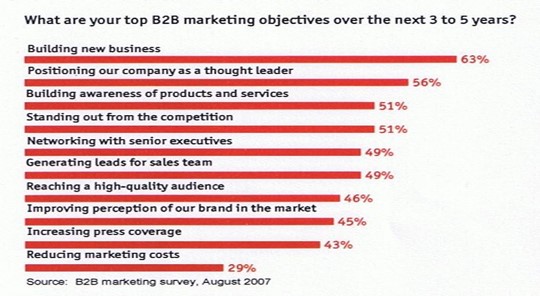
There is little doubt that in the B2B market, buyers are becoming much more informed and discerning. Traditional methods (sales meetings, advertising) of marketing communications are losing their luster in reaching and influencing target audiences. According to a study conducted by the Economist Intelligence Unit back in 2008 (EIU, Megatrends in B2B Marketing), both buyers and sellers are moving towards vehicles that are well positioned for the marketing of content. Fast forward 15 years and content is still a crucial part of a B2B marketing strategy. According to Hub Spot, 80% of business decision makers prefer to get their information on a company from an article with some 80% of C suite executives using social media as part of their purchase process.
One way firms can differentiate themselves is through a strong thought leadership programme that is integrated into the firm’s overall strategy.
(Source: Economist Intelligence Unit)
Thought leadership content vehicles
White paper
Blog
Op ed pieces
Conferences
Speaking
Media quotes and commentary
Podcasts
Books and other publications
Videos
Social media conversations such as LinkedIn, Twitter etc
Newsletters
Lobbying
Take a point of view
The market place is cluttered and clients will automatically filter out information that does not grab their attention. Aside from providing valuable information, it is crucial to take a point of view. Having an opinion will stimulate people to think and gives added credibility in the process of positioning your firm as an expert in a particular industry or subject matter.
Integration with overall marketing strategy and firm culture
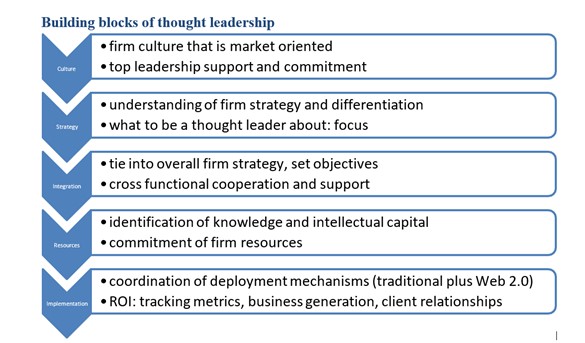
Strategy should come before your thought leadership programme. One needs a thorough understanding of how your firm is differentiated, what your key target markets needs are, and the opportunities in the market place. There is little point in creating a thought leadership platform that goes off on all directions and has little focus. If your firm does not have a clear marketing strategy in place, get one, and then think about how a thought leadership strategy ties into your firm strategy and what you should be writing and talking about.
Identify what your competitors are doing in terms of thought leadership and what they are talking about. Identify areas where you see opportunities to do something different or better. Remember that creating a thought leadership strategy and programme takes time and will not result in instant ROI. Make sure you have the resources to deliver insight of real value and ensure that your people are given the time and support in developing their thought leadership.
Is a thought leadership strategy right for you?
Not all firms will want to dominate their marketing activity with a thought leadership strategy. There will be cases whereby a firm may wish to put its resources in to other areas to build and maintain contact with clients and other stakeholders. Firms that may fall into this category include those with:
Lack of resources to develop and distribute material
Lack of in house experts who can credibly produce material or speak at events
Lack of interest among seniors who are happy using existing client relationship activities
Firms that do not have a clear overall strategy and end up doing ad hoc activities
Lack of acceptance in alternative marketing channels such as social media
Lack of support and commitment from top management
Whilst there are many firms adopting a thought leadership strategy, there are just as many who are not. Some of these may fit the conditions cited above but still produce good results because they have a general commitment to marketing excellence and a firm culture that values customer relationships, which are built through various activities.
Marketing your thought leadership
We seem to be moving from a world where content is producer generated and distributed to where it is user generated (found) and shared. McKinsey, probably the leader in thought leadership strategy as a business development tool has something like 2 million regular readers of the McKinsey quarterly, over 450,000 Facebook fans, and around 600,000 followers on Twitter. You Tube is now one of the largest search engines on the internet where esteemed journals such as the Harvard Business Review have their own page with over 600K subscribers.
There are various channels for distributing your thought leadership, both paid and unpaid with email still being the most popular according to various pieces of research.
(Source: Hub Spot)
(Source: Marketing Profs)
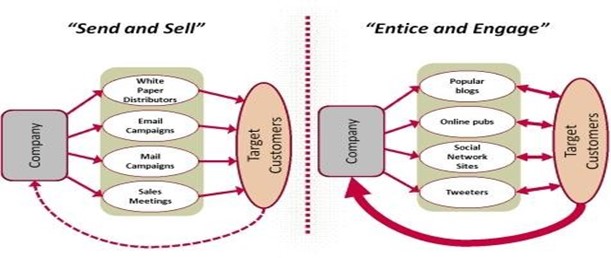
According to the Bloom Group in the US, we have moved from an age where thought leadership vehicles such as white papers have moved from a send and sell model to one that is ‘entice and engage’. This is depicted in the diagram below.
(Source: The Bloom Group).
The key concepts in this figure show that rather than target clients being pushed materials through traditional promotions, target clients will actively seek the information they are interested in through social media activities. This is a two way conversation where clients can choose to engage the producer of thought leadership materials and the producer can have meaningful interactions with target clients and influencers.
Whilst I am not convinced that traditional means of thought leadership marketing (see for example the research cited above) are far less effective than social media vehicles, it is absolutely imperative that your firm accept a social media strategy as part of your integrated promotional efforts. It is very important to note that social media is a two way conversation, do not just send out your materials as thinly veiled advertising attempts. Spend time on understanding the media, who the influencers are, and what is being talked about. Engage, listen, and interact, don’t shout!
Strategy and tactics of thought leadership
Every firm will have certain competencies that enable it to deliver superior customer value, or at least it should. Thought leadership is as much a match of these competencies to your overall strategy as it is about writing and delivering content. strategy in place.
At the heart of strategic thinking is the idea of your value proposition. What is it about your firm, its people, your structures/systems, industry/subject expertise, and services, that truly enable the firm to differentiate itself in the market place.
Just as importantly, identify who are the influencers and opinion leaders that have the ability to sway the decision making of potential customers and what are they looking for both in terms of content and how you deploy that content. Just because one particular vehicle may not reach a specific target client does not mean it is ineffective in reaching influencers. That is the underlying strength of social media. Once you have the strategy in place, you are well positioned to start building a thought leadership strategy and programme.
15 Questions to ask yourself
Do you have something to say?
Will you provide valuable and insightful information for key audiences?
Can you deliver on a consistent basis through various channels and vehicles?
Can you set clear objectives for the outcomes?
Do you have the right firm culture?
Do you have the intellectual capital and can you package it in a compelling fashion?
Is your firm leadership fully committed?
Is a thought leadership strategy right for you?
Can your team be trained to research and write about key topics or will you outsource?
Do your senior team really understand client needs and their businesses, will they learn?
Do you have a clear and consistent business and marketing strategy?
Can you adopt the concepts of social media and Web 2.0/3.0?
Can you integrate your deployment methods?
Will you measure and track the ROI and in what way?
Can you accept the impact of thought leadership in the market place takes time
In his book Practice What You Preach (published by the Free Press in 2001), David Maister studied a number of professional service firms and identified nine factors that, if firms lived and breathed these statements, explained over 50 percent of the variation in firm performance. These nine statements were:
Client satisfaction is a top priority at our firm
We have no room for those that put their personal agenda ahead of the interests of the client or the firm
Those who contribute most to the overall success of the firm are rewarded the most highly
Management gets the best work out of everybody
Around here you are required, not just encouraged, to learn and develop new skills
We invest a significant amount of time in things that will pay off in the future
People within our firm always treat others with respect
The quality of supervision on projects is always uniformly high
The quality of the professionals in our office is as high as can be expected
When you take a close look at these statements, you notice how much they have to do with leadership and the building of a market driven firm based on knowledge. Maister was quick to point out that these statements were not just rhetoric but were values that each employee lived and breathed in their daily work, including the senior partners of the firm, hence the title of the book.
His findings are even more relevant given the hard times many firms are facing given the global economic slowdown and the mass of layoffs and other cost cutting measures we have seen. Leaders at these firms are under increasing pressure to walk the walk and become ethical managers. However, given the findings of some recent research on being able to ‘practice what you preach’ this is not easy. In a paper published in Psychological Science and profiled in Strategy + Business, researchers found that power was linked to hypocrisy. Using a variety of experiments, they concluded that powerful people display a greater inconsistency between what they practice and what they preach than their counterparts with less power. In other words, people in positions of authority are less likely to do what they tell others to do and based on the findings of David Maister, this could have significant implications for the leaders since they have a disproportionate influence on others inside the firm and we all know that actions speak louder than words.
The message for senior leaders within an organization is clear, if you expect certain types of behavior from your people (such as those listed in the nine statements above), you better be prepared to carry these through yourself in order to maintain your credibility.
There has been so much written about why organizations fail to change despite the warning signs being clear and present. Certainly the remnants of organization theory (such as Taylor’s Scientific Management or Max Weber’s Bureaucracy) have a major role in the way firms are led today as do MBA courses and what is taught (shareholder value as the holy grail). Henry Mintzberg (Professor of Management at McGill) has said that management is much more a practice than it is science. He also states that shareholder value has nothing to do with human values, ‘it’s got nothing to do with decency, it’s got nothing to do with anything but greed’. He is not alone in this view.
An article in Bloomberg from a former Harvard business professor examining the fundamental problems with MBA education and her experiences at Harvard (The Old Solutions have become the New Problems). Shoshana Zuboff who spent 15 years teaching on the Harvard MBA says ‘I have come to believe that much of what my colleagues and I taught has caused real suffering, suppressed wealth creation, destabilized the world economy, and accelerated the demise of the 20th century capitalism in which the U.S. played the leading role’. She goes onto criticize many of the concepts espoused on the MBA under the guise of shareholder value. These concepts include downsizing, re-engineering, outsourcing, etc, which led firms to focus on ‘financialization’ as opposed to innovation and wealth creation through new products and services. I would also add new business models.
According to Zuboff:
‘Old rules assumed economic value. That’s why Harvard Business School students have been trained for a century in the “administrative point of view.” The manager’s job was to oversee and control what was inside organization space, or what they were trained to view as “my company.” Everything else was a distraction. The “administrative point of view” reflects a simpler time when business was about selling a product. It teaches you to operate from the perspective of organization space—how to maximize your company’s efficiency and serve its interests. It’s a world of boundaries: who’s inside and who’s out; who’s up and who’s down. It’s a world of producers vs. consumers, my company vs. your company, us vs. them. Business is no longer just about the product. Now it’s about solutions for the individual. Economic value is hidden in consumers’ unmet needs and is released by providing people with the means to fulfill those needs. But in order to release new value, you need to get out of organization space and into the subjective space where individuals live. I call it “I-Space.” This means shedding the “us-them” mentality. Now everyone is an insider’.
In the classic article, On the Folly of Rewarding A, in the Hope for B (Steven Kerr, Academy of Management Executive, 1975 and updated 1995), the author gives an array of examples from different fields that encapsulates even today the majority of issues with change initiatives and the way companies are run – ‘it’s the reward system stupid’! The below examples, in my opinion, cover 90% of the issues most organizations face:
We hope for long term growth, but reward quarterly earnings
We hope for teamwork, but reward individual effort
We hope for challenging stretch objectives, but reward making the numbers
The ideas here echo many of the challenges discussed above in terms of exploit vs explore. Organizations need to get used to running paradoxical thought processes, and hence ambidextrous organizations, and turning these into integrated management practices. For example, dual roles managing the business of today vs the business of tomorrow. Extending this concept of dual roles and ambidextrous organizations, Innosight (the consultancy co founded by Clayton Christensen), call this dual transformation. Transformation A is repositioning the business to maximise its resilience whilst transformation B is creating tomorrows growth engine. Historically, it has always been managers that play the game and run the business of today that have more clout than those who are often considered pie in the sky thinkers (innovators).
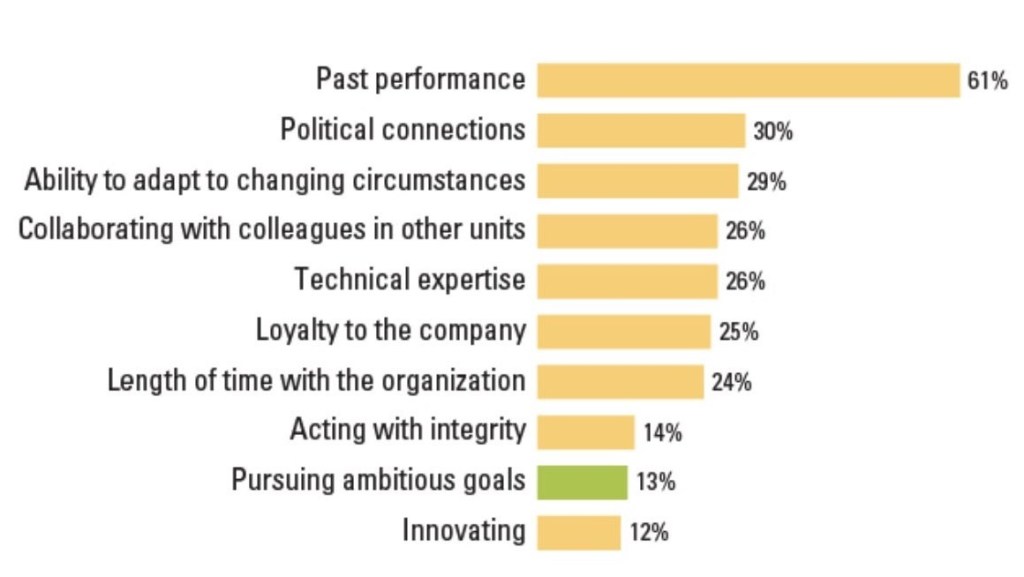
How to Get Promoted (Source: Sull, D., and Sull C (2018) With Goals, FAST beats SMART. MIT Sloan Management Review, June)
In an era of shareholder returns and the holy grail of managing lag indicators (such as earnings) fueled by toxic ‘strategy’ mechanisms such as yearly budgeting processes, the time is here for a re-think for most organizations. The elements of a high performing culture are a market, knowledge and learning orientation. As Peter Drucker once said, ‘Culture eats strategy for breakfast’. I will go further. Strategy is the how, it is action not declaration, hence your culture is your strategy as it is the how of achieving objectives.
Leadership then is fundamental as it is leadership that sets the tone and culture of the organization. There is often much more rhetoric than real action within leadership ranks. Even worse, in the language of Chris Argyris (former Harvard professor and author of Overcoming Organizational Defenses), most organizations have huge gaps between espoused values and theories in use (think Douglas McGregor’s Theory X and Y). Political oligarchy has become so entrenched in most organizations that they have seriously failed to tap the collective wisdom of the crowd. According to Mark Bertolini, CEO of Aetna; ‘Creating new business models is a leadership challenge. In order to create those new businesses in any organization, I don’t care how old it is, you have to start to look at what is going to be the operating model that’s going to make that new business commercially viable and sustainable for the long run’.
Relationship between Leadership, Culture, Innovation and Firm Performance (Source: authors own analysis)
By definition, working on BMI means working under uncertainty. The ideas and thinking that got you to where you are today is not the same thinking that will get to where you need to be tomorrow. Traditional strategy processes built on industrial economic thought are much less relevant in a world of competitive arenas, transient competitive advantage, and eco systems. Firms must be cautious not to conflate current digital initiatives with business transformation. In the fitness industry we are seeing a flood of on demand and live content, move to e commerce platforms to benefit from consumer demand driven by COVID, investment in apps etc, but none of this is BMI. According to Leinwand and Mani (HBR, March 2021):
‘Companies need to step back and fundamentally reconceive how they create value. They need to reimagine their place in the world, rethink how they create value through ecosystems, and transform their organizations to enable new models of value creation. The bottom line is companies need to shape their own future, recognizing that the world has fundamentally shifted, and that they must find their purpose in it. If you can’t answer the questions “Why are we here?” or “What unique value do we add for our customers?” then you are likely at best just staying in the game’.
They go on to say that organizations must:
Reimagine your place in the world, instead of focusing on digitizing what you already do. Companies that transform for success in the digital age define their reason for being in terms of the bold value they create for their customers (and their customers’ customers), and why. They take advantage of new technology not to copy what everyone else is doing, but to advance their own missions by investing in the differentiating capabilities that allow them to deliver on their purpose. Filling their new place in the world with life often requires them to shed old business models, assets, and beliefs about value creation.
Create value through ecosystems, rather than trying to do it all alone. Successful companies in the digital age recognize that the way to remain relevant comes from working together with an ecosystem of players in order to deliver the ambitious value propositions that customers want and to quickly innovate and scale up the incredible capabilities that are needed. Operating in this way requires leaders to think about value creation more boldly, question what their organization must truly own, and be prepared to open up to competitors and give up traditional sources of revenue in order to address some of the most fundamental customer needs.
Re-imagine your organization to enable a new model of value creation, rather than asking people to work in new ways within the confines of the old organizational model. Winners in the digital era break up old power structures so that new ideas and capabilities can be scaled more collaboratively. They put in place outcome-oriented teams tasked with collaborating across the organization and work with their ecosystem partners to deliver the differentiating (and often cross-functional) capabilities they need to win.
In traditional organizations and theory, strategy has been considered the domain of top management and that their job is to strategize and once developed, sell the strategy and get buy in from the rest of the organization. There are problems with this type of approach. Firstly, top management are themselves immersed in the day to day management of the organisation and hence have limited capacity to scan and interpret the market. Secondly, an increasing number of industries are driven by knowledge workers, these highly intelligent and independent workers do not take well to what they perceive as undue top down influence and control. David Maister (ex Harvard Professor), an expert in working with knowledge intensive firms, suggests that organisations take a bottom up approach to strategy meaning that people at all levels have a major say in the strategy process.
There are many concepts and tools that can aid in bringing this new approach to life including lean start up, innovators method, agile, design thinking, bossa nova, the fifth discipline, systems thinking, cybernetics, complexity thinking, scenario planning etc. There are some great tools available now such as those developed by Strategy Tools and Strategyzer. Again, without the right culture and structure, none of these are likely to make much impact.
As Steve Blank points out in his frequently cited article in HBR, often organizations know they need to change but play a game of organizational ‘whack a mole’ in a futile attempt to swat every problem that pops up without understanding the root cause. He calls this innovation theatre. He goes on to say that organizations must build a mind set, culture and process that becomes innovation doctrine. In their article (How Leaders Delude Themselves about Disruption, MIT Sloan Management Review, 2020), Scott Anthony and Michael Putz describe the 4 lies that leaders tell themselves including that their organization is immune (we are safe) and that their people are not up to the task. Cognitive bias affects leaders as much as it does anyone else. Assuming people are not up to the task creates a self-fulfilling prophecy. Leaders, and organizations, need to become much more self aware in order to create strategic clarity.
Critically, organizations need to stop thinking along the lines of everything is knowable and get used to less than concrete concepts that do not fit in with arbitrary yearly budgets, targets, or hurdle rates that have nothing to do with the future sustainability of the business.
The idea that marketing is a key factor in superior organizational performance is not new and substantial research now demonstrates that a market orientation is the bed rock of company performance. This has been demonstrated in both manufacturing and service industries including the professional services. However few firms seem to adopt the idea of marketing holistically.
To tackle this issue requires a process that must be undertaken by various parties within the firm. Firstly, marketers need to make clear that promotion is only a very small part of marketing and that a market orientation (note the use of the word market as opposed to marketing-this is not just semantics) is a much broader concept that entails an organizations posture to the market. This includes the type of customers the organization will serve and with what kinds of services, how it will maintain relationships with its existing clients and attract new ones, and crucially, what type of people should the firm hire and how to retain them. One of the challenging aspects of organizations today is that not only are they competing for new customers, they are very frequently competing to attract and retain talent. As one well known professional once put it ‘my most important assets walk out the day and go down the lift everyday’. Senior staff within an organization must take responsibility for the strategic direction of their firm and assign resources to understand and build marketing capability. They must take the lead in communicating the need for a strong customer centric organization and break the resistance and apathy that has so often gripped incumbents by harnessing forces for change.
Marketing is as much a mind set as anything else, it is an organizational culture that should pervade the entire organization and people within a firm should realize that any organization is a customer satisfying entity. Since the ‘re-birth’ of the marketing concept prompted by the writings of such people as Frederick Webster in 1988, marketing has once again been placed as an important consideration for organizational performance, and hence has caught the attention of senior management in many businesses that are typically not considered prime prospects for marketing (such as non profit groups, governmental and quasi governmental bodies, and religious organizations). Even the bastions of the educational sector have taken on board some of marketing’s trappings.
This is good and bad. There is a substantial difference between the trappings of marketing (such as having a person designated as a marketer) and the substance of marketing, which is concerned with the value that is created for the customer. One may use the analogy of promotion orientation and market orientation to gain a better understanding of the difference between trappings and substance.
A promotion orientation takes the perspective that the organization will sell what it has and that persuasive communications are the key to marketing success. This orientation takes an inside out perspective and is a short term tactical approach to marketing that is unlikely to be sustainable in the longer term as customers no longer want to buy what you are selling and in the form you offer it. The trappings of marketing are not necessarily unimportant but in isolation do not make up what marketing is and means.
In contrast, the substance of marketing is analogous to what is known as a market orientation. This is not the same as a marketing orientation and the difference is more than semantic. Marketing orientation places the emphasis for marketing in the function of the marketing department and hence artificially separates marketing activities from the rest of the organization. It also carries the negative associations of the term marketing that so often seem to exist in the minds of organizational members. A market orientation can be defined according to the two seminal works in this area by Kohli and Jaworski and Narver and Slater. These academics (Jaworski is now a consultant at Monitor Group) have done much to operationalize the implementation of the marketing concept in the form of market orientation.
According to Kohli and Jaworski (1990):
‘market orientation is the organization wide generation of market intelligence pertaining to current and future customer needs, dissemination of the intelligence across departments, and organization wide responsiveness to it’ (p.6)
According to Slater and Narver (1995):
‘a business is market oriented when its culture is systematically and entirely committed to the continuous creation of superior customer value’ (p.22)
In addition, Narver and Slater (1990) state that market orientation consists of three behavioural components of customer orientation, competitor orientation, and inter-functional co-ordination.
There are several key points to take from these definitions. Market orientation is both a culture (values and beliefs about customers, a business philosophy) and a set of behaviours. That is, there is a difference between accepting the marketing concept and implementing it. Moreover, the responsibility of responding to market needs falls on the entire organization and not only on the marketing function. Empirical support for the market orientation construct is strong both in Asia and the western world as organizations that exhibit higher degrees of market orientation show business performance levels above their peers. Organization wide action is the key to satisfying customers and an understanding of a customer’s entire value needs is what we mean by the substance of marketing. Trappings count for nothing if you have chosen the wrong value. Customer value migrates and pushing what you have will not provide long term profit driven sustainability. Innovation is a key word and this consists of a combination of market driving and market driven management.
I Marketing Culture – what it looks like
It should be clear now that adopting a marketing culture is not about the marketing function or sales team. It is about a firm wide commitment and adoption of the belief that clients and client value should be at the heart of the firms activities and processes. In other words, marketing is ‘how we do things around here’, it is an organizational culture. More formally, organizational culture can defined as a shared pattern of beliefs and behaviour that are both explicit and implicit.
Research by Morgan, Foreman and Poh (1994) state that the 4 major hurdles to implementing a marketing effort are:
Ensuring all staff are trained in the fundamental advocacy of marketing in satisfying customer needs
Recognizing the need for an integrated marketing approach using grounded market intelligence on which optimal decisions should be made
Firms top management and partners providing a consolidated commitment to marketing
Active involvement at all hierarchical levels in the formulation of marketing plans so that successful implementation can be enhanced
One can see from such requirements it is not simply a 1-2-3- step process, rather it requires attitude and behaviour modification. This highlights the very important fact that instilling a marketing culture is as much a management and leadership issue as a marketing one. One cannot expect a firm wide adoption of the marketing concept without top management support and strong leadership. What firm is going to change its structure to a client centered without it being pushed through by the most senior people within the firm? The lack of expertise can be overcome with outside help as well as the hiring of marketing professionals. These professionals can act as change agents or catalysts for the changes that are needed with the support of top management.
Most successful marketing efforts ensure that somebody within the firm has overall responsibility for the marketing function. This is usually with the appointment of a marketing director or manager. Moreover, adopting a marketing culture requires integration of people and information across the entire firm and at all levels. This will not happen by itself and certainly cannot be the sole responsibility of the marketing department. Another area that comes up is the coupling of marketing and sales. In some firms it is deemed the same thing, in others they are separate departments. Marketing sets the tone for sales. In other words, marketing creates the right culture and sets the strategic direction of the firm in terms of markets the firm should serve and the services it should provide. Once you have a good understanding of these issues the firm should be more be able to sell effectively. Sales without marketing is like shooting in the dark, you will hit your target every now and then but with a huge waste of resources and in the process you will probably upset a number of potential customers by trying to sell them something they neither need nor recognize the value of.
II Firm Structure, Marketing Culture & Performance
As has been stressed a number of times here, marketing is a process and business philosophy that requires a fundamental change in the way senior leaders think and act. In order to fully embrace a marketing culture, a firm must have the right foundations upon which it can act and respond appropriately to the changing demands of customers and the business environment in general.
When one considers the ideas of team based structures or market oriented eco systems one must consider the fundamental change that must occur within an organization for this to be successful. Going back to the initial definitions of market orientation cited at the onset of this piece, it becomes apparent that in order to set up and implement effective teams, a firm must become deeply engaged in target market segments and develop an in depth understanding of the needs of the customers within these segments. However, information collection is only the starting point, generation and dissemination of this information that is actionable and implanted across organizational departments such as product development, service and sales etc will determine whether such an effort is worthwhile. This idea of cross functional coordination is not unusual but is often poorly executed. Overcoming fiefdoms and the idea that my department is my department is absolutely vital if the development of a true marketing culture is to progress. The benefits of using such teams are many. Organizational members share and develop news skills whilst developing a big picture view of their customers business as well as their own. Additionally, the inter functional coordination necessary enhances organizational communication to the point where using market intelligence becomes the basis for decision making and innovation. In essence, market oriented teams become marketing teams and if you can develop the skills necessary to implement such practices effectively, you will have developed competencies that keep you ahead of your competition.
III Conclusion
Marketing and management become strongly intertwined when discussing the ideas of implementing a marketing culture. It is a firm wide effort that as much as anything requires a basic change of attitude amongst firm seniors that must have strong leadership to effect such change. Crossing these organizational barriers is never easy but one will reap the rewards if one is prepared to take the risk. Firm leadership is crucial and in many ways can be described as marketing leadership. Marketing is so fundamental to a firm that thinking of it as something separate or as something you do when business is slow is a sure fire way to lead your firm to extinction.
There are no universally accepted definitions of a value proposition but there are a growing number of tools that can help in the development of compelling value propositions. Rather than try to focus on a single definition the following list of characteristics by Alex Osterwalder provides a solid guide:
Are embedded in great business models
Focus on few pain relievers and gain creators, but do those extremely well
Focus on jobs, pains, or gains that a large number of customers have or for which a small number is willing to pay a lot of money
Align with how customers measure success
Focus on the most significant jobs, most severe pains, and most relevant gains
Differentiate from competition in a meaningful way
Address functional, emotional and social jobs all together
Outperform competition substantially on at least one dimension
Are difficult to copy
Focus on unsatisfied jobs, pains, and gains.
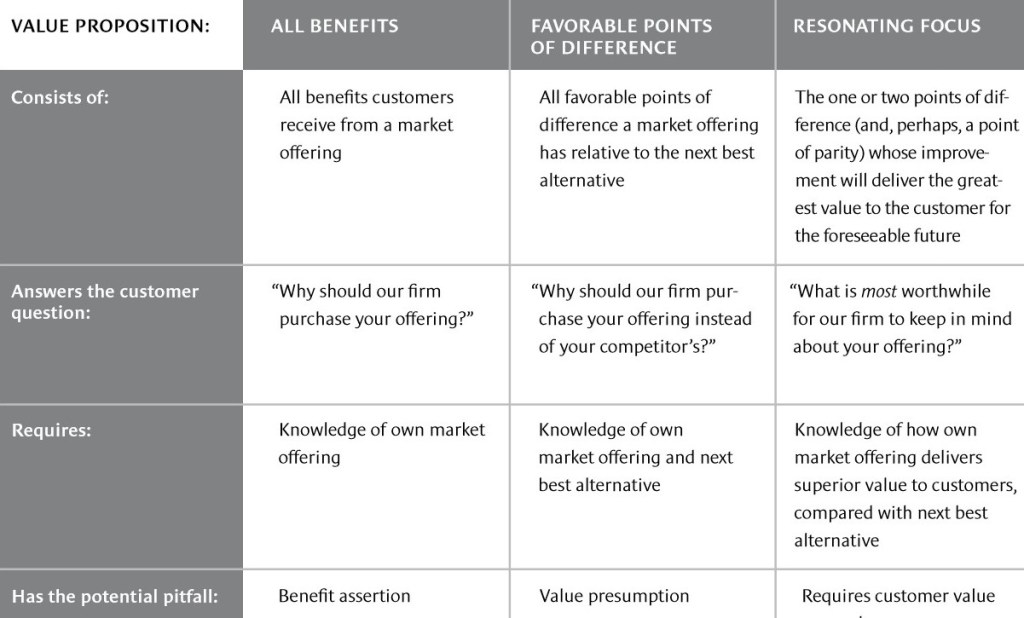
James Anderson and colleagues (in a HBR article from March 2006), explain there are 3 kinds of value propositions which are depicted in the diagram below. They argue that a resonating focus approach is the most compelling and hardest to develop as they require a deep understanding of customer and stakeholder needs. In other words, a problem solving approach.
3 Types of Value Proposition (Source: Anderson, J.C., Narus, J.A., and van Rossum, W (2006) Customer value propositions in business markets. Harvard Business Review, March)
The resonating focus approach helps a company narrow down the value being sought by customers to the most important elements. It may also suggest that different customers within the buying organization have different needs and hence it makes sense to create different communication strategies aimed at different buying centre constituents. For example, a club owner maybe more concerned with capital investment costs and ROI whereas a fitness director may focus on benefits related to ease of use and education support. You cannot cover all these value factors in one statement, but you can customise these communications based on who you are talking to. According to Hub Spot, the value proposition explains how your solution solves customer problems/improves their situation, what specific benefits they can expect, and why customers should buy from you over your competitors. It is not a slogan or positioning statement. Below is what I consider to be the current value proposition (VP) of the major commercial fitness equipment manufacturers:
‘We provide a complete range of cardiovascular, functional and strength equipment to meet all your customer needs. Based on the latest science and advances in technology, our premium equipment is designed to offer the best user experience in terms of biomechanics, safety, and content. Known for industry leading reliability and service, our solutions will make sure your facility stands out from the crowd.’
If this VP sounds generic, it’s because it is. Go to the web site of any major manufacturer, remove the brand name and pictures, and you will be hard pressed to tell one brand from another. If we explore this VP from the perspective of the resonating focus and some of the 10 characteristics above, it doesn’t perform very well. It is most likely the local entity on the ground (such as the distributor or direct office) that forms the bulk of the VP. When thinking about BMI, manufacturers will have to explore in depth how to partner more closely (adapt the BM) to create a more compelling VP across geographies that links the entity and corporate brand more closely together in order to meet the pains, gains and jobs to be done.
Below are a few VPs from traditional manufacturing firms which have adopted BMI using a PSS:
Hilti – Hilti offers holes not hammers. With its Tool Fleet Management System, the company provides guaranteed availability, maximum uptime, with no upfront costs. Customers get access to the best tools whenever and wherever they need them.
Kone cranes – At Konecranes, we are not just lifting things, but entire businesses. We have real-time knowledge of how millions of lifting devices perform. We use this knowledge, around the clock, to make our customers’ operations safer and more productive.
Otis Elevators – Using smart, internet of things (IoT) technology, Otis ONE™ brings you and your passengers the next generation of service. With 24/7 real-time, connected service combined with our foundational historic data your elevator experience will be transformed as you receive new insights. Transparent, proactive, predictive: this is Otis ONE™.
Royal DSM – the new resin addresses the growing market demand for powder coatings that can be cured quicker or at lower temperatures. In particular, the Uralac® EasyCure P 3225 resin can either be cured in just 5 to 6 minutes at 180ºC, compared to the 10 to 12 minutes of market alternatives, or in 12 minutes at 160ºC. In this way, the resin enables higher production output and can help prevent bottlenecks, as well as lowering energy consumption, reducing natural gas usage by up to 30%.
Siemens Health Care – We assist you in reducing risk. We increase machine uptime and increase your profitability.
What is striking about these VPs is how similar they are despite coming from very different industries. They focus on a few key resonating points which act almost as unique selling propositions (USP) whilst aligning with customer measures of success, namely reductions in cost and improved productivity. They are also embedded in strong business models which make imitation difficult. As Didier Bonnet and George Westerman explain (The New Elements of Digital Transformation, MIT Sloan Management Review, 2021), as some firms are still implementing traditional automation approaches such as ERP and product life cycle management, others are moving far ahead by digitally reinventing operations. ‘Thanks to the growing availability of cheap sensors, cloud infrastructure, and machine learning, concepts such as Industry 4.0, digital threads, and digital twins have become a reality. Digital threads connecting machines, models, and processes provide a single source of truth to manage, optimize, and enhance processes from requirements definition through maintenance (p.4)’.
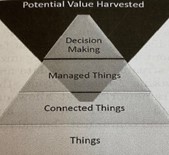
Business Value Realization (Source: Barkai, J. (2016) The Outcome Economy)
If we consider the current status of traditional manufacturers, they are basically at the level of selling things (some with connected things, especially those targeting the consumer market). The VP examples above are much more heavily concentrated on managing things and decision making. That is how they deliver compelling VPs to their customers. Studying what those are doing in other industries is known as analogous research. Other approaches common include stakeholder mapping, customer journey mapping, exploratory research, ethnographic research, in depth interviews, desk research and quantitative approaches.
The VPs essentially address a mix of business, technical and personal value. This idea is very similar to the value proposition canvas (from Alex Osterwalder) which focuses on gain and pain points. We can use this tool to analyse the VP sought by equipment buyers and develop a new BM. The completion of the canvas would involve substantial stakeholder input including customer research.
The Value Proposition Canvas (Source: Strategyzer)
Customer jobs – this is based on the seminal ideas of Clayton Christensen (author of The Innovators Dilemma). The concept is that customers don’t simply buy a product but rather ‘hire’ it to do a job. The classic example he gave was that of a McDonalds milkshake (hired to make the commute to work). For Hilti customers it could be executing contracts and for a firm like Slack enabling real time collaboration (or Zoom, virtual collaboration)
Gains – predictable costs and access to latest tools would be customer gains/needs for Hilti. In the case of remote diagnostics for medicine, customers would gain medical advice at their convenience
Pains – Hilti customer pains (to be overcome by the new VP) would include high upfront costs and risk of project delays. For Slack they aim to alleviate lost and messy communications via long email threads and other channels
Pain relievers – the aim here is to overcome some of the pains. Hilti, for example, offers subscription based services to eliminate high up front costs. Home medical diagnostics reduces the pain of travelling and waiting for medical services
Gain creators – Hilti offers immediate repairs or access to new equipment to ensure near 100% uptime. Slack offers real time project management to enhance productivity together with a fast learning curve
Products/services – the online fleet management system is the core of the solution for Hilti together with their inventory management system for tools. For Peloton it would be the content which leads the physical product allowing customers to access world class training when it suits them in their own home
Some authors have modified this canvas to change the value map to benefits, features and experience whist on the customer profile, the elements are named needs, wants, and fears. Both models are useful and can aid thinking. You should not get hung up on the methodology as the intention is to spur different lines of thought. Aside from using this model for an organization’s own analysis, it can be very revealing to study the BMI of companies in other industries:
Strategy/Company
Caterpillar
Siemens Healthcare
GM
Subscription Portfolio
Smart Machines-wide range of connected industrial equipment CAT connect-onboard sensors to help optimize equipment management and productivity
Laboratory as a Business (LaaB)-consulting services that to help customers achieve business objectives Upgrade services-a suite of software applications expanding the lifespan of equipment and reducing TCO
Maven-a peer to peer rental service that allows GM owners to rent out cars using a digital platform
Transformation Strategy
Acquired Yard Club (a peer to peer rental platform to share and manage heavy equipment
Repositioned digital groups under a head of Digital Enabled Services
Deploy AI-leverage data to help automate and standardize complex diagnostics
Acquired Cruise-a dedicated business unit for development of autonomous vehicles Book by Cadillac-an on demand subscription service that lets users choose from a range of curated vehicles and allows them to change vehicles up to 18x year
Other highlights
500K connected assets
55% of revenue is recurring
Over 150,000 Maven members. More then 5m On Star connected vehicles on the road
Below are some examples of organizational issues (taken from The Outcome Economy by Joseph Barkai) when servicing and maintenance are considered secondary and hence neglected early on which are indicative of what happens in the supply of fitness equipment:
Fault diagnostic tools are unable to isolate the root cause of equipment down to a single field replaceable unity (FRU). This leads to longer repair times, multiple parts being replaced and increasing costs
Service tech is unfamiliar with the configuration of the equipment and does not have the proper service information or parts on hand, resulting in multiple trips
The stage gate approach to product development ‘freezes’ the design before service planners can evaluate the design and improve its serviceability
To overcome using IIOT:
Onboard and remote diagnostics are designed to meet mutually agreed service level agreements (SLAs)
These diagnostics are aligned with hardware modularity, FRUs and part inventory management policies. These allows failures to be mapped to spare parts in country
Remote monitoring and diagnostic systems help maximise the utilisation of tech staff and allows more efficient allocation
Back end systems are designed to take advantage of machine generated data to assist in capturing operations and failure data. This is then used to improve design of existing and new products
Based on all the methods available for the ideation and preparation phases, an organization will start to get a feel for the possible value propositions that could be developed. There is a plethora of customer value models available which can be incredibly useful in delineating what value is to a customer. It is also important to note that customer needs are not always well expressed by customers so a mix of inside out and outside in thinking is required. Together with an iterative process and a big enough pool of on going projects, the firm should be well positioned to explore new opportunities.






 Strategy & Competitiveness