Whilst some forward thinking organizations have adopted marketing as a culture, mind set, and all encompassing philosophy to creating and delivering customer value, far too many still only look at marketing in its most basic form, that of the 4Ps, or even worse, in its most superficial form, promotion.
In this case, when business is in need of a turnaround, organizations engage in many promotional based activities thinking this will help drive revenue etc. This may be the case should a lack of branding etc be the bottleneck restraining organisational change, but in the many cases I see, especially in the fitness industry, this is not the case.
Organisations need to address the underlying issues. This is strategy and marketing.
For operators of health and wellness clubs these are often issues related to poor member experiences which lead to lower levels of member retention, negative word of mouth and hence lower levels of new member acquisition. In addition, the poor member experiences are often a result of a less than stellar culture that creates demotivated and disengaged staff. This can become a vicious cycle of declining internal and external indicators leading to continued poor financial performance.
So, before you try to spend your way into a turnaround, think about the critical issues your firm is facing and get wide spread input from staff, customers and other key stakeholders (open strategy) so you can start addressing the key bottlenecks.
What to know:
Firstly – what marketing is not:
Promotion
Clever logo and new brand name
Run by the marketing/BD people
Something that can be turned on and off according to prevailing conditions
In its entirety, something that cannot be measured using ROI
What it is:
A business process about creating client value
A firm culture that has the most significant impact on firm performance
The guiding force for strategy and strategic management
The bed rock of firm performance (market orientation)
HIIT is a strategy workshop for Health, Fitness and Wellness Operators that provides immediately actionable insight by focusing on your key challenges, what’s happening in the market, and informed diagnosis
With a select team based in Asia, we help you align around the key issues you face and leave you with actionable insight. All delivered in a half day or one day interactive workshop that is impactful and cost effective
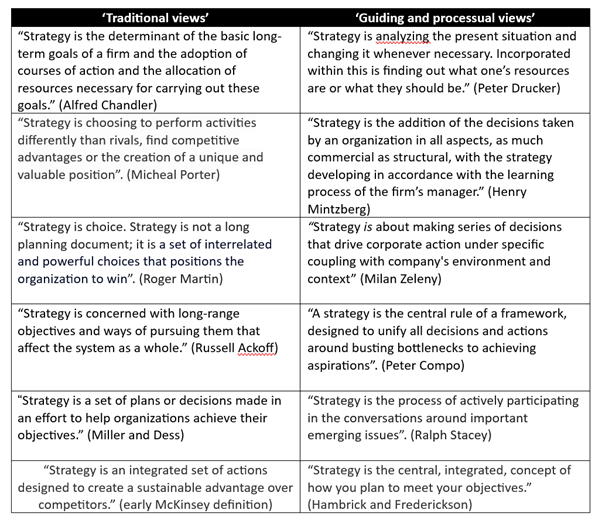
Whilst in many ways this is a false dichotomy (probably more of a continuum), it does highlight the difference between long term deterministic approaches to strategy to those which are more emergent and iterative/agile in nature. The guiding views also stress the importance of addressing critical challenges which are highly contextual. That does not mean that system thinking approaches where cause and effect are more clearly delineated are not useful, it means that you should use the right tool for the job. A strategy must guide but it cannot lock you into an approach which is so rigid as to prevent change. As Dave Snowden eloquently states, complexity allows ontologically incongruent systems to co-exist and that is a major breakthrough. It allows and even encourages coherent heterogeneity resisting the homogenisation of common values and the like that characterises much of systems thinking. My views on strategy in the light of its convergence with marketing (which is both cultural and as set of behaviours) and managing paradox allows for a strategist to hold opposing ideas and still function (to paraphrase F. Scott Fitzgerald). Mental models are central to the strategy process. The decision processes highlighted by the ‘complex’ view stand out as being close to the heart of strategy as organizational culture is the final determinant of what those processes will look like. As I stated at the start of this paper, there is no theory of strategy creation. This suggests that strategy, structure, and execution are not linear but more concurrent in nature. It also suggests that culture impacts strategy to such a significant degree that it MUST be considered as central to the strategy process. If your organization is a top down hierarchical bureaucratic dinosaur then your strategy will be dictated by those pre existing conditions. You don’t need to be a rocket scientist to figure out that the outcome will not be good!
HIIT is a strategy workshop for Health, Fitness and Wellness Operators that provides immediately actionable insight by focusing on your key challenges, what’s happening in the market, and informed diagnosis.
It would seem reasonable that the starting point should be some shared understanding of what strategy is. I can say with a certain degree of confidence that it is NOT planning, budgeting, objectives, first mover advantage, mission, vision etc. Some of these maybe elements of strategy but they are not strategy. Strategy is the how, it is action, and it is doing.
In probably the two most well known discussions of what strategy is, Michael Porter (What is Strategy, HBR 1996) and Hambrick and Fredrickson (Are You Sure You Have a Strategy, Academy of Management Executive, 2005), the authors lay out somewhat different views of what strategy is.
According to Porter, operational effectiveness and strategy work in different ways. He gives the examples of Japanese firms (such as Toyota) which focused on operational effectiveness during the 70s and 80s. As the gap in operational effectiveness has narrowed, these companies which rarely have a strategy according to Porter, have faltered as they don’t have unique strategic positions. According to Porter, strategy is choosing to perform activities differently than rivals do, he uses the examples of South West Airlines and Ikea to demonstrate the concept of strategic positions. Porters approach to strategy is considered to fit into the positioning school of strategy which is essentially analytical in its approach, focusing on industry structure. It is a top down linear deterministic process that supposes structure follows strategy. Whilst offering a number of useful tools for analysis, many consider this strategy process as overly static and rigid in its approach. Something devised and more suitable for another time. It is also hard to link the analysis that Porter suggests to the actual process of strategy making. It should be noted there are at least 10 schools of strategy according to Henry Mintzberg and colleagues (Strategy Safari, 2005).
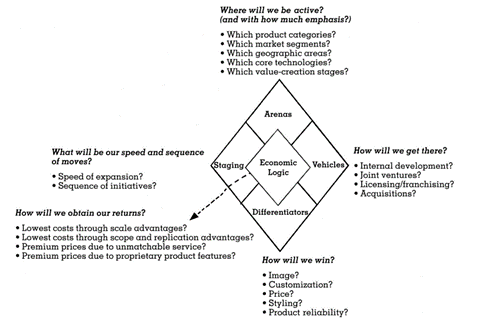
Strategy, in the view of Hambrick and Fredrickson, is a centrally, externally oriented concept of how an organization will achieve its objectives. It is not too dissimilar to the view of Porter but diverges in a few important ways. Firstly, it brings in the view of industry as an arena. A much broader view of industry and akin to the concept of what business are we in. Secondly, the authors identify the importance of competences in creating a competitive advantage, and if those competences do not exist, does the organization have a process for constant innovation and opportunity creation. This fits in with the ideas that competitive advantage can no longer be thought of something which is developed and then defended, but rather that all advantages are transient and hence organizations need to be in a constant state of flux and renewal. This is clearly linked to culture and learning and suggests another view of strategy that is more suited to today’s dynamic environments. In her new book (Seeing Around Corners), Professor Rita McGrath makes a strong case for different ways of thinking about strategy and gives this compelling example: ‘Another great saying from Andy Grove’ – “When spring comes, snow melts first at the periphery, because that is where it is most exposed”. According to McGrath, for people running organizations, this has important ramifications – if snow melts from the edges, how do we make sure we see when this is happening?
Hambrick and Fredrickson provide the below framework for defining what a strategy is.
Based on this analysis, the authors breakdown the go to market approach of Ikea which can be summarized as: offering inexpensive, instant fulfillment furniture to young white collar customers in a new shopping experience format. This is primarily achieved through organic expansion and rapid globalization leveraging and creating economies of scale and efficiencies through replication.
This paper was written in 2006 and it is obvious that Ikea has continued to iterate on its strategy. It has focused heavily on technology to lead digital transformation in the company. It has also expanded its arena beyond the original furniture industry to thinking of itself as a lifestyle company targeting an immensely broad spectrum of the market. What is probably most well known about Ikea is their constant stream of innovation. For example, in a Forbes article from 2018, When asked to describe IKEA’s vision for the future at the recent ThinkX event in Stockholm co-sponsored by SAP and Singularity University, Kristin Grimsdottir responds:
“We are not merely a home furnishing company; we focus on Life at Home and how we can make it better for people. For instance, we’re already helping customers generate their own energy with home solar panels and battery storage options and exploring the area of urban organic farming, so you can grow your own food in your kitchen”.
Ikea is an interesting choice of subject for many strategy writers as they use Ikea to provide evidence (often in hindsight) that clear strategy is developed from analysis, leading to a clear position in the market. That may be the case in hindsight, but the actual story of Ikea is one of much more about learning through trial and error. The same can be said of many organizations such as Dell and Honda.
This highlights an incredibly important point. If strategy is the how, how do Ikea and other successful firms continue to innovate/regenerate whilst others, such as Nokia, could not? I believe that how can be summed up in one word – culture. You can devise the ‘best’ strategic position in the world but if it cannot be executed then it is not strategy – it is another meaningless vision statement that adorns the boardrooms of most organizations. Of course, you could also devise the ‘worst’ strategic approach in the eyes of the market (such as Nokia, Kodak, Blockbuster and many others did) and experience the same failure. Culture permeates strategy in numerous ways, from silos to mental models to personal agendas, it is culture that determines the nature of your strategy process plus the outcome of your strategy (intended or emergent).
David J Teece (in his book Dynamic Capabilities) identifies dynamic capabilities as sensing, seizing and managing threats/transforming. He also criticizes concepts such as the Porter’s five forces as being overly static in nature. His ideas highlight the very real need to consider organizational culture in the role of strategy. How can one become ‘capable’ at sensing or transforming if the culture of the organization is insulated, siloed and hierarchical? This is barely considered in the positioning school, if at all.
The discussion so far has made it clear that rather than some top down driven rational process contingent upon a senior leadership team who has all the answers, strategy needs a new view. One that recognizes the often messy and iterative nature of true strategy making and the need to consider culture and mental models as central to either inhibiting or facilitating positive behaviors/outcomes.
It is in fact a knowledge, market and learning orientation that have the most significant impact on firm performance. It may not be ‘strategy’ as most people know it but if strategy is the ‘how’ and the key source of competitive advantage (in the words of Porter), then in fact your culture is your strategy. If not, then at least we can agree with Peter Drucker when he stated that culture eats strategy for breakfast (the quote attributed to Drucker by Mark Fields from Ford Motor Co)!
Culture is often considered some gooey abstract concept that is some magical property which high performing organizations are able to capture and others not. It may be true that some firms have great cultures and others do not but it is hardly an unknowable or untestable concept. The features of a high performing culture have been clearly operationalized and delineated. Some of these are well articulated in the book by Doshi and McGregor, Primed to Perform or in the numerous books/articles by Dave Ulrich. More is available in the literature on innovation and market oriented cultures.
My use of the word of the market (as opposed to marketing) orientation is very deliberate. There is a substantial difference between the trappings of marketing (such as having a person designated as a marketer) and the substance of marketing, which is concerned with the value that is created for the customer. A market orientation can be defined according to the two seminal works in this area by Kohli and Jaworski, and Narver and Slater. These academics have done much to operationalize the implementation of the marketing concept in the form of market orientation.
In the book Reinventing the Organization (2019), Yeung and Ulrich provide some fascinating insight into market oriented eco systems (MOE) built by firms such as Facebook, Tencent, Alibaba, Google etc. A market oriented eco system, in the view of the authors, is an emerging organizational logic that instead of a firm being organized by traditional divisions (command and control), it is organized along team based structures supported by a platform of resources, knowledge, and skills. The approach integrates a number of theories such as holocracy, boundaryless, agile etc. In my opinion, these types of organizational forms are becoming crucial to deal with the complexity of dynamic environments and rely heavily on the ability to leverage market, learning and knowledge cultures. They also help build these cultures because team based forms are critical to realizing the value of capability driven cultures. Hence structure does not just follow strategy but rather structure influences strategy and culture.
In their latest book, Humanocracy, Gary Hamel and Michele Zanini paint a compelling picture of the end of bureaucracy and the need for more humanistic approaches to management. I believe that adhocracy and other self emergent systems are much better suited to the job than typical structures. In fact, toxic ‘strategy’ mechanisms such as yearly budgeting can be eliminated almost entirely by beyond budgeting approaches which involve the concepts of sociocracy which is very similar to the ideas of the MOE proposed by Yeung and Ulrich.
What happens if I rewrite the Ikea strategy based on the Hambrick and Fredrickson version incorporating the ideas of emergent strategy that come from learning, culture, doing and iterating, including the way their strategy has evolved:
Ikea offers a range of lifestyle choices to sustainability conscious consumers anchored by home furniture as the hub of their experiences. We leverage new technologies and eco systems for instant fulfilment and visualization. This is primarily achieved through a market oriented culture that puts team based structures and innovation at the heart of what we do, creating both market driven and market driving solutions. Economies of scale/scope of learning are now more important than traditional metrics of efficiency.
This definition now shifts the concept of strategy away from unique position to something that is more around unique processes. It also identifies that learning is the centre of competitive advantage since advantage is transient. The vision of Ikea has not been changed but the how of achieving this vison has. It suggests that strategy is not something that comes from yearly strategic planning activities but rather it comes from a continual questioning of assumptions about the beliefs of the organization. Firms need to move from a know it all culture to a learn it all culture in the words of Satya Nadella (Microsoft CEO).
Probably the most well known example of this clash between schools of how strategy is made is the case of Honda entering the US motorcycle market in the late 1950s. It was presented as a classic case of strategic analysis using well known concepts such as cost leadership and the experience curve by the Boston Consulting Group (BCG) in a report submitted to the British Government (who had engaged BCG to analyse the demise of the British motorcycle industry). It turned out, after the original team members sent to the USA by Honda were interviewed at depth by Richard Pascale (when he was a Professor at Stanford University), that their success had little to do with a planned strategy (as that had failed miserably) and had much more to do with learning and serendipity (they had originally planned on entering the market with big bikes but ended up accessing the market with the 50cc super cub).
All this suggests that strategy, structure, and execution are not linear but more concurrent in nature. It also suggests that culture impacts strategy to such a significant degree that it MUST be considered as central to the strategy process. If your organization is a top down hierarchical bureaucratic dinosaur then your strategy will be dictated by those pre existing conditions. You don’t need to be a rocket scientist to figure out that the outcome will not be good!
The danger of seeking a unique position in the market based on traditional analytical approaches is well encapsulated in the thoughts of Milan Zeleny. This trade off, he suggests, originates from the ideas of Pareto optimality. He goes on to say: ‘this is not efficiency…but a marginalization of the customer”. The danger of pursuing some competences at the expense of others is those neglected competences atrophy and all advantages are temporary. Competences are bought and reconfigured all the time.
In the HBR classic by Henry Mintzberg (The Rise and Fall of Strategic Planning, 1994), the author describes how typical strategic planning processes have become strategic programming, the articulation and elaboration of strategies that already exist. For him, strategic thinking is about synthesis, which involves creativity and intuition. This comes from messy informal processes of learning that are carried out by people at various levels of the organization. This then comes back to the idea of emergence in strategy creation. In fact, as Arie De Gues (former head of planning at Royal Dutch/Shell) stated in a 1988 HBR article, the real purpose of effective planning is to change the mental models that decision makers carry in their heads. This is perhaps the most vexing challenge in the strategy creation process.
In summary then, this is what strategy is, and is not:
One of the major challenges in the health and fitness industry is creating long lasting behaviour change. Depending upon which sources you look at, less than 50% of the population meet recommended physical activity guidelines. This number does not seem to have changed much over the years whilst levels of sedentary behaviour are increasing. Although happening long before Covid, the acceleration and adoption of alternative forms of access to exercise (digital apps, home equipment) outside of the traditional gym has shown there is a demand for new types of access. These may have not have had the long lasting impact some would have hoped for as access, time saving etc are only minor limiting factors. The major factors seem to include lack of knowledge, lack of motivation, and lack of enjoyment (the reader is referred to self determination theory for a more thorough review). It seems to me that many of the alternative options that popped up contributed pieces of the motivation puzzle but no one has put this together into what I would call a fully conceptualised wellness journey that leads to long lasting behaviours. This is not to say that the MV will, but it could be a major part of the puzzle in enlarging the overall pie.
Although not specifically related to the fitness industry, Hwang (2022) found in a study of MV users that individual self-determination of the metaverse formed intrinsic motivation such as identification and enjoyment, which affected the intention to continue use, and the trust of metaverse members partially moderated the relationship between self-determination and motivation. The result contributes to the sustainability of the metaverse platform by suggesting an approach to users and the environment to improve the intention of continuous use of metaverse. This is fascinating because moving people from extrinsic to intrinsic motivation is one of the key challenges facing the health and fitness industry.
The study of the impact of the MV on learning and student outcomes is probably more advanced than it is currently in the physical activity realm. Research by Marini et al (International Journal of Interactive Mobile Technologies, 2022) shows that using the metaverse application positively impacts students’ learning outcomes. Students can use the Metaverse app to see better learning outcomes. Students are also more interested in learning and can easily understand and discover new knowledge. In addition, students find it more fun to learn using the Metaverse app, which is a mobile augmented reality. This research is representative of many similar types of research and it is not a stretch to think that if knowledge and autonomy are two major limiting factors affecting an individuals level of physical activity, then the MV could help bridge this gap based on its inherent strengths in aiding learning (often through enjoyment).
Kinesiologists at the University of Minnesota reviewed 15 studies that looked at the impact of VR on physical activity. Among those that looked at physical outcomes such as body composition, fitness level, and muscular strength, two-thirds showed positive results from VR workouts.
Perhaps the more interesting finding comes from the studies that looked at VR’s psychological effects. According to the research, virtual workouts can reduce fatigue and symptoms of depression. This is interesting as some evidence does show that overuse of digital technologies can lead to mental health issues. There then seems to be a role for the MV in combating its own negative impact.
In a study published in 2019 by University of Georgia researchers, they explored the topic whether the use of virtual reality during high-intensity cycling could reduce pain from exercise. The study tested 94 healthy adults, specifically selecting those who didn’t have a high likelihood of motion sickness – one of the potential drawbacks of using a VR headset. The study found that, among those who were exposed to the interactive VR experience, the perceived pain intensity in their quadriceps was 12–13 per cent lower during the second and third sprints compared to participants in the non-interactive group. Meanwhile, cycling performance was the same across the board; pain relief was not a side-effect of reduced cycling performance among those engaged by the interactive VR experience. This should not be surprising to many as immersive GX experiences have been around for a while and even anecdotally it can be observed that levels of perceived exertion are lower than in traditional types of activities.
In a review by Yang and colleagues (Korean Journal of Sport Biomechanics, 2022) it was analyzed that exercise rehabilitation using virtual reality and metaverse games for the rehabilitation of disabled and elderly patients can help improve brain, physical ability, and anti-aging by activating the body and mind. Thomason, in an interesting perspective published in Global Health Journal (2022), explored the potential of token economics and the MV could be used in treating those with chronic diseases.
Whilst clearly not an exhaustive review of the literature, the research cited does hold some exciting implications compared to existing health and fitness experiences. The health and fitness MV seems to hold the ability to span a wide range of audiences and needs despite it often being touted as a young person’s arena. With enhanced capabilities in experiences, learning, connections, community, autonomy and fun – the unfulfilled promise could yet to be fulfilled. A final compelling example is that of iGYM which is an AR system for inclusive play that was created to give young people with mobility disabilities access to physical play activities with their non disabled peers.



 Strategy & Competitiveness