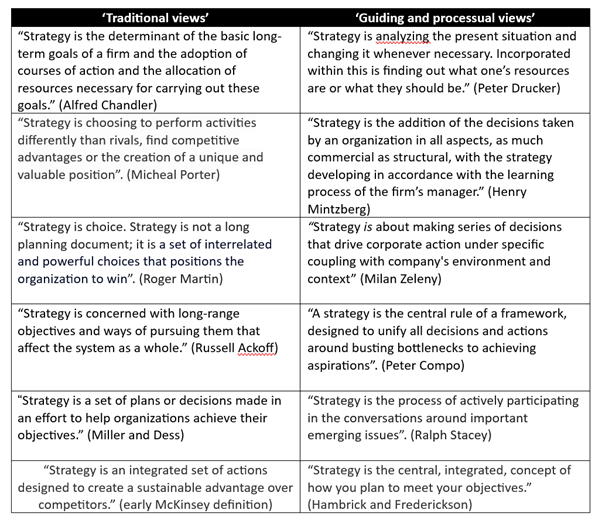
| Whilst in many ways this is a false dichotomy (probably more of a continuum), it does highlight the difference between long term deterministic approaches to strategy to those which are more emergent and iterative/agile in nature. The guiding views also stress the importance of addressing critical challenges which are highly contextual. That does not mean that system thinking approaches where cause and effect are more clearly delineated are not useful, it means that you should use the right tool for the job. A strategy must guide but it cannot lock you into an approach which is so rigid as to prevent change. As Dave Snowden eloquently states, complexity allows ontologically incongruent systems to co-exist and that is a major breakthrough. It allows and even encourages coherent heterogeneity resisting the homogenisation of common values and the like that characterises much of systems thinking. My views on strategy in the light of its convergence with marketing (which is both cultural and as set of behaviours) and managing paradox allows for a strategist to hold opposing ideas and still function (to paraphrase F. Scott Fitzgerald). Mental models are central to the strategy process. The decision processes highlighted by the ‘complex’ view stand out as being close to the heart of strategy as organizational culture is the final determinant of what those processes will look like. As I stated at the start of this paper, there is no theory of strategy creation. This suggests that strategy, structure, and execution are not linear but more concurrent in nature. It also suggests that culture impacts strategy to such a significant degree that it MUST be considered as central to the strategy process. If your organization is a top down hierarchical bureaucratic dinosaur then your strategy will be dictated by those pre existing conditions. You don’t need to be a rocket scientist to figure out that the outcome will not be good! |

 Strategy & Competitiveness