There are a number of ways of thinking about BMI and design (and how to mobilise the company to innovate more broadly) using a variety of lenses including systems thinking, mental models, complexity theory as well as varied schools of strategy thought with a major focus on culture (including learning and knowledge based strategies).
I will focus on some specific methodologies proposed by Amit and Zott (Business Model Innovation Strategy, 2020) leveraging entrepreneurial approaches – that is discovery driven planning and lean start up. These should be considered as complements to other approaches rather than an either or approach.
Discovery driven planning (DDP) was originally developed by Ian MacMillan (a Professor at Wharton) and Rita McGrath (a Professor at Columbia and author of numerous books including Seeing Around Corners). In her article from Long Range Planning (2010), McGrath explains that conventional approaches to planning suffer from a mismatch between the knowledge a firm actually possesses and the knowledge its planning systems assume it possesses. As a firm ventures into new business models, increasing numbers of the underlying assumptions it makes will differ from those inherent in its existing models. In conventional strategic planning, the measure of a plan’s success is how close your projections came to what happened later on. This is nonsensical in a high-uncertainty environment – if you could predict what was going to happen accurately, so could everyone else, and there would be very little advantage to be gained. The goal of a discovery-driven plan is therefore to learn as much as possible at the lowest possible cost, bringing us to the theme of experimentation. DDP is a methodology to facilitate different ways of thinking in established firms. They key steps in DDP are (from Amit and Zott, ibid, and McGrath, ibid):
- Framing – this asks mangers to define long term success and then reason back to figure out what would be needed to achieve that success (i.e. reverse income statement)
- Benchmarking – the business model is benchmarked against competitive models and market demand
- Deliverables and key process metrics – critical assumptions are highlighted such as willingness of customers to pay, competences needed by the organization to implement
- Key check points and parsimony – this is where key assumptions are tested using various methods such as market studies, pilot tests, customer research etc. This resembles rapid prototyping and gives a firm the opportunity to evaluate, pivot, and reject an idea if necessary, with limited resource investment
DDP has many advantages grounded in its philosophy around experimentation and learning. It also leads to evidence based decisions which can overcome the often problematic biases and self serving opinions that surface during the strategy process. One of the major challenges with this approach is that it is in direct opposition to the traditional linear staged gate approach to planning that most established firms take.
The lean start up methodology has many similarities to DDP and other experimentation approaches and is most associated with work of people like Steve Blank (now a Stanford adjunct professor) and Eric Ries (author of the Lean Start Up). The idea of lean is to shorten product development and quickly find a viable business model.
According to de Faria et al (Procedia Computer Science, 2021), the Lean Start Up methodology consists of a scientific, hypothesis-driven approach to entrepreneurship, where entrepreneurs translate their vision (i.e. business idea) into falsifiable hypotheses which are embedded in a first version of a business model. These hypotheses are then tested through a series of minimum viable products (MVPs). From the perspective of business models, this would be the development of minimum viable business models (MVBM).
| Group | Hypothesis |
| Operations/ costs | Can we support customer service needs in a timely and cost effective manner |
| What competences do we have that can be leveraged | |
| Marketing/ market conditions and customer behavior | Is the market ready for a subscription concept |
| Can we market the need effectively | |
| Marketing resources needed are within our current resources | |
| Financial | The market size matches our revenue needs |
| The average selling price per unit covers costs and expected margins | |
| Technology / Capabilities | We have the bandwidth for education and ongoing support for customers |
| Our ERP systems provide the necessary one source of truth | |
| Value Proposition | The concept clearly differentiates itself from other similar concepts in the market |
| The VP will be compelling to customers |
Example Hypotheses (Source: authors own analysis)
Once you have a key set of hypotheses for testing (see examples above), you would consider ways to test and validate these. For example, a firm could do some internal research with the technical and customer service team to see whether they have the resources and expertise to provide the level of service needed under a new business model.
The application of lean to BMI certainly has its limitations and criticisms but overall it provides a structured process to the development of new business models (depicted in the figure below) providing the key benefits of reduced market risk and CAPEX.
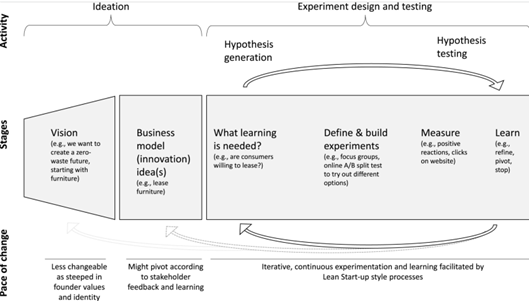
Business Model Development Process, Experimentation, and Lean Start Up in Practice (Source: Bocken, N and Snihur, Y (2020) Lean Start Up and the Business Model: experimenting for novelty and impact. Long Range Planning, Vol 53, No 4, Aug)
One of the most well known examples of BMI and the application of a rigorous process to designing new business models is that of Bosch. The company was struggling with the challenges being presented by IOT and the digitization of various industries. These are the questions that Bosch was grappling with when they decided to create an innovation funnel for their ideas, which would run on evidence rather than opinions. This innovation funnel enabled Bosch to go from 214 unvalidated but interesting ideas, to 19 validated and scalable growth engines. The below figure identifies the Bosch process for BMI.
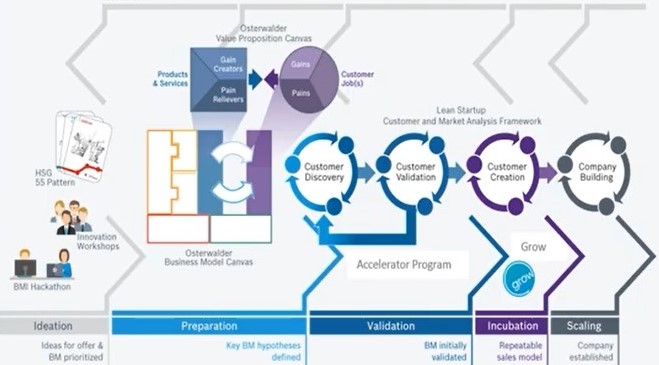
The Bosch Business Model Development Framework
Innovation does not need to be a hit or miss affair nor do you have to bet the house. A well developed process supported by the right culture separates from those who do this well and those that engage in innovation theatre.

 Strategy & Competitiveness