It is not always apparent why organizations choose certain actions and how this affects their marketing and strategic management initiatives, particularly if we consider that the overriding objective of downsizing is to improve operating efficiency and competitiveness.
Downsizing can be defined as;
‘a set of activities, undertaken on the part of management of an organization, designed to improve organizational efficiency, productivity, and/or competitiveness. It represents a strategy implemented by managers that affects the size of the firm’s workforce and the work processes used’ (Freeman and Cameron, 1993, p.10).
However, this assumes some type of comprehensive plan, which may or may not in fact exist. For example, effects on work processes suggests some kind of re-engineering or systemic intervention, whilst most companies have no plan associated with downsizing other than to reduce costs (Blanchard and Randolph, 1996). Indiscriminate downsizing is not an effective approach.
The body of literature on downsizing is both large and varied, having analysed macro and micro level models to explain the causes and effects of the change (Shaw and Barrett-Power, 1997).
Researchers have studied financial outcomes (e.g. Barker et al., 1998; Cascio et al., 1997; Worrell et al., 1991), changes in organizational structure (e.g. DeWitt, 1993; Littler and Innes, 1999; McKinley, 1992), as well as the impact on those who lose their jobs (e.g. Leana and Feldman, 1992) and those who are survivors (e.g. Armstrong-Stassen, 1998; Brockner, 1988; Mishra and Spreitzer, 1998).
Cameron et al. (1991) has found that the most effective downsizing firms spoke in terms of duality, both a short term internal approach, and a long term external approach. This may be so because an effective change model must be customer focused and market driven in its external relations, and process focused and team oriented in its internal operations (Carr and Johansson, 1995). This is a critical consideration. In my view, strategy is less about choice and more about managing paradoxes. In the strategy of downsizing, organizations must maintain a firm understanding of the value proposition they hope to deliver whilst cutting costs all the while remembering that it is human capability that delivers that VP.
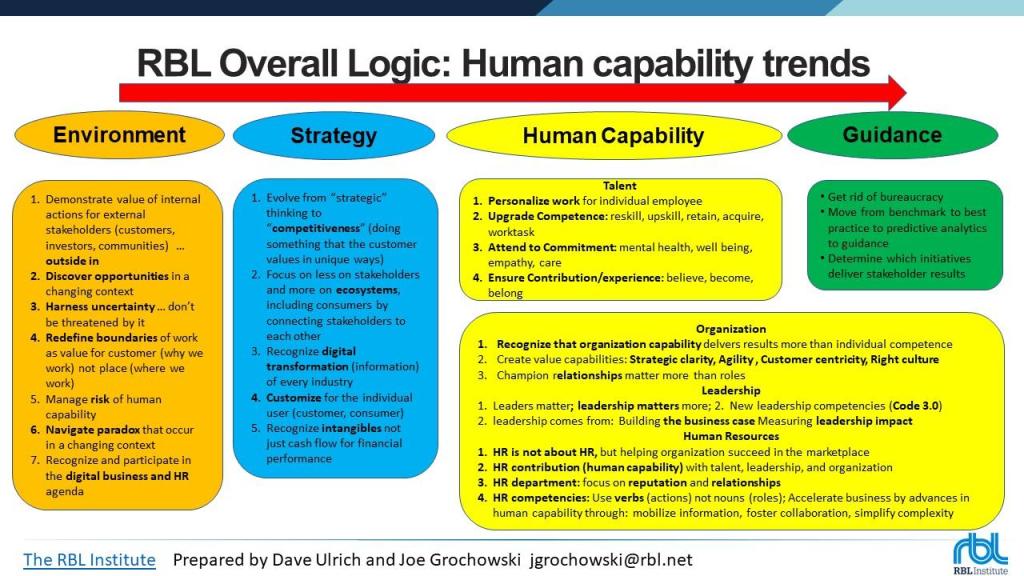
Dave Ulrich (professor at University of Michigan and probably the leading thinker in HR today) has described the future of HR as something much bigger than HR. This means that thinking of people as assets is no longer appropriate. One should be thinking of human capability and how the organization embeds human capabilities to improve performance. Poorly executed downsizing approaches that treats people merely as assets is not the optimal approach needed to improve performance. One needs to take a holistic view of the organization and its environment.
The reasons for different approaches adopted by management are many in number:
- Espoused values and concomitant value structures are one dimension that has been considered by Kabanoff and Waldersee (1995) – there is a significant difference between values in use and espoused values. Every organisation, as part of their mission, claim the importance of their people but it seems very few live those values when the going gets tough. As explained by former Harvard professor Chris Argyris, ‘when it comes to complex issues – issues that can cause embarrassment, or may represent a threat to a person or an organization – espoused theories almost never operate. What does operate is the theory that people actually use, which I call their Theory in Use. These are the theories of action that are implied by our behavior, and they are likely to be unknown to us. We all possess a strong propensity to hold inconsistent thoughts and actions: the difference between espoused theories and theories-in-use applies at the level of national strategies, organizational strategies and small group and interpersonal behavior’ (Rotman Magazine, 2008)
- Perceived features of over supply are another (Greenhalgh et al., 1988) – this is where the organization makes assumptions (right or wrong) about the nature of workforce oversupply in terms of functions, hierarchy, roles, responsibilities, gender etc and how work is performed
- Mutual trust (Mishra and Mishra, 1994) – mutual trust can be both positive and extremely destructive. In the destructive sense, a lack of trust by senior management often leads to unilateral layoffs with little advance communication or consultation. Research shows that early notification and two way communication enhances downsizing success both in terms of those laid off as well as the morale of those who remain. Additionally, firms that engage their employees openly and honestly when it comes to the need to cut costs often find creative ways to achieve this whilst minimizing permanent layoffs. A great example of this is the changes made at the Burzoo
- Culture – probably the most important determinant of approach is organizational culture. Culture can be defined as the pattern of shared values and beliefs that help individuals understand organizational functions and provide them with norms for behaviour. Schein (1992) distinguishes 3 levels of culture including basic underlying assumptions, espoused values, and artefacts. Corporate theories in use and organizational culture are closely linked and whilst underlying beliefs are not visible, management actions and behaviour are, and these can be used to understand the values that are truly emphasized by the organization. It also gives an indication of management worldview.
Wayne Cascio (University of Colorado), probably the leading researcher on downsizing, highlights a number of myths and missteps that strongly impact the success of a downsizing initiative (this section draws heavily on Cascio and Wynn, 2004 as well as Cascio, 2009):
- Indiscriminate downsizing boosts profits – in an extensive study of over 6000 occurrences in changes in employment for firms in the S&P 500 between 1982 and 2000, Cascio and Young (2003) identified several groups of downsizers for analysis purposes:
- Employment Downsizers: Companies where the decline in employment is greater than 5% and the decline in plant and equipment is less than 5%.
- Downsizing by Reducing Assets (Asset Downsizers): Companies with a decline in employment greater than 5% and a decline in plant and equipment that exceeds the change in employment by at least 5%.
- Combination Employment and Asset Reduction (Combination Downsizers): Companies that reduce the number of employees by more than 5% but do not fit into either of the two categories above
- Stable Employers: Companies with changes in employment between plus or minus 5%.
- Employment Upsizers: Companies where the increase in employment is greater than 5% and the increase in plant and equipment is less than 5%.
- Upsizing by Acquiring Assets (Asset Upsizers): Companies with an increase in employment of 5% or greater and an increase in plant and equipment that exceeds the change in employment by at least 5%.
- Combination Employment and Asset Increase (Combination Upsizers): Companies that increase employment by more than 5% but do not fit into either of the other upsizing categories.
The researchers then observed the firms’ financial performance (profitability and total return on common stock) from one year before to two years after the employment change events. The authors found no significant evidence that employment downsizing led to improved financial performance, as measured by return on assets or industry-adjusted return on assets. Downsizing strategies, either employment downsizing or asset downsizing, did not yield long-term payoffs that were significantly larger than those generated by Stable Employers—those companies in which the complement of employees did not fluctuate by more than ±5%.
- Lack of employee input – numerous researchers have found that employee input is critical in downsizing success. Firms must consider both the impact on those who are laid off as well those who remain. Communications should be early and transparent. Negative reactions can be reduced if the underlying reasons are explained clearly and if those reasons are considered valid by the workforce. Seeking workforce input into cost reductions can often lead to alternatives that negate the need for layoffs.
- Using downsizing as a first response – when downsizing is a knee-jerk reaction, it has long-term costs. Employees and labor costs are rarely the true source of the problems facing an organization. Workers are more likely to be the source of innovation and renewal.
- Failing to change the way work is done – firms that cut workers without changing business processes in an effort to become more efficient simply take the same amount of work and load it onto fewer workers. Burnout and stress are typical byproducts of this approach, which does nothing to solve more fundamental problems facing a business
- Understanding damage to company culture – employee morale is the first casualty in a downsizing. When a firm institutes its first round of downsizing, employees’ initial reaction is usually a sense of betrayal. Long-term consequences of altering the work environment include increased voluntary turnover and decreased innovation
According to Robert Reich, ex US labour secretary, the real question is not whether to downsize but how it is done (cited in Mishra et al., 1998). Clearly then, downsizing may well be here to stay. Yet it is an extremely sensitive issue that affects not only individuals and their jobs, but society in general. Therefore, gaining an understanding of downsizing strategies used and what is effective is extremely important if we want to answer questions such as:
- What are the downsizing strategies and processes in use and how are top management developing and implementing these ideas?
- What is the worldview of these managers and do they consider the overall business picture when considering a bout of downsizing?
- Are they ‘qualified’ to play such a major role in the lives of so many people?
- What are the underlying characteristics of the change processes and how can the intended (and reported) actions of top management be reconciled with the views and perceptions of survivors, and how important is this?
- How can a more comprehensive and systemic downsizing plan help an organization and how can it be initiated?
- Is market orientation the missing link in an effective change programme and can it help to produce a model of more successful initiatives?
In addition, Gandolfi (2009) identifies six human consequences of downsizing:
- Downsizing produces considerable human consequences
- Downsizing impacts the entire workforce, victims, survivors, and executioners, in a most profound manner
- Victims generally receive generous outplacement services and financial packages when exiting the downsized firms
- Survivors often find themselves with increased workloads and job responsibilities while receiving little support, re-training, and resources
- Survivors suffer from a range of sicknesses in the wake of downsizing
- Executioners suffer from similar psychological and emotional effects as victims and survivors
Summary
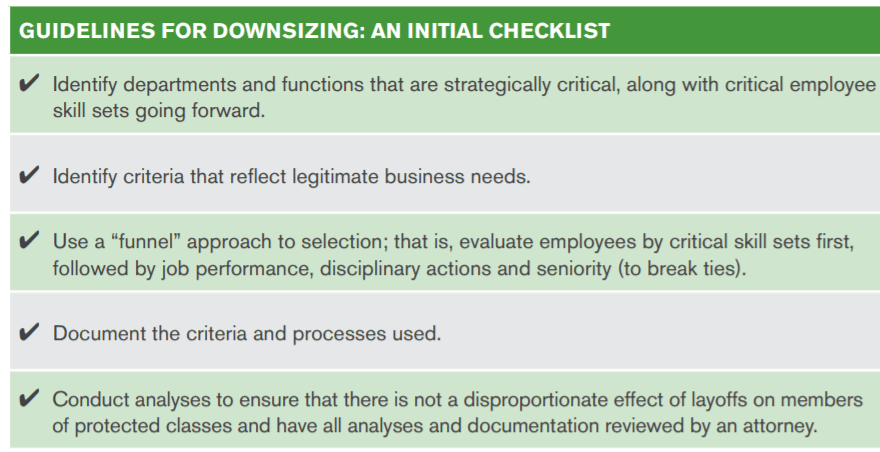
All in all there are a multitude of factors at play when it comes to downsizing, hence it is important for managers to take a systems perspective. As identified in the table on p.4, the best outcomes are those associated with systemic organization re-design where the worst outcomes are associated with pure layoffs. It then seems prudent for managers to turn to the evidence of what works and what does not to ensure many of the issues identified in this paper are avoided. The below tables are both great reference points and starting points when cost cutting is needed and provide a useful summary to the arguments presented here.

(Source: Cascio, W (2009). Employment Downsizing and its Alternatives: strategies for long term success. Society for Human Resource Management).
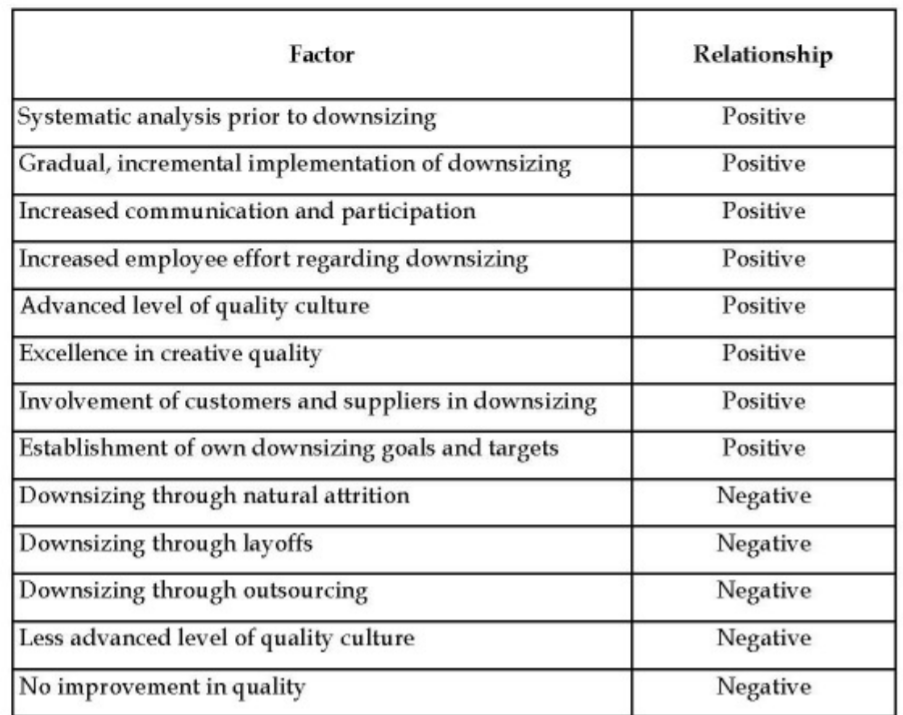
Overall Effectiveness Level of Downsizing Approaches (Source: Gandolfi, F (2010). Organizational Downsizing: a review of two decades of a strategic phenomenon. Sasin Journal of Mgt, Vol 16, No 1, 85-108).
If the reader is interested in how to enrich jobs in the mass market service industry whilst maximising profit they are referred to the ground breaking work of Zeynep Ton and colleagues from MIT (a good starting point: https://goodjobsinstitute.org/wp-content/uploads/2018/03/Good-Jobs-Solution-Full-Report.pdf).
References
Armstrong-Stassen, M. (1998) The Effect of Gender and Organizational Level on How Survivors Appraise and Cope with Organizational Downsizing. J of Applied Behavioural Science. Jun, 34(2), pp.125-142.
Barker, V.L., Mone, M.A., Mueller, G.C., and Freeman, S.J (1998) Does it add up? An empirical study of downsizing for firm turnaround. In D. Ketchen (ed) Advances in applied business strategy. Vol 5, pp.57-82, Greenwich Conneticut: JAI Press.
Blanchard, K., and Randolph, A. (1996) Empowerment is Key to Growth. Executive Excellence, May, p.10.
Brockner, J. (1988) The Effects of Work Layoffs on Survivors: Research, theory and practice. In B.M. Staw and L.L. Cummings (Eds). Research in Organizational Behaviour, 10, pp.213-255.
Cameron, K.S., Freeman, S.J., and Mishra, A.K. (1991) Best Practices in White Collar Downsizing: Managing contradictions. Aca of Mgt Exec, 5(3), pp.57-73.
Carr, D.K., and Johansson, H.J. (1995) Best Practices in Re-engineering. McGraw Hill, New York.
Cascio, W (2009). Employment Downsizing and its Alternatives: strategies for long term success. Society for Human Resource Management).
Cascio, W.F., and Wynn, P (2004) Managing a Downsizing Process. HRM, 43(4), 425-436
Cascio, W.F., Young, C.E., and Morris, J.R. (1997) Financial Consequences of Employment Change Decisions in Major US Corporations. Aca of Mgt J, 40(5),
Cascio,W.F, and Young, C.E (2003) Resizing the organization.
Cummings, T. and Worley, J (2001) Organization Development and Change (7ed). Cincinnati, OH: Southwestern College Publishing, Inc.
Dewitt, R.L (1993) The Structural Consequences of Downsizing. Org Sci, 4, pp.30-40.
Freeman S.J., and Cameron, K.S (1993) Organizational Downsizing: A convergence and re-organizational framework. Org Sci, 4(3), pp.10-29.
Gandolfi, F (2010). Organizational Downsizing: a review of two decades of a strategic phenomenon. Sasin Journal of Mgt, Vol 16, No 1, 85-108).
Gandolfi, F (2009) Where Did Downsizing Go? A Review of 30 Years of A Strategic Business Phenomenon. The Australasian Journal of Business and Social Inquiry 7 (1): 40-65.
Greenhalgh, L., Lawrence, A.T., and Sutton, R.I. (1988) Determinants of Workforce Reduction Strategies in Declining Organizations. Aca of Mgt Review, 13(2), pp.241-254.
Kabanoff, B., Waldersee, R. and Cohen, M. (1995) Espoused Values and Organizational Change Themes. Academy of Management Journal, 38, 1075-1104.
Leana, C.R., and Feldman, D.C (1992) Coping with Job Loss: How individuals, organizations, and communities respond to layoffs. New York, Lexington Books.
Littler, C.R., and Innes, P (1999) How Firms Contracts Longitudinal Study of the Effects of Downsizing on Firm Employment Structures. Paper presented at the annual meeting of the Academy of Management, Chicago.
Mavondo, F.T. and Farrell, M. (2003). Cultural Orientation: Its Relationship with Market Orientation, Innovation and Organisational Performance. Decision Science, 241-249.
McKinley, W (1992) Decreasing Organizational Size: To untangle or not to untangle? Aca of Mgt Rev, 17, pp.112-123.
Mishra, A.K., and Mishra, K.E. (1994) The Role of Mutual Trust in Effective Downsizing Strategies. Human Resource Mgt, 33(2), pp.261-279.
Mishra, A.K., and Spreitzer, G.M. (1998) Explaining How Survivors Respond to Downsizing: The roles of trust, empowerment, justice, and work re-design. Aca of Mgt Rev, 23(3), pp.567-588.
Mishra, K.E., Spreitzer, G.M., and Mishra, A.K. (1998) Preserving Employee Morale During Downsizing. Sloan Management Review, Winter, 39(2), pp.83-95.
Schein, E. (1992) Organizational Culture and Leadership (2ed). San Francisco, Jossey Bass Publishers.
Shaw, J.B., and Barrett-Power, E. (1997) A Conceptual Framework for Assessing Organization, Work Group, and Individual Effectiveness During and Afetr Downsizing. Human Relations, Feb, 50(2), pp.109-127.
Worrell, D.L., Davidson, W.N., and Sharma, V.M. (1991) Layoff Announcements and Stockholder Wealth. Aca of Mgt J. 34, pp.662-678.

 Strategy & Competitiveness