Business models have not been well articulated until recently. It was not until around the mid 2000s that serious research begun into understanding what the elements of a business model are and what types of business model innovations exist. The most well known encapsulation of this concept is probably the business model canvas developed by Alex Osterwalder. There are numerous definitions of business models:
Santos et al. (2009) “Business model innovation is a reconfiguration of activities in the existing business model of a firm that is new to the product service market in which the firm competes.”
Gambardella and McGahan (2010) “Business-model innovation occurs when a firm adopts a novel approach to commercializing its underlying assets.”
Yunus et al. (2010) “Business model innovation is about generating new sources of profit by finding novel value proposition/value constellation combinations.”
Khanagha et al. (2014) “Business model innovation activities can range from incremental changes in individual components of business models, extension of the existing business model, introduction of parallel business models, right through to disruption of the business model, which may potentially entail replacing the existing model with a fundamentally different one.”
What all these definitions have in common is the need for the organization to think about the underlying assets and competencies it may or may not have and buy/partner/reconfigure these to offer new and/or better value propositions for customers.
According to Constantinos Markides (author of Game Changing Strategies), a business model is the sum of answers to three interrelated questions:
- Who should I target as customers?
- What products or services should I be offering them and what should be my (differentiated) value proposition?
- How should I do this in an efficient way?
What is striking about these questions is how similar to they seem to questions of marketing strategy. I have argued in my book, Marketing Professional Services in Asia (Lexis Nexis, 2009), that strategy and marketing are inextricably interlinked and that it is a market orientation that drives firm performance. A market orientation (both a culture and set of behaviors) consists of a competitor orientation, customer orientation, and inter-functional coordination. This is why marketing must have a seat at the strategy table.

Business Model Innovation Typology (Source: Foss, N. J and Saebi, T, J of Mgt, 2017, Vol 43, No 1)
There are various types of BMI that can be categorized according to their scope and novelty.
- Evolutionary – new to the firm and incremental in nature. Consider the way most fitness equipment manufacturers have focused on solution selling which involves education and design offerings to help operators serve their members
- Focused – new to industry without major changes in BM. Examples would include serving new segments or customers that have been traditionally ignored such as offering commercial grade equipment and experiences to the home market
- Adaptive – new to the firm and architectural change. Think about how most manufacturers are now offering on demand and live content through consoles and apps in order to offer new solutions to both operators and end users
- Complex – new to industry and architectural in nature – the most obvious example would be the rush of both operators and manufacturers to offer on line content and buying opportunities (popular buzzwords reflecting this include hybridization and phygital)
None of these descriptions are intended to identify the level of sophistication or value producing potential of any BMI but are useful in understanding what is meant by BMI. Clearly those in the evolutionary or focused category are most likely to work in core businesses which are being exploited whereas architectural changes may offer a more suitable lens for exploring new businesses that may one day become the new core business. Think about how Amazon revolutionized the e commerce market by firstly engaging in complex BMI through the online selling of books then more incremental changes selling DVDs and other commodities. They have since been on a whirlwind of different innovation types in many industries including health care, delivery, and cloud services (AWS). The approach of Amazon sits squarely in the portfolio mind set discussed previously.
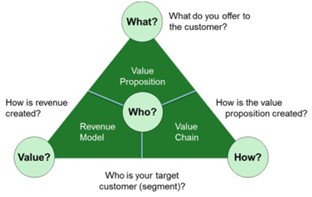
Business Model Triangle (Source: St Gallen Business Model)
There are numerous tools and concepts for analyzing customer value propositions which in turn help you think about BMI. I will discuss these later. For manufacturing firms this has focused very heavily on what is called ‘servitization’. Enabled by the IOT, organizations which traditionally focused on selling hardware and offered some services for free (or at a low fee) are now creating product service systems (PSS) whereby a total solution is offered. Well known examples would include IBM and their success in technology services and Siemens in the health care business. There is a paradox to be managed here. Firms which focus on product innovation and servitization in combination actually experience a decline in short term performance. Research by Visnjic et al (published in the Journal of Product Innovation Mgt, 2014), shows that this happens due to an increase in resource commitment and coordination costs. However, after a few years, firms that engaged in concurrent innovation performed significantly better than those firms which did not. This presents another cultural challenge as senior managers are under pressure to meet short term targets at the expense of the longer term viability of the firm. The rationale for companies to engage in servitization is clear. Recurring revenue business models generate some 8x business value compared to similar organizations with minimal recurring revenue.
According to Ibarra et al (Procedia Manufacturing, 2018), there are three approaches to the challenges and features created by industry 4.0 on business models:
- A service-oriented approach: the need to rethink the optimal mix of product and service business has been identified, since the digital part of a hybrid solution is always a service. The result is the so-called product service system (PSS) concept, a framework describing the integrated development, realization, and offering of specific product-service bundles as a solution for the customer. As a result, suppliers, customers, and other partners become part of a networked ecosystem. Imagine a fitness equipment manufacturer who no longer ‘sells’ equipment but rather sells solutions helping an operator to manage the top and bottom line by managing 100% uptime of equipment
- A network-oriented approach: the horizontal and vertical integration of the value chain and the related interoperability expands firms’ traditional boundaries due to the organization and the stakeholders’ network. New actors arise and the role of existing ones is changing. As a consequence, new ways of creating and offering value through ecosystems that goes beyond individual value chains are raising. Accordingly, traditional manufacturing companies oriented to product sales, feel increasingly compelled to revise their existing Business Models. A clear example would be multi sided platforms with content/solution developers and providers and exercise experiences driven by AI, machine learning and behavioural economics
- A user-driven approach: this context opens up inroads to make manufacturing more responsive to user-driven design and to align it better with customer value creation processes and contexts. From this approach, companies need to develop new capabilities in both, learning more about their customers (using digital capabilities to obtain information about customers, promoting evidence-based decision making, developing integral customer experiences, etc.) and becoming more of an ecosystem beyond individual value chains (become great at building partnerships with new stakeholders). Thus, the Industry 4.0 provides opportunities to create new and more flexible value propositions to respond to customer demands such as the provision of individualized products and even batch-size-line production. In the future, not only will new entrants gather huge amounts of data to offer hyper personalised solutions to exercisers, manufacturers will be able to offer dynamic pricing models based on installation type and usage data. In addition, with the advances in 3D printing and rapid prototyping B2B buyers will be able to go on line and co design equipment in short run batches
There are numerous examples of old school manufacturing organisations that have recognised that hardware is quickly becoming commoditized and differentiation lays in solutions and services. In the manufacturing of fitness equipment, especially cardio equipment, commoditization has already arrived and the points of difference will be service, content, platforms and eco systems. In other words, demonstrate ROI or die!
The below operationalisation of a firm’s business model is one that is very well known and was popularized by Alex Osterwalder.

Business Model Canvas (Source: Adapted from CFI and Alex Osterwalder)
Backstage Disruption – refers to the foundational competencies and assets (configured into capabilities) that support the entire value proposition:
- Key partners – Tesla for example relies heavily on emerging technology provided by suppliers and complementors which helps them scale. Netflix would have a different set of partners including Amazon AWS and media producers.
- Key activities – content production and distribution would be important activity differentiators for Netflix compared to the original incumbent Blockbuster as well as existing movie studio competitors.
- Key resources – for Netflix or Apple then platforms and eco systems are critical resources and very difficult to match due to network effects (scale and scope of learning). One could even claim the personal brand of Elon Musk is a key resource for Tesla.
Frontstage Disruption – this is what is often most visible to the customer in terms of the value proposition:
- Customer relationships – the on demand self service nature of the Netflix service creates powerful relationships directly between the company and end user. Data analytics and machine learning acts as though the platform knows you (switching costs increase). In the B2B world, John Deere enhances relationships through real time data to help customers improve their operational efficiency.
- Channels – omni channel approaches are not new but can be newly defined or reconfigured for an industry. Think how Dell revolutionized computer sales or Amazon in the book industry. One of the benefits of disintermediation is the direct relationship manufacturers can build with customers increasing market sensing and responsiveness.
- Customer segments – Tesla clearly targets a mix of environmental and tech customers, a growing affluent consumer base. Netflix is able to leverage the power of data analytics to create highly specific micro segments to further personalise its offer.
Profit Formula Disruption – here the focus is on capturing value through pricing levels/mechanism and cost structure:
- Cost structure – Southwest Airlines is a classic example of a low cost structure driven by low frills, point to point flying network, and quick turn around times. Dell is another well known example of a company that built deep relationships with suppliers to manage a production system highly reliant on JIT and low inventory levels. However, the bridge between being a low cost provider and differentiator has narrowed in years mainly due to the expectation of customers who demand both competitive pricing and valued features. Toyota is well known for the typical indicators of low cost structure yet with a highly featured product. Other firms increase cost structure to generate higher returns.
- Revenue streams – one of the clearest indicators that your business can be either disrupted or substituted is a transactional revenue stream. Typical manufacturing organizations such as Otis, Caterpillar and Rolls Royce have moved to some kind of performance based pay based on a subscription model. Known as the outcome economy, these firms manage margins and revenue streams based on what they achieve for the customer. Amazon is a good example of a firm leveraging core competencies to enhance revenue stream options (think of the huge investments they made in cloud based infrastructure which they turned into a profit centre with AWS).
The final piece of the puzzle is the value proposition (more likely to come first in your thinking process). In classic marketing terminology there are 4 types of value:
- Functional value – what does your offer do? Netflix offers 24/7 access and unlimited streaming. Rolls Royce charges customers by the amount of time the product is used and the efficiencies it delivers (power by the hour)
- Monetary value – some products such as Apple have a relatively low cost structure but charge a premium price and hence offer little monetary value. Others such as Tesla may do the same but offer monetary advantages to customers in terms of total cost of ownership (TCO)
- Social value – the ability to connect with others has been the foundation of social media behemoths such as Facebook and WeChat
- Psychological value – status driven buys of premium brands such as LV, Ferrari etc are obvious examples. Less obvious examples have been the massive surge in health and fitness wearables which enhance how you feel about yourself
In reality, solutions/products may serve a number of value purposes that could differ by segment or buyer persona.
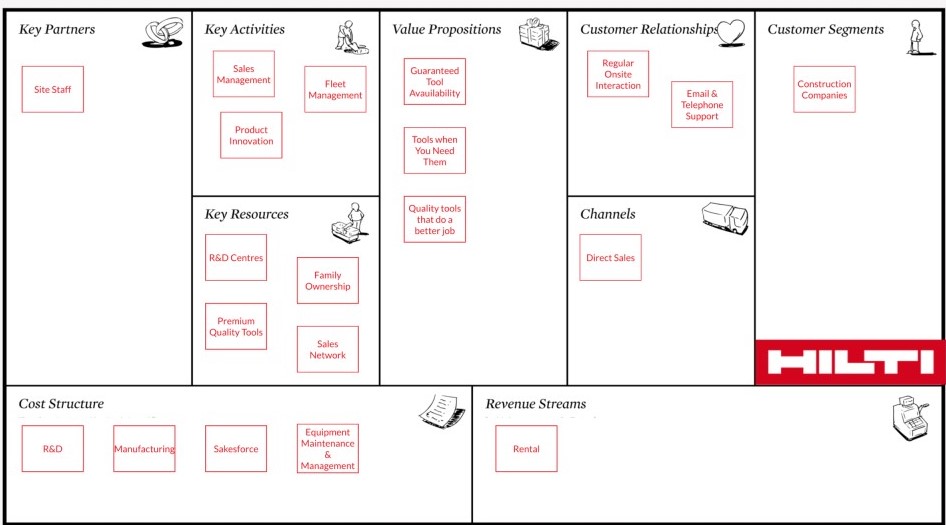
Hilti Business Model (Source: https://www.denis-oakley.com/hilti-business-model/)
Hilti (a power tools manufacturer) is a classic example of a transactionally based B2B seller who recognised the need to shift in light of changing market conditions and competitive pressures. You can see in the above canvas the key elements of the BMI for Hilti:
- Value proposition – shift from selling high end tools to selling ‘holes’. Managing the total solution for the customer from availability at site to guaranteed uptime
- Key activities – one of the most challenging aspects of the BMI was the move to fleet management competencies so their team could coordinate the large number of customer sites where tools were leased and ensure the performance of these tools
- Customer relationships – from mainly selling to crib managers and project leaders, the sales team had to build relationships with the executive level in order to demonstrate the solutions available and their value
- Revenue streams – from one off sales to recurring revenue subscriptions through a leasing model
- Cost structure – investing in fleet management capabilities added significant cost to the BM of Hilti and took some years for the revenue increase to off set this change (this fits in with the research I cited earlier that firms which engage in PSS (product service system BMI) experience a drop off in performance in the short term)
The overall success of this BMI has been dramatic. Hilti has over 1 million pieces of equipment on lease with over 100,000 customers. Almost the entire value chain can be reconfigured based on industry 4.0 technologies including training, recruiting, logistics, invoicing and reporting.
As the CEO of Hilti Dr. Christoph Loos explains “We struggled with many operational challenges in capturing the new contractual obligations in our IT systems (ensuring fleet customers wouldn’t be charged for repair costs, tool pick-ups and deliveries)”. “Out of a finance perspective, it’s easier to sell a tool and to get your money after 30 days than delivering a few hundred tools to a customer and receiving monthly instalments over 4 years while piling up receivables on your balance sheet.”
He goes on to explain further challenges, “a very strong alignment of the executive team at Hilti and staying the course despite internal resistance over a long time period (>15 years). And to allow enough time for the required change management to take hold by scaling it up step-by-step, country-by-country. The approach in each new country to generate initial successes, typically with customers with strong ties to Hilti, with strong senior management involvement and our best sales team members. Their initial success was then used to inspire the rest of the team.”
The Hilti example provides a compelling example of the cultural and structural challenges within an organization moving towards BMI. Imagine an executive team whose KPIs are strongly linked to revenue targets without much focus on lead indicators (such as innovation pipeline). What would be the motivation for them to initiate such a large scale transformation if bonuses were to be severely impacted? It is most likely much easier to overcome these challenges in privately owned firms than those which are publicly listed or controlled by private equity.

 Strategy & Competitiveness