Why, what, and who is thought leadership?
The term thought leadership was coined by Joel Kurtzman in 1994. He was the editor of Strategy + Business and he used the term to designate those thinkers which had contributed significant new ideas to management.
Thought leadership is defined by the Gartner Group as:
“The giving—for free or at a nominal charge—of information or advice that a client will value so as to create awareness of the outcome that a company’s product or service can deliver, in order to position and differentiate that offering and stimulate demand for it.”
I personally do not like this definition. Thought leadership certainly should provide information that is valuable but it does not need to link to a firm’s service offering. As a form of content marketing, thought leadership should demonstrate in depth knowledge of an industry or business matter that will help position a firm as an expert. Whether that is definitively linked to a product is not the key issue. The key is to produce materials that clients and potential clients will find of real value and start to think of you as both an expert and resource in that subject matter. By integrating thought leadership into your overall marketing strategy, one can then strengthen relationships with clients and other stakeholders and lead to the trusted advisor status that many professional service firms (PSFs) desire.
I define thought leadership as:
“The provision of valuable and differentiated insights to targeted audiences that creates a position of leadership perception for the delivering firm with the view of strengthening client relationships over the medium to long term”
Thought leadership is one of the most effective ways for a firm to position itself as an expert in their sector. Unfortunately, its use has proliferated among firms in recent years and hence it becomes that much more important to have something valuable to say and distribute it in a world where social media is such a key channel.
The ‘Business Case’ for thought leadership
There is little doubt that in the B2B market, buyers are becoming much more informed and discerning. Traditional methods (sales meetings, advertising) of marketing communications are losing their luster in reaching and influencing target audiences. According to a study conducted by the Economist Intelligence Unit back in 2008 (EIU, Megatrends in B2B Marketing), both buyers and sellers are moving towards vehicles that are well positioned for the marketing of content. Fast forward 15 years and content is still a crucial part of a B2B marketing strategy. According to Hub Spot, 80% of business decision makers prefer to get their information on a company from an article with some 80% of C suite executives using social media as part of their purchase process.
One way firms can differentiate themselves is through a strong thought leadership programme that is integrated into the firm’s overall strategy.
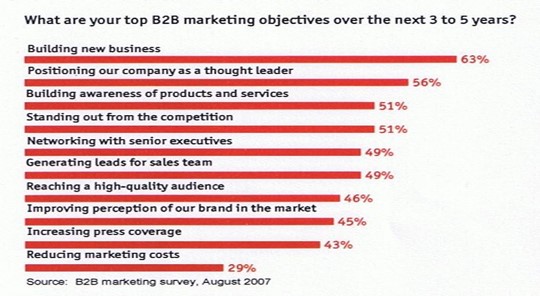
(Source: Economist Intelligence Unit)
Thought leadership content vehicles
- White paper
- Blog
- Op ed pieces
- Conferences
- Speaking
- Media quotes and commentary
- Podcasts
- Books and other publications
- Videos
- Social media conversations such as LinkedIn, Twitter etc
- Newsletters
- Lobbying
Take a point of view
The market place is cluttered and clients will automatically filter out information that does not grab their attention. Aside from providing valuable information, it is crucial to take a point of view. Having an opinion will stimulate people to think and gives added credibility in the process of positioning your firm as an expert in a particular industry or subject matter.
Integration with overall marketing strategy and firm culture
Strategy should come before your thought leadership programme. One needs a thorough understanding of how your firm is differentiated, what your key target markets needs are, and the opportunities in the market place. There is little point in creating a thought leadership platform that goes off on all directions and has little focus. If your firm does not have a clear marketing strategy in place, get one, and then think about how a thought leadership strategy ties into your firm strategy and what you should be writing and talking about.
Identify what your competitors are doing in terms of thought leadership and what they are talking about. Identify areas where you see opportunities to do something different or better. Remember that creating a thought leadership strategy and programme takes time and will not result in instant ROI. Make sure you have the resources to deliver insight of real value and ensure that your people are given the time and support in developing their thought leadership.
Is a thought leadership strategy right for you?
Not all firms will want to dominate their marketing activity with a thought leadership strategy. There will be cases whereby a firm may wish to put its resources in to other areas to build and maintain contact with clients and other stakeholders. Firms that may fall into this category include those with:
- Lack of resources to develop and distribute material
- Lack of in house experts who can credibly produce material or speak at events
- Lack of interest among seniors who are happy using existing client relationship activities
- Firms that do not have a clear overall strategy and end up doing ad hoc activities
- Lack of acceptance in alternative marketing channels such as social media
- Lack of support and commitment from top management
Whilst there are many firms adopting a thought leadership strategy, there are just as many who are not. Some of these may fit the conditions cited above but still produce good results because they have a general commitment to marketing excellence and a firm culture that values customer relationships, which are built through various activities.
Marketing your thought leadership
We seem to be moving from a world where content is producer generated and distributed to where it is user generated (found) and shared. McKinsey, probably the leader in thought leadership strategy as a business development tool has something like 2 million regular readers of the McKinsey quarterly, over 450,000 Facebook fans, and around 600,000 followers on Twitter. You Tube is now one of the largest search engines on the internet where esteemed journals such as the Harvard Business Review have their own page with over 600K subscribers.
There are various channels for distributing your thought leadership, both paid and unpaid with email still being the most popular according to various pieces of research.

(Source: Hub Spot)

(Source: Marketing Profs)
According to the Bloom Group in the US, we have moved from an age where thought leadership vehicles such as white papers have moved from a send and sell model to one that is ‘entice and engage’. This is depicted in the diagram below.
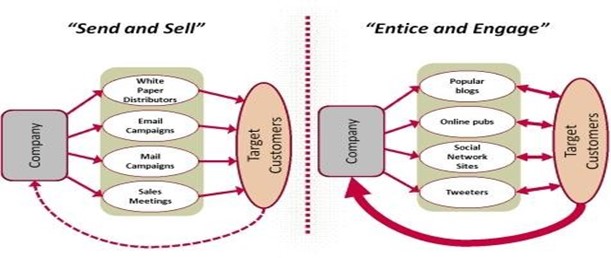
(Source: The Bloom Group).
The key concepts in this figure show that rather than target clients being pushed materials through traditional promotions, target clients will actively seek the information they are interested in through social media activities. This is a two way conversation where clients can choose to engage the producer of thought leadership materials and the producer can have meaningful interactions with target clients and influencers.
Whilst I am not convinced that traditional means of thought leadership marketing (see for example the research cited above) are far less effective than social media vehicles, it is absolutely imperative that your firm accept a social media strategy as part of your integrated promotional efforts. It is very important to note that social media is a two way conversation, do not just send out your materials as thinly veiled advertising attempts. Spend time on understanding the media, who the influencers are, and what is being talked about. Engage, listen, and interact, don’t shout!
Strategy and tactics of thought leadership
Every firm will have certain competencies that enable it to deliver superior customer value, or at least it should. Thought leadership is as much a match of these competencies to your overall strategy as it is about writing and delivering content. strategy in place.
At the heart of strategic thinking is the idea of your value proposition. What is it about your firm, its people, your structures/systems, industry/subject expertise, and services, that truly enable the firm to differentiate itself in the market place.
Just as importantly, identify who are the influencers and opinion leaders that have the ability to sway the decision making of potential customers and what are they looking for both in terms of content and how you deploy that content. Just because one particular vehicle may not reach a specific target client does not mean it is ineffective in reaching influencers. That is the underlying strength of social media. Once you have the strategy in place, you are well positioned to start building a thought leadership strategy and programme.
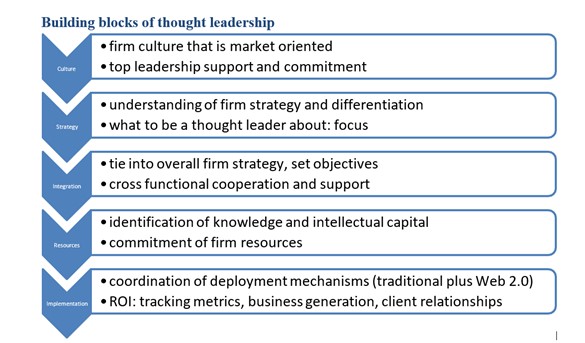
15 Questions to ask yourself
- Do you have something to say?
- Will you provide valuable and insightful information for key audiences?
- Can you deliver on a consistent basis through various channels and vehicles?
- Can you set clear objectives for the outcomes?
- Do you have the right firm culture?
- Do you have the intellectual capital and can you package it in a compelling fashion?
- Is your firm leadership fully committed?
- Is a thought leadership strategy right for you?
- Can your team be trained to research and write about key topics or will you outsource?
- Do your senior team really understand client needs and their businesses, will they learn?
- Do you have a clear and consistent business and marketing strategy?
- Can you adopt the concepts of social media and Web 2.0/3.0?
- Can you integrate your deployment methods?
- Will you measure and track the ROI and in what way?
- Can you accept the impact of thought leadership in the market place takes time

 Strategy & Competitiveness