Strategy as Knowledge & Learning – the how of the strategy process

Too many so called strategies or strategy statements are ill conceived positioning statements that describe, to some degree, the ‘what’. This is a view deeply rooted in a school of strategy that relies heavily on analytical techniques and little on learning or emergence. There is almost no description of the how. It could be argued that strategy is the how and I have argued that elsewhere.

In his book (Strategy and the Fat Smoker), David Maister states: “In the last two-and-a-half decades, I have been trusted to see a large number of strategic plans from a wide variety of professional firms around the world, including direct competitors. What is immediately noteworthy is how similar (if not identical) they all are.”

He goes on to say, “Real strategy lies not in figuring out what to do, but in devising ways to ensure that, compared to others, we actually do more of what everyone knows they should do.”

What Maister is alluding to here is that many organizations know what to do, and in fact, if they executed on half of what they stated they would in fact be doing strategy as strategy is action, not declaration. This is also well encapsulated in the book by Jeffrey Pfeffer and Robert Sutton (The Knowing Doing Gap). The premise here is that firms must turn knowledge into action.

I am arguing that knowledge of the how comes from action and learning and hence strategy as knowledge and learning is about the how and execution. As you act you learn and that knowledge should be codified and institutionalized so that the strategy process can continue to evolve and transform the organization.

To reinforce this point, think about analytical approaches to strategy that use various models to ‘devise’ strategy and draw on so called examples of excellent company performance to identify the what of strategy.

This type of research suffers from a number of fallacies that are well articulated by

Phil Rosenzweig in his book, The Halo Effect:

“Much of our thinking about company performance is shaped by the Halo Effect, which is a tendency to make specific evaluations based on a general impression.  When a company is growing and profitable, we tend to infer that it has a brilliant strategy, a visionary CEO, motivated people, and a vibrant culture.  When performance falters, we’re quick to say the strategy was misguided, the CEO became arrogant, the people were complacent, and the culture stodgy.  Using examples like Cisco, ABB, IBM, Lego, and more, I show how the Halo Effect is pervasive in the business world.  At first, all of this may seem like harmless journalistic hyperbole, but when researchers gather data that are contaminated by the Halo Effect—including not only press accounts but interviews with managers—the findings are suspect.  That is the principal flaw in the research of Jim Collins’s Good to Great, Collins and Porras’s Built to Last, and many other studies going back to Peters and Waterman’s In Search of Excellence.  They claim to have identified the drivers of company performance, but have mainly shown the way that high performers are described.  My book is the first to show why, for all their claims of voluminous data and rigorous analysis, their research is fundamentally flawed—and why their conclusions about the drivers of company performance are unfounded”.

In reality, firms have an intended strategy which then seems to divert based on what Henry Mintzberg called emergent strategies into a realized strategy. This learning view of strategy can be leveraged into producing the desired behavior change needed for the successful execution that is the how of strategy. There are no better examples of this type of emergence than Honda’s foray into the US motorcycle market or Ikea’s transformation into the worlds leading furniture retailer.

Here is an example of a strategy statement for Ikea based on more traditional definitions of strategy:

offering inexpensive, instant fulfillment furniture to young white collar customers in a new shopping experience format. This is primarily achieved through organic expansion and rapid globalization leveraging and creating economies of scale and efficiencies through replication.

Ikea is an interesting choice of subject for many strategy writers as they use Ikea to provide evidence (often in hindsight) that clear strategy is based on analysis, leading to a clear position in the market. That may be the case in hindsight, but the actual story of Ikea is one of much more about learning through trial and error. The same can be said of many organizations such as Dell and Honda.

This highlights an incredibly important point. If strategy is the how, how do Ikea and other successful firms continue to innovate/regenerate whilst others, such as Nokia, could not? I believe that how can be summed up in one word – culture. You can devise the ‘best’ strategic position in the world but if it cannot be executed then it is not strategy – it is another meaningless vision statement that adorns the boardrooms of most organizations. Of course, you could also devise the ‘worst’ strategic approach in the eyes of the market (such as Nokia, Kodak, Blockbuster and many others did) and experience the same failure. Culture permeates strategy in numerous ways, from silos to mental models to personal agendas, it is culture that determines the nature of your strategy process plus the outcome of your strategy (intended or emergent).

In the book Reinventing the Organization (2019), Yeung and Ulrich provide some fascinating insight into market oriented eco systems (MOE) built by firms such as Facebook, Tencent, Alibaba, Google etc. A market oriented eco system, in the view of the authors, is an emerging organizational logic that instead of a firm being organized by traditional divisions (command and control), it is organized along team based structures supported by a platform of resources, knowledge, and skills. The approach integrates a number of theories such as holocracy, boundaryless, agile etc. In my opinion, these types of organizational forms are becoming crucial to deal with the complexity of dynamic environments and rely heavily on the ability to leverage market, learning and knowledge cultures. They also help build these cultures because team based forms are critical to realizing the value of capability driven cultures. Hence structure does not just follow strategy but rather structure influences strategy and culture.

In their latest book, Humanocracy, Gary Hamel and Michele Zanini paint a compelling picture of the end of bureaucracy and the need for more humanistic approaches to management. I believe that adhocracy and other self emergent systems are much better suited to the job than typical structures. In fact, toxic ‘strategy’ mechanisms such as yearly budgeting can be eliminated almost entirely by beyond budgeting approaches which involve the concepts of sociocracy which is very similar to the ideas of the MOE proposed by Yeung and Ulrich.

What happens if I rewrite the Ikea strategy statement above incorporating the ideas of emergent strategy that come from learning, culture, doing and iterating, including the way their strategy has evolved:

Ikea offers a range of lifestyle choices to sustainability conscious consumers anchored by home furniture as the hub of their experiences. We leverage new technologies and eco systems for instant fulfilment and visualization. This is primarily achieved through a market oriented culture that puts team based structures and innovation at the heart of what we do, creating both market driven and market driving solutions. Economies of scale/scope of learning are now more important than traditional metrics of efficiency.

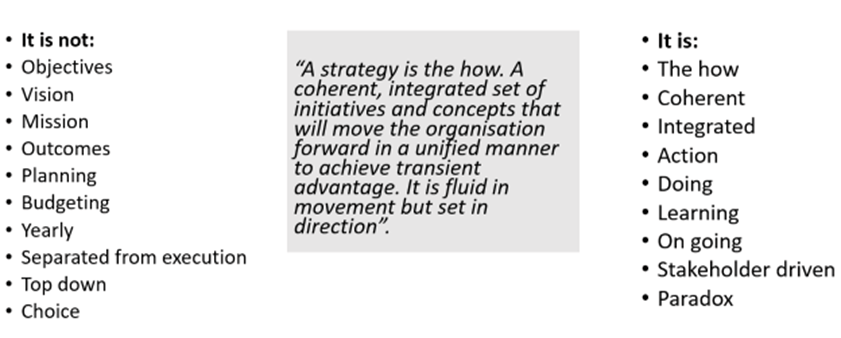
This definition now shifts the concept of strategy away from unique position to something that is more around unique processes. It also identifies that learning is the centre of competitive advantage since advantage is transient. The vision of Ikea has not been changed but the how of achieving this vison has. It suggests that strategy is not something that comes from yearly strategic planning activities but rather it comes from a continual questioning of assumptions about the beliefs of the organization. Firms need to move from a know it all culture to a learn it all culture in the words of Satya Nadella (Microsoft CEO).

In summary then, this is what strategy is, and is not:
Source: authors own analysis

Strategy is as much about the how as it is the what. The strategy process needs a major overhaul in most organizations and must move towards a knowledge and learning perspective.
Science: when will it hit the gym floor?

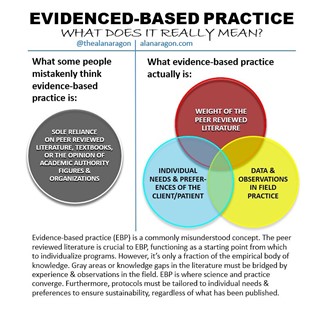
When will science finally hit the gym floor? We have been through the aerobics era, the bodybuilding era, HIIT, functional and many other trends (and some fads). What we need is a common foundation guiding all of this, I believe that to be the scientific era (evidence based).

I define the scientific era as knowledge provision on the gym floor that is grounded in empirical evidence on what works and what doesn’t, how something should be done, and how it shouldn’t. Too much of what we see on the gym floor is dominated by intuition, anecdotal evidence, teachings passed down, and in some cases, pure nonsense influenced by the media and so called fitness gurus (with no qualifications to be speak of).

In fact, evidence based practice is mix of a few factors which are well encapsulated in the below explanation by Alan Aragon:

Let’s take an example:

Women in Asia are still generally worried about lifting weights due to the myth that strength training will make them look bulky. ‘I don’t wanna get too muscular’ is probably the most oft heard phrase when a woman is newly introduced to weights. So they tend to focus on cardio and classes such as Pilates etc as they believe it will give them a toned and long, lean muscle look.

Step in the quasi experts and celebrities such as Gwyneth Paltrow and the belief that long lean muscles can be achieved by their espoused methods whereas lifting weights will give you a bulky look, and bang the myth becomes reality!

I am not saying that Pilates or Yoga are not effective methods of training. I am saying that claiming these are capable of giving you long lean muscles whilst weight lifting will make you bulky is utter nonsense. The science is clear, muscle length and shape is predetermined and even intense stretching over extended periods of time seems to have little influence. Although training or long periods of inactivity can affect muscle length that effect is short lived and I imagine invisible to the human eye. What a woman sees as ‘tone’, is actually muscle growth and/or body fat reduction. Tone is essentially a level of leanness achieved by exercise and nutrition. Toning is bodybuilding because it is muscle growth. You can’t tone up! You build muscle or you don’t. So claiming that weight lifting will make you bulky and more ‘womanly’ methods will make you look toned and lean is not science, its nonsense. Its even more nonsense to claim such forms of exercise are going to deliver better results than HIIT for leanness.

Let’s take another example:

The explosion of so called functional training has been a boon to the fitness industry. Its also been a double edged sword! A plethora of equipment and training methods to choose from, many of which are not based on any type of science. The whole word functional is exceptionally confusing also. Functional depends on your goal. If isolated quadriceps strength is needed (ie. An 80 year old women who has problems getting of the toilet due to a quad and hamstring strength imbalance), then a leg extension or smith machine squats could be highly functional.

Standing on a bosu ball and curling 10kg DBs is functional for nothing, unless you live on a planet with bosu balls for ground! It doesn’t improve your balance and it doesn’t more greatly engage your core than standing on a stable surface and lifting the amount of weight you are normally capable of lifting when not standing on something wobbly. Walk into any gym nowadays and watch trainers assigning all sorts of nonsense exercises in the name of functionality. Yes, it’s great that this seems to have opened a new segment to the health market but at the end of the day, people want results safely. Many of these types of exercises and programs offer neither. Hence the large degree of disillusionment often associated with our industry.

I suppose linked closely to all this are the fitness professionals in the club. Most complete their one time certification and then seem disinterested to know more. They are more like professional counters than professional trainers. I am still amazed at the amount of trainers I see allowing terrible exercise form, have the audacity to talk on their phones, and not even record the workouts of their clients. How is this still acceptable?  

If your trainers are not even remotely familiar with works of some of the people below then something is terribly wrong:

  • Alan Aragon
  • Brad Schoenfeld
  • Bret Contreras
  • Dr Jade Teta
  • Nick Tumminello
  • Eric Helms
  • Prof William Kraemer
  • Prof Steven J Fleck
  • Dr John Rusin
  • Joel Seedman
  • Dr Donald Chu
  • Dr Jim Stoppani
  • Mike Boyle
  • Mark Rippetoe
  • Eric Cressey
  • Prof Stuart McGill
  • Dr John Beradi
  • Dr Kelley Starret

Ultimately, if science is going to hit the gym floor, it must hit the management of these clubs. I don’t just mean in terms of education, policies, and procedures related to how trainers will work with members. I mean how management actually works with the fitness staff themselves. Management science and know how in terms of innovation, motivation, and people development.

The Strategy of Downsizing: lessons that Peloton and others still fail to heed

The recent announcement of Peloton laying off 2800 employees again sheds light on the pervasive organizational phenomenon of downsizing. Whatever euphuism is used (rightsizing, restructuring, and yes even smart sizing), downsizing is often the pain experienced by employees for the missteps of management. This is not to say that cost cutting by downsizing per se is wrong for the long term viability of the organization, but rather, the way in which downsizing is done has a huge impact on whether such an initiative can be deemed a success.

Far from thinking just about the potential cost savings from letting a certain percentage of the workforce go, firms need to the think deeply about lost knowledge, the morale and motivation of those who remain (survivors), the perceptions of the market place, as well as the impact on the customer and the ability of the company to deliver on its value proposition (or changing proposition). In addition, the firm should think seriously about the impact on those let go and how they are treated. Not only for human reasons but also for the very real likelihood that the organization will look to re-hire many of these same people should performance improve (there is wealth of research which shows this is often the case as firms yo-yo from hiring to firing in short term reactions to the market).

Download the paper below

Strategy and Marketing Effectiveness for SMEs

Much of what has been written about strategy and strategic management is based upon the assumption that strategic choice is actually a viable option for most firms and that resource issues are non problematic. That assumption may hold for large firms but not for SME’s. The vast majority of firms are SME’s and a large number of these are in fact micro enterprises. Whilst one may talk about geographic diversification and market expansion so readily for large firms based on a premium image and heavily differentiated service, the options for SME’s can be severely limited due to a number of factors:

  1. Lack of time to explore new opportunities
  2. Limited market information and research capability
  3. Lack of marketing and management expertise
  4. Money restraints
  5. Lack of accessibility to investment
  6. Lack of human resources

The list is not exhaustive but essentially highlights the key factors that affect a SME from being able to consider opportunities in the same way that larger firms can. These issues become even more pronounced when the SME is considering internationalization. Bearing in mind the resource limitations often faced by SMEs, this article will provide knowledge to the owner/operators of these firms that can help them to overcome such barriers and compete effectively.

I Strategy for the SME

I have criticized a number of existing strategic management concepts in terms of their applicability to the dynamic environments that most businesses operate, this questioning can be extended to their application to the SME and indeed the issues faced by such firms exacerbates the problems inherent in the concepts so readily applied to larger firms. For example, use of portfolio management tools (such as the BCG matrix or the GE matrix) are problematic for the SME. Classifying a business based on such concepts as market share or growth have inherent limitations for smaller firms. The very nature of such firm means they tend to operate in only a few service markets and it is quite possible that the majority of their revenue could stem from markets that would be considered declining ones under portfolio prescriptions yet still highly profitable. If one wanted to take a poorly performing business (as prescribed by a portfolio approach) and divest of it, where would one get the money to invest in growing markets that were not yet profitable? Similar problems can be found in the use of Michael Porters three generic strategies. For example, if a niche strategy is successful and hence the niche market itself becomes attractive to other larger firms, what stops the larger firms acquiring the needed expertise in that market and hence competing directly with the SME? It is exactly these types of issues that face small firms and little direction is given to them in traditional writings in strategic management and marketing.

In their excellent book, Competing for Markets: Growth strategies for SME’s, Khai Sheang Lee and colleagues identify a number of generic strategies that can be utilized by small firms (Asia focused) and in particular, consider the reaction of larger incumbent firms. The generic strategies described by the authors are:

  • Niching – if the SME can offer a service to an ignored segment of the market that is differentiated and provides a competitive advantage, then it can use a niche strategy. For example, small architectural and design firms rely heavily on the knowledge and creativity of the founding partners and through work have gained prominent positions in niche markets even on a global scale.
  • Substitution – a small firm can enter a currently served market by offering a substitutable, but differentiated, service, particularly if a niche strategy is not sustainable over the longer term. Basically, the firm is a second mover and benefits from the market development activities of larger firms. The firm should take care to differentiate its service from competitors either through the service itself or through marketing activities. For instance, new health clubs in China could take advantage of the growing fitness market developed by offering a similar service to larger international chains (with a lower price) but differentiating itself through a focus on local cultural knowledge. It would be self defeating for the larger firms to copy this approach as they focus on their international experience and scale of operation.
  • Free riding strategy – in product marketing there are various forms of free riding but in services it tends to be limited to an imitation strategy. A SME can benefit from second mover advantages by entering a market that is already developed and well served by larger firms. By offering a service that is the same as the incumbent firms the SME does not need to bear the costs of market development and the risks associated with being a first mover. A small firm can take a small piece of a market (or its associated service market) by riding on the coat tails of the development efforts by larger firms. An obvious example would be the growth of coffee culture led by Starbucks that allowed numerous local brands in various markets to benefit from the market development efforts of Starbucks.

These generic strategies take into account the resource limitations often faced by smaller firms and the fact that creating a competitive advantage is not always as easy as it seems when prescribed by consultants and other expert sources. They also take into account competitive reactions of the incumbent firms in terms of their ability to retaliate or accommodate. Again, it should be stressed that strategy is not a static concept and whilst a small firm may pursue one of the generic strategies discussed it will, over time, need to adapt to changing market conditions and adopt an alternative strategy altogether if necessary.

In reality, a particular strategy may not fit neatly in to the three generic strategies prescribed but that does not devalue them. Small firms tend to be more limited in their strategic choice than larger firms and by using the strategies described and their appropriate decision frameworks a smaller firm should be able to enhance their strategic decision making in line with what the firm can offer and the conditions of the competitive environment.

II Marketing Effectiveness and Success/Failure in the SME

It has been well documented that marketing in small firms is quite different from marketing in larger firms. The inherent resource constraints that small firms face means they rely heavily on networks of contacts and although they are aware of general marketing concepts they do not apply them in the same way that larger firms do. For example, planning tends to be a more formal process in larger firms yet more ad hoc in small firms. Whereas certain marketing experts may lament the lack of formal planning in smaller firms, much research supports a less structured approach in smaller firms. This is known as entrepreneurial marketing and in fact can be just as readily applied to large firms as well as smaller ones.

Not only do the marketing practices of small and large firms differ, they should, the limited resources of SME’s means they cannot adopt scaled down practices of large firms or text book theory and expect to achieve satisfactory outcomes. The marketing competencies often associated with SME’s are:

 knowledge
 experience
 communication
 managerial judgement
 networking

When considering the success or failure of SME’s, there are essentially two categories to be considered: external and internal. External factors would consist of environmental factors such as the economy and competitors. Internal factors include things such as management, availability of resources and strong leadership. Much research has examined the main factors that affect SME performance and includes both service firms as well as manufacturing firms.

Research in Singapore by Theng and Boon (1996) examined the failure of SME’s and the factors perceived to be the most important causes of such failure. The results found that external factors (finance and labour issues) were important, but that internal factors (short sightedness, lack of management expertise, low initiative and entrepreneurialism) were more important in determining the poor performance of a small firm. Lin (1998) also reached a similar conclusion in her study of SME’s in Taiwan as management skills and concepts of the business founders were considered the most important factors when compared to employee skills and concern for production. This was also related to superior business performance.

III Conclusion

The SME faces a different environment to that of large firms and hence its decision making should be based on the resource limitations often facing such firms. Such firms should take an entrepreneurial approach to marketing and strategy and strive towards developing those competencies that create successful SME’s. Moreover, when looking to external resources to enhance the firms marketing capability, the SME owner/partner should seek expertise and education that is rooted in the context of the specific situation they face. Scaled down text book theory offered by many institutes (such as trade associations and private firms) is not wholly applicable to the smaller firm and indeed may even be detrimental.