There has been so much written about why organizations fail to change despite the warning signs being clear and present. Certainly the remnants of organization theory (such as Taylor’s Scientific Management or Max Weber’s Bureaucracy) have a major role in the way firms are led today as do MBA courses and what is taught (shareholder value as the holy grail). Henry Mintzberg (Professor of Management at McGill) has said that management is much more a practice than it is science. He also states that shareholder value has nothing to do with human values, ‘it’s got nothing to do with decency, it’s got nothing to do with anything but greed’. He is not alone in this view.
An article in Bloomberg from a former Harvard business professor examining the fundamental problems with MBA education and her experiences at Harvard (The Old Solutions have become the New Problems). Shoshana Zuboff who spent 15 years teaching on the Harvard MBA says ‘I have come to believe that much of what my colleagues and I taught has caused real suffering, suppressed wealth creation, destabilized the world economy, and accelerated the demise of the 20th century capitalism in which the U.S. played the leading role’. She goes onto criticize many of the concepts espoused on the MBA under the guise of shareholder value. These concepts include downsizing, re-engineering, outsourcing, etc, which led firms to focus on ‘financialization’ as opposed to innovation and wealth creation through new products and services. I would also add new business models.
According to Zuboff:
‘Old rules assumed economic value. That’s why Harvard Business School students have been trained for a century in the “administrative point of view.” The manager’s job was to oversee and control what was inside organization space, or what they were trained to view as “my company.” Everything else was a distraction. The “administrative point of view” reflects a simpler time when business was about selling a product. It teaches you to operate from the perspective of organization space—how to maximize your company’s efficiency and serve its interests. It’s a world of boundaries: who’s inside and who’s out; who’s up and who’s down. It’s a world of producers vs. consumers, my company vs. your company, us vs. them. Business is no longer just about the product. Now it’s about solutions for the individual. Economic value is hidden in consumers’ unmet needs and is released by providing people with the means to fulfill those needs. But in order to release new value, you need to get out of organization space and into the subjective space where individuals live. I call it “I-Space.” This means shedding the “us-them” mentality. Now everyone is an insider’.
In the classic article, On the Folly of Rewarding A, in the Hope for B (Steven Kerr, Academy of Management Executive, 1975 and updated 1995), the author gives an array of examples from different fields that encapsulates even today the majority of issues with change initiatives and the way companies are run – ‘it’s the reward system stupid’! The below examples, in my opinion, cover 90% of the issues most organizations face:
- We hope for long term growth, but reward quarterly earnings
- We hope for teamwork, but reward individual effort
- We hope for challenging stretch objectives, but reward making the numbers
The ideas here echo many of the challenges discussed above in terms of exploit vs explore. Organizations need to get used to running paradoxical thought processes, and hence ambidextrous organizations, and turning these into integrated management practices. For example, dual roles managing the business of today vs the business of tomorrow. Extending this concept of dual roles and ambidextrous organizations, Innosight (the consultancy co founded by Clayton Christensen), call this dual transformation. Transformation A is repositioning the business to maximise its resilience whilst transformation B is creating tomorrows growth engine. Historically, it has always been managers that play the game and run the business of today that have more clout than those who are often considered pie in the sky thinkers (innovators).
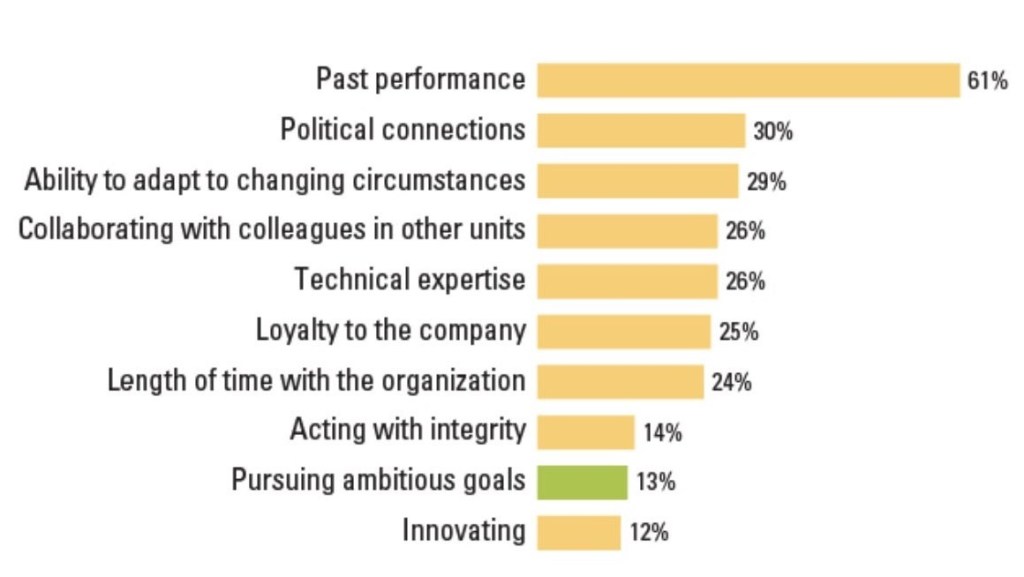
How to Get Promoted (Source: Sull, D., and Sull C (2018) With Goals, FAST beats SMART. MIT Sloan Management Review, June)
In an era of shareholder returns and the holy grail of managing lag indicators (such as earnings) fueled by toxic ‘strategy’ mechanisms such as yearly budgeting processes, the time is here for a re-think for most organizations. The elements of a high performing culture are a market, knowledge and learning orientation. As Peter Drucker once said, ‘Culture eats strategy for breakfast’. I will go further. Strategy is the how, it is action not declaration, hence your culture is your strategy as it is the how of achieving objectives.
Leadership then is fundamental as it is leadership that sets the tone and culture of the organization. There is often much more rhetoric than real action within leadership ranks. Even worse, in the language of Chris Argyris (former Harvard professor and author of Overcoming Organizational Defenses), most organizations have huge gaps between espoused values and theories in use (think Douglas McGregor’s Theory X and Y). Political oligarchy has become so entrenched in most organizations that they have seriously failed to tap the collective wisdom of the crowd. According to Mark Bertolini, CEO of Aetna; ‘Creating new business models is a leadership challenge. In order to create those new businesses in any organization, I don’t care how old it is, you have to start to look at what is going to be the operating model that’s going to make that new business commercially viable and sustainable for the long run’.

Relationship between Leadership, Culture, Innovation and Firm Performance (Source: authors own analysis)
By definition, working on BMI means working under uncertainty. The ideas and thinking that got you to where you are today is not the same thinking that will get to where you need to be tomorrow. Traditional strategy processes built on industrial economic thought are much less relevant in a world of competitive arenas, transient competitive advantage, and eco systems. Firms must be cautious not to conflate current digital initiatives with business transformation. In the fitness industry we are seeing a flood of on demand and live content, move to e commerce platforms to benefit from consumer demand driven by COVID, investment in apps etc, but none of this is BMI. According to Leinwand and Mani (HBR, March 2021):
‘Companies need to step back and fundamentally reconceive how they create value. They need to reimagine their place in the world, rethink how they create value through ecosystems, and transform their organizations to enable new models of value creation. The bottom line is companies need to shape their own future, recognizing that the world has fundamentally shifted, and that they must find their purpose in it. If you can’t answer the questions “Why are we here?” or “What unique value do we add for our customers?” then you are likely at best just staying in the game’.
They go on to say that organizations must:
- Reimagine your place in the world, instead of focusing on digitizing what you already do. Companies that transform for success in the digital age define their reason for being in terms of the bold value they create for their customers (and their customers’ customers), and why. They take advantage of new technology not to copy what everyone else is doing, but to advance their own missions by investing in the differentiating capabilities that allow them to deliver on their purpose. Filling their new place in the world with life often requires them to shed old business models, assets, and beliefs about value creation.
- Create value through ecosystems, rather than trying to do it all alone. Successful companies in the digital age recognize that the way to remain relevant comes from working together with an ecosystem of players in order to deliver the ambitious value propositions that customers want and to quickly innovate and scale up the incredible capabilities that are needed. Operating in this way requires leaders to think about value creation more boldly, question what their organization must truly own, and be prepared to open up to competitors and give up traditional sources of revenue in order to address some of the most fundamental customer needs.
- Re-imagine your organization to enable a new model of value creation, rather than asking people to work in new ways within the confines of the old organizational model. Winners in the digital era break up old power structures so that new ideas and capabilities can be scaled more collaboratively. They put in place outcome-oriented teams tasked with collaborating across the organization and work with their ecosystem partners to deliver the differentiating (and often cross-functional) capabilities they need to win.
In traditional organizations and theory, strategy has been considered the domain of top management and that their job is to strategize and once developed, sell the strategy and get buy in from the rest of the organization. There are problems with this type of approach. Firstly, top management are themselves immersed in the day to day management of the organisation and hence have limited capacity to scan and interpret the market. Secondly, an increasing number of industries are driven by knowledge workers, these highly intelligent and independent workers do not take well to what they perceive as undue top down influence and control. David Maister (ex Harvard Professor), an expert in working with knowledge intensive firms, suggests that organisations take a bottom up approach to strategy meaning that people at all levels have a major say in the strategy process.
There are many concepts and tools that can aid in bringing this new approach to life including lean start up, innovators method, agile, design thinking, bossa nova, the fifth discipline, systems thinking, cybernetics, complexity thinking, scenario planning etc. There are some great tools available now such as those developed by Strategy Tools and Strategyzer. Again, without the right culture and structure, none of these are likely to make much impact.
As Steve Blank points out in his frequently cited article in HBR, often organizations know they need to change but play a game of organizational ‘whack a mole’ in a futile attempt to swat every problem that pops up without understanding the root cause. He calls this innovation theatre. He goes on to say that organizations must build a mind set, culture and process that becomes innovation doctrine. In their article (How Leaders Delude Themselves about Disruption, MIT Sloan Management Review, 2020), Scott Anthony and Michael Putz describe the 4 lies that leaders tell themselves including that their organization is immune (we are safe) and that their people are not up to the task. Cognitive bias affects leaders as much as it does anyone else. Assuming people are not up to the task creates a self-fulfilling prophecy. Leaders, and organizations, need to become much more self aware in order to create strategic clarity.
Critically, organizations need to stop thinking along the lines of everything is knowable and get used to less than concrete concepts that do not fit in with arbitrary yearly budgets, targets, or hurdle rates that have nothing to do with the future sustainability of the business.

 Strategy & Competitiveness