There are no universally accepted definitions of a value proposition but there are a growing number of tools that can help in the development of compelling value propositions. Rather than try to focus on a single definition the following list of characteristics by Alex Osterwalder provides a solid guide:
- Are embedded in great business models
- Focus on few pain relievers and gain creators, but do those extremely well
- Focus on jobs, pains, or gains that a large number of customers have or for which a small number is willing to pay a lot of money
- Align with how customers measure success
- Focus on the most significant jobs, most severe pains, and most relevant gains
- Differentiate from competition in a meaningful way
- Address functional, emotional and social jobs all together
- Outperform competition substantially on at least one dimension
- Are difficult to copy
- Focus on unsatisfied jobs, pains, and gains.
James Anderson and colleagues (in a HBR article from March 2006), explain there are 3 kinds of value propositions which are depicted in the diagram below. They argue that a resonating focus approach is the most compelling and hardest to develop as they require a deep understanding of customer and stakeholder needs. In other words, a problem solving approach.
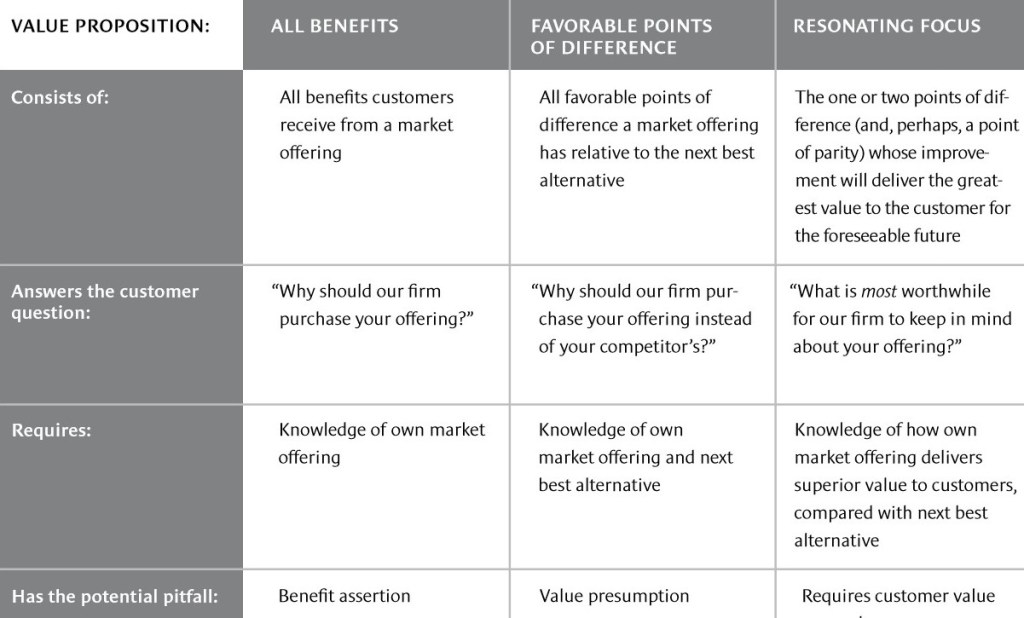
3 Types of Value Proposition (Source: Anderson, J.C., Narus, J.A., and van Rossum, W (2006) Customer value propositions in business markets. Harvard Business Review, March)
The resonating focus approach helps a company narrow down the value being sought by customers to the most important elements. It may also suggest that different customers within the buying organization have different needs and hence it makes sense to create different communication strategies aimed at different buying centre constituents. For example, a club owner maybe more concerned with capital investment costs and ROI whereas a fitness director may focus on benefits related to ease of use and education support. You cannot cover all these value factors in one statement, but you can customise these communications based on who you are talking to. According to Hub Spot, the value proposition explains how your solution solves customer problems/improves their situation, what specific benefits they can expect, and why customers should buy from you over your competitors. It is not a slogan or positioning statement. Below is what I consider to be the current value proposition (VP) of the major commercial fitness equipment manufacturers:
‘We provide a complete range of cardiovascular, functional and strength equipment to meet all your customer needs. Based on the latest science and advances in technology, our premium equipment is designed to offer the best user experience in terms of biomechanics, safety, and content. Known for industry leading reliability and service, our solutions will make sure your facility stands out from the crowd.’
If this VP sounds generic, it’s because it is. Go to the web site of any major manufacturer, remove the brand name and pictures, and you will be hard pressed to tell one brand from another. If we explore this VP from the perspective of the resonating focus and some of the 10 characteristics above, it doesn’t perform very well. It is most likely the local entity on the ground (such as the distributor or direct office) that forms the bulk of the VP. When thinking about BMI, manufacturers will have to explore in depth how to partner more closely (adapt the BM) to create a more compelling VP across geographies that links the entity and corporate brand more closely together in order to meet the pains, gains and jobs to be done.
Below are a few VPs from traditional manufacturing firms which have adopted BMI using a PSS:
Hilti – Hilti offers holes not hammers. With its Tool Fleet Management System, the company provides guaranteed availability, maximum uptime, with no upfront costs. Customers get access to the best tools whenever and wherever they need them.
Kone cranes – At Konecranes, we are not just lifting things, but entire businesses. We have real-time knowledge of how millions of lifting devices perform. We use this knowledge, around the clock, to make our customers’ operations safer and more productive.
Otis Elevators – Using smart, internet of things (IoT) technology, Otis ONE™ brings you and your passengers the next generation of service. With 24/7 real-time, connected service combined with our foundational historic data your elevator experience will be transformed as you receive new insights. Transparent, proactive, predictive: this is Otis ONE™.
Royal DSM – the new resin addresses the growing market demand for powder coatings that can be cured quicker or at lower temperatures. In particular, the Uralac® EasyCure P 3225 resin can either be cured in just 5 to 6 minutes at 180ºC, compared to the 10 to 12 minutes of market alternatives, or in 12 minutes at 160ºC. In this way, the resin enables higher production output and can help prevent bottlenecks, as well as lowering energy consumption, reducing natural gas usage by up to 30%.
Siemens Health Care – We assist you in reducing risk. We increase machine uptime and increase your profitability.
What is striking about these VPs is how similar they are despite coming from very different industries. They focus on a few key resonating points which act almost as unique selling propositions (USP) whilst aligning with customer measures of success, namely reductions in cost and improved productivity. They are also embedded in strong business models which make imitation difficult. As Didier Bonnet and George Westerman explain (The New Elements of Digital Transformation, MIT Sloan Management Review, 2021), as some firms are still implementing traditional automation approaches such as ERP and product life cycle management, others are moving far ahead by digitally reinventing operations. ‘Thanks to the growing availability of cheap sensors, cloud infrastructure, and machine learning, concepts such as Industry 4.0, digital threads, and digital twins have become a reality. Digital threads connecting machines, models, and processes provide a single source of truth to manage, optimize, and enhance processes from requirements definition through maintenance (p.4)’.
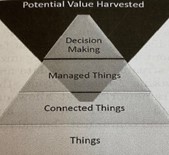
Business Value Realization (Source: Barkai, J. (2016) The Outcome Economy)
If we consider the current status of traditional manufacturers, they are basically at the level of selling things (some with connected things, especially those targeting the consumer market). The VP examples above are much more heavily concentrated on managing things and decision making. That is how they deliver compelling VPs to their customers. Studying what those are doing in other industries is known as analogous research. Other approaches common include stakeholder mapping, customer journey mapping, exploratory research, ethnographic research, in depth interviews, desk research and quantitative approaches.
The VPs essentially address a mix of business, technical and personal value. This idea is very similar to the value proposition canvas (from Alex Osterwalder) which focuses on gain and pain points. We can use this tool to analyse the VP sought by equipment buyers and develop a new BM. The completion of the canvas would involve substantial stakeholder input including customer research.

The Value Proposition Canvas (Source: Strategyzer)
Customer jobs – this is based on the seminal ideas of Clayton Christensen (author of The Innovators Dilemma). The concept is that customers don’t simply buy a product but rather ‘hire’ it to do a job. The classic example he gave was that of a McDonalds milkshake (hired to make the commute to work). For Hilti customers it could be executing contracts and for a firm like Slack enabling real time collaboration (or Zoom, virtual collaboration)
Gains – predictable costs and access to latest tools would be customer gains/needs for Hilti. In the case of remote diagnostics for medicine, customers would gain medical advice at their convenience
Pains – Hilti customer pains (to be overcome by the new VP) would include high upfront costs and risk of project delays. For Slack they aim to alleviate lost and messy communications via long email threads and other channels
Pain relievers – the aim here is to overcome some of the pains. Hilti, for example, offers subscription based services to eliminate high up front costs. Home medical diagnostics reduces the pain of travelling and waiting for medical services
Gain creators – Hilti offers immediate repairs or access to new equipment to ensure near 100% uptime. Slack offers real time project management to enhance productivity together with a fast learning curve
Products/services – the online fleet management system is the core of the solution for Hilti together with their inventory management system for tools. For Peloton it would be the content which leads the physical product allowing customers to access world class training when it suits them in their own home
Some authors have modified this canvas to change the value map to benefits, features and experience whist on the customer profile, the elements are named needs, wants, and fears. Both models are useful and can aid thinking. You should not get hung up on the methodology as the intention is to spur different lines of thought. Aside from using this model for an organization’s own analysis, it can be very revealing to study the BMI of companies in other industries:
| Strategy/Company | Caterpillar | Siemens Healthcare | GM |
| Subscription Portfolio | Smart Machines-wide range of connected industrial equipment CAT connect-onboard sensors to help optimize equipment management and productivity | Laboratory as a Business (LaaB)-consulting services that to help customers achieve business objectives Upgrade services-a suite of software applications expanding the lifespan of equipment and reducing TCO | Maven-a peer to peer rental service that allows GM owners to rent out cars using a digital platform |
| Transformation Strategy | Acquired Yard Club (a peer to peer rental platform to share and manage heavy equipment Repositioned digital groups under a head of Digital Enabled Services | Deploy AI-leverage data to help automate and standardize complex diagnostics | Acquired Cruise-a dedicated business unit for development of autonomous vehicles Book by Cadillac-an on demand subscription service that lets users choose from a range of curated vehicles and allows them to change vehicles up to 18x year |
| Other highlights | 500K connected assets | 55% of revenue is recurring | Over 150,000 Maven members. More then 5m On Star connected vehicles on the road |
Below are some examples of organizational issues (taken from The Outcome Economy by Joseph Barkai) when servicing and maintenance are considered secondary and hence neglected early on which are indicative of what happens in the supply of fitness equipment:
- Fault diagnostic tools are unable to isolate the root cause of equipment down to a single field replaceable unity (FRU). This leads to longer repair times, multiple parts being replaced and increasing costs
- Service tech is unfamiliar with the configuration of the equipment and does not have the proper service information or parts on hand, resulting in multiple trips
- The stage gate approach to product development ‘freezes’ the design before service planners can evaluate the design and improve its serviceability
To overcome using IIOT:
- Onboard and remote diagnostics are designed to meet mutually agreed service level agreements (SLAs)
- These diagnostics are aligned with hardware modularity, FRUs and part inventory management policies. These allows failures to be mapped to spare parts in country
- Remote monitoring and diagnostic systems help maximise the utilisation of tech staff and allows more efficient allocation
- Back end systems are designed to take advantage of machine generated data to assist in capturing operations and failure data. This is then used to improve design of existing and new products
Based on all the methods available for the ideation and preparation phases, an organization will start to get a feel for the possible value propositions that could be developed. There is a plethora of customer value models available which can be incredibly useful in delineating what value is to a customer. It is also important to note that customer needs are not always well expressed by customers so a mix of inside out and outside in thinking is required. Together with an iterative process and a big enough pool of on going projects, the firm should be well positioned to explore new opportunities.

 Strategy & Competitiveness