There is a massive amount of confusion regarding the role of marketing in organizations. This confusion grows when you add in sales and how the two are related. It is no accident that marketing is known as a cost and relegated to a support function since many organizations believe it to be exactly that. Even more so, firms see little intersection between the overall value delivery process and how marketing actually adds value to the customer. Marketing and sales teams are often artificially separated both in work processes and in mind sets.
In his seminal article from the Harvard Business Review in 1991, Regis Mckenna stated that marketing is everything and everything is marketing – it is not a function but a way of doing business. We can even go back to the traditional text book definitions of marketing, such as those by Philip Kotler, that essentially state marketing is about the creation and delivery of customer value. Tim Ambler from the London Business School points out that trying to measure the ROI on marketing as whole is like trying to measure the ROI on eating, if you don’t do it you die! Clearly then, the measure of marketing ROI is firm profitability, although it hardly works that way in most companies.
Market Orientation
Let’s take this one step further and make it more concrete so we can conceptualize what it means when say marketing is a business process that permeates the entire organization. The market orientation literature that blossomed from around 1990 helps us to operationalize and specifically identify what it is to have a marketing culture (i.e. be market oriented). It is both a set of behaviours and a culture. This is depicted in the diagram below which also shows the how marketing and sales should be integrated.

The figure shows the explicit link between marketing (as strategy, in other words the orientation and culture of the firm), firm behaviours, and the link to the manifestations of marketing, BD, and the areas of sales team work that it affects. What this figure details is that aside from technical advice, customers demand an increasing amount of business advice and industry knowledge that is linked to the technical advice sales people provide. For a firm to effectively differentiate themselves in the eyes of the customer, they must be able to deliver a level of value (whether through industry and technical know how, responsiveness, pro-activity etc) to customers that is different from what other providers can offer. Additionally, since a marketing culture is associated with job satisfaction and engagement, it acts as a motivator for sales people to engage in individual level market oriented behaviours which are aligned with the needs of customers. In this sense, marketing in its truest form becomes a key pillar in the work of sales teams and what they deliver to customers as it is the key pillar of f
Breaking Down the Silos
This conceptualisation is good but it does not necessarily help with the wicked problem of breaking down the functional barriers between marketing and sales. It does help with both mind set and behaviours but does not go far enough in terms of practicalities.
Kotler et al in an article from the Harvard Business Review (2006), found four major themes when looking at this disconnect:
- The marketing function takes different forms in different companies at different product life-cycle stages—all of which can deeply affect the relationship between Sales and Marketing.
- The strains between Sales and Marketing fall into two main categories: economic and cultural.
- It’s not difficult for companies to assess the quality of the working relationship between Sales and Marketing (they provide a diagnostic tool in the article).
- Companies can take practical steps to move the two functions into a more productive relationship, once they’ve established where the groups are starting from.
The authors provide the following check list as a guide:
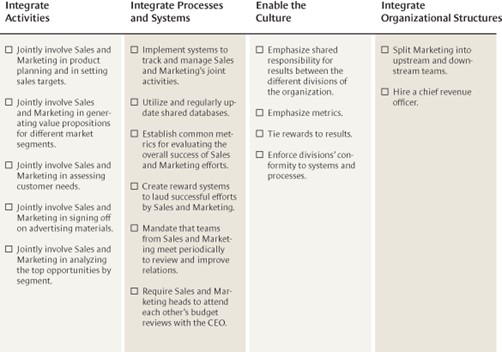
(Source: Kotler, P., Rackham, N., and Krishnaswamy, S (2006) Ending the War Between Sales and Marketing. Harvard Business Review)
The list suggests that there a number of things that an organization can consider when looking to integrate the two functions including a more defined communication process, joint decision making, cross disciplinary work (job rotations), team based structures and project based assignments. We can also see many organizations fully integrate these functions under some type of sales or channel enablement roles. These can only realise their full potential when enablement roles are not set up as distinct functions, doing so puts too much emphasis on the individual’s skill set in bridging the two functions (people are good but that is almost asking the impossible).
In another HBR article from 2019, Casciaro et al make the point that silos can be broken down most effectively by identifying activities that facilitate boundary spanning. They state,
“We’ve found that people can be trained to see and connect with pools of expertise throughout their organizations and to work better with colleagues who think very differently from them. The core challenges of operating effectively at interfaces are simple: learning about people on the other side and relating to them. But simple does not mean easy; human beings have always struggled to understand and relate to those who are different. Leaders need to help people develop the capacity to over- come these challenges on both individual and organizational levels. That means providing training in and support for four practices that enable effective interface work.”
They suggest four ways to do this:
- Develop and deploy cultural brokers
- Encourage people to ask the right questions
- Get people to see the world through others eyes
- Broaden your employees vision – i.e. through use of cross functional teams
Further research from de Waal et al (2019), published in the journal Sustainability, identifies 5 factors that are strongly correlated with breaking down silos:
- Organizational values
- Collaborative operating model
- Collaborative environment
- Leadership
- People reward and development
All of these examples converge around a few key ideas of networked organizations, knowledge sharing, learning, and flat team based structures. This then clearly converges on change. Very broadly there are two ways to lead change. One is to change mind sets, which is exceptionally hard, and the other is to change behaviors which then leads to mind set change. For example, instead of spending considerable time on culture and change workshops (when done correctly these can be effective but time consuming and often have little impact if not integrated into firm processes), why not experiment with asking those in marketing and sales what the issues are facing both and how they could be solved. Then ask them to create cross functional teams to identify and solve the issues. This is effective because the protagonists take ownership of the issues and co create the solution. Buy in happens simultaneously – it does not need to be sold to them, nor should it be. The organization must also ensure that it itself supports this approach through training/L&D, performance management, and changing organizational forms.
The below framework provides an overview of what has been discussed. Now it is a matter of execution and that is true strategy – the how and the process.

Integrating Marketing and Sales (Source: authors analysis)

 Strategy & Competitiveness