Too many so called strategies or strategy statements are ill conceived positioning statements that describe, to some degree, the ‘what’. This is a view deeply rooted in a school of strategy that relies heavily on analytical techniques and little on learning or emergence. There is almost no description of the how. It could be argued that strategy is the how and I have argued that elsewhere.
In his book (Strategy and the Fat Smoker), David Maister states: “In the last two-and-a-half decades, I have been trusted to see a large number of strategic plans from a wide variety of professional firms around the world, including direct competitors. What is immediately noteworthy is how similar (if not identical) they all are.”
He goes on to say, “Real strategy lies not in figuring out what to do, but in devising ways to ensure that, compared to others, we actually do more of what everyone knows they should do.”
What Maister is alluding to here is that many organizations know what to do, and in fact, if they executed on half of what they stated they would in fact be doing strategy as strategy is action, not declaration. This is also well encapsulated in the book by Jeffrey Pfeffer and Robert Sutton (The Knowing Doing Gap). The premise here is that firms must turn knowledge into action.
I am arguing that knowledge of the how comes from action and learning and hence strategy as knowledge and learning is about the how and execution. As you act you learn and that knowledge should be codified and institutionalized so that the strategy process can continue to evolve and transform the organization.
To reinforce this point, think about analytical approaches to strategy that use various models to ‘devise’ strategy and draw on so called examples of excellent company performance to identify the what of strategy.
This type of research suffers from a number of fallacies that are well articulated by
Phil Rosenzweig in his book, The Halo Effect:
“Much of our thinking about company performance is shaped by the Halo Effect, which is a tendency to make specific evaluations based on a general impression. When a company is growing and profitable, we tend to infer that it has a brilliant strategy, a visionary CEO, motivated people, and a vibrant culture. When performance falters, we’re quick to say the strategy was misguided, the CEO became arrogant, the people were complacent, and the culture stodgy. Using examples like Cisco, ABB, IBM, Lego, and more, I show how the Halo Effect is pervasive in the business world. At first, all of this may seem like harmless journalistic hyperbole, but when researchers gather data that are contaminated by the Halo Effect—including not only press accounts but interviews with managers—the findings are suspect. That is the principal flaw in the research of Jim Collins’s Good to Great, Collins and Porras’s Built to Last, and many other studies going back to Peters and Waterman’s In Search of Excellence. They claim to have identified the drivers of company performance, but have mainly shown the way that high performers are described. My book is the first to show why, for all their claims of voluminous data and rigorous analysis, their research is fundamentally flawed—and why their conclusions about the drivers of company performance are unfounded”.
In reality, firms have an intended strategy which then seems to divert based on what Henry Mintzberg called emergent strategies into a realized strategy. This learning view of strategy can be leveraged into producing the desired behavior change needed for the successful execution that is the how of strategy. There are no better examples of this type of emergence than Honda’s foray into the US motorcycle market or Ikea’s transformation into the worlds leading furniture retailer.
Here is an example of a strategy statement for Ikea based on more traditional definitions of strategy:
offering inexpensive, instant fulfillment furniture to young white collar customers in a new shopping experience format. This is primarily achieved through organic expansion and rapid globalization leveraging and creating economies of scale and efficiencies through replication.
Ikea is an interesting choice of subject for many strategy writers as they use Ikea to provide evidence (often in hindsight) that clear strategy is based on analysis, leading to a clear position in the market. That may be the case in hindsight, but the actual story of Ikea is one of much more about learning through trial and error. The same can be said of many organizations such as Dell and Honda.
This highlights an incredibly important point. If strategy is the how, how do Ikea and other successful firms continue to innovate/regenerate whilst others, such as Nokia, could not? I believe that how can be summed up in one word – culture. You can devise the ‘best’ strategic position in the world but if it cannot be executed then it is not strategy – it is another meaningless vision statement that adorns the boardrooms of most organizations. Of course, you could also devise the ‘worst’ strategic approach in the eyes of the market (such as Nokia, Kodak, Blockbuster and many others did) and experience the same failure. Culture permeates strategy in numerous ways, from silos to mental models to personal agendas, it is culture that determines the nature of your strategy process plus the outcome of your strategy (intended or emergent).
In the book Reinventing the Organization (2019), Yeung and Ulrich provide some fascinating insight into market oriented eco systems (MOE) built by firms such as Facebook, Tencent, Alibaba, Google etc. A market oriented eco system, in the view of the authors, is an emerging organizational logic that instead of a firm being organized by traditional divisions (command and control), it is organized along team based structures supported by a platform of resources, knowledge, and skills. The approach integrates a number of theories such as holocracy, boundaryless, agile etc. In my opinion, these types of organizational forms are becoming crucial to deal with the complexity of dynamic environments and rely heavily on the ability to leverage market, learning and knowledge cultures. They also help build these cultures because team based forms are critical to realizing the value of capability driven cultures. Hence structure does not just follow strategy but rather structure influences strategy and culture.
In their latest book, Humanocracy, Gary Hamel and Michele Zanini paint a compelling picture of the end of bureaucracy and the need for more humanistic approaches to management. I believe that adhocracy and other self emergent systems are much better suited to the job than typical structures. In fact, toxic ‘strategy’ mechanisms such as yearly budgeting can be eliminated almost entirely by beyond budgeting approaches which involve the concepts of sociocracy which is very similar to the ideas of the MOE proposed by Yeung and Ulrich.
What happens if I rewrite the Ikea strategy statement above incorporating the ideas of emergent strategy that come from learning, culture, doing and iterating, including the way their strategy has evolved:
Ikea offers a range of lifestyle choices to sustainability conscious consumers anchored by home furniture as the hub of their experiences. We leverage new technologies and eco systems for instant fulfilment and visualization. This is primarily achieved through a market oriented culture that puts team based structures and innovation at the heart of what we do, creating both market driven and market driving solutions. Economies of scale/scope of learning are now more important than traditional metrics of efficiency.
This definition now shifts the concept of strategy away from unique position to something that is more around unique processes. It also identifies that learning is the centre of competitive advantage since advantage is transient. The vision of Ikea has not been changed but the how of achieving this vison has. It suggests that strategy is not something that comes from yearly strategic planning activities but rather it comes from a continual questioning of assumptions about the beliefs of the organization. Firms need to move from a know it all culture to a learn it all culture in the words of Satya Nadella (Microsoft CEO).
In summary then, this is what strategy is, and is not:
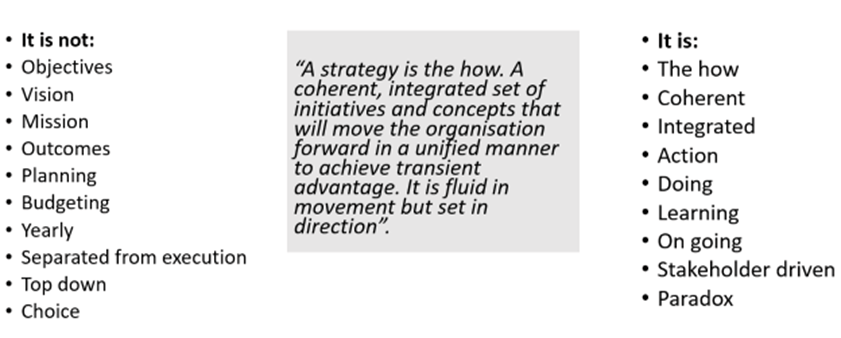
Strategy is as much about the how as it is the what. The strategy process needs a major overhaul in most organizations and must move towards a knowledge and learning perspective.

 Strategy & Competitiveness