In his book Practice What You Preach (published by the Free Press in 2001), David Maister studied a number of professional service firms and identified nine factors that, if firms lived and breathed these statements, explained over 50 percent of the variation in firm performance. These nine statements were:
Client satisfaction is a top priority at our firm
We have no room for those that put their personal agenda ahead of the interests of the client or the firm
Those who contribute most to the overall success of the firm are rewarded the most highly
Management gets the best work out of everybody
Around here you are required, not just encouraged, to learn and develop new skills
We invest a significant amount of time in things that will pay off in the future
People within our firm always treat others with respect
The quality of supervision on projects is always uniformly high
The quality of the professionals in our office is as high as can be expected
When you take a close look at these statements, you notice how much they have to do with leadership and the building of a market driven firm based on knowledge. Maister was quick to point out that these statements were not just rhetoric but were values that each employee lived and breathed in their daily work, including the senior partners of the firm, hence the title of the book.
His findings are even more relevant given the hard times many firms are facing given the global economic slowdown and the mass of layoffs and other cost cutting measures we have seen. Leaders at these firms are under increasing pressure to walk the walk and become ethical managers. However, given the findings of some recent research on being able to ‘practice what you preach’ this is not easy. In a paper published in Psychological Science and profiled in Strategy + Business, researchers found that power was linked to hypocrisy. Using a variety of experiments, they concluded that powerful people display a greater inconsistency between what they practice and what they preach than their counterparts with less power. In other words, people in positions of authority are less likely to do what they tell others to do and based on the findings of David Maister, this could have significant implications for the leaders since they have a disproportionate influence on others inside the firm and we all know that actions speak louder than words.
The message for senior leaders within an organization is clear, if you expect certain types of behavior from your people (such as those listed in the nine statements above), you better be prepared to carry these through yourself in order to maintain your credibility.
There has been so much written about why organizations fail to change despite the warning signs being clear and present. Certainly the remnants of organization theory (such as Taylor’s Scientific Management or Max Weber’s Bureaucracy) have a major role in the way firms are led today as do MBA courses and what is taught (shareholder value as the holy grail). Henry Mintzberg (Professor of Management at McGill) has said that management is much more a practice than it is science. He also states that shareholder value has nothing to do with human values, ‘it’s got nothing to do with decency, it’s got nothing to do with anything but greed’. He is not alone in this view.
An article in Bloomberg from a former Harvard business professor examining the fundamental problems with MBA education and her experiences at Harvard (The Old Solutions have become the New Problems). Shoshana Zuboff who spent 15 years teaching on the Harvard MBA says ‘I have come to believe that much of what my colleagues and I taught has caused real suffering, suppressed wealth creation, destabilized the world economy, and accelerated the demise of the 20th century capitalism in which the U.S. played the leading role’. She goes onto criticize many of the concepts espoused on the MBA under the guise of shareholder value. These concepts include downsizing, re-engineering, outsourcing, etc, which led firms to focus on ‘financialization’ as opposed to innovation and wealth creation through new products and services. I would also add new business models.
According to Zuboff:
‘Old rules assumed economic value. That’s why Harvard Business School students have been trained for a century in the “administrative point of view.” The manager’s job was to oversee and control what was inside organization space, or what they were trained to view as “my company.” Everything else was a distraction. The “administrative point of view” reflects a simpler time when business was about selling a product. It teaches you to operate from the perspective of organization space—how to maximize your company’s efficiency and serve its interests. It’s a world of boundaries: who’s inside and who’s out; who’s up and who’s down. It’s a world of producers vs. consumers, my company vs. your company, us vs. them. Business is no longer just about the product. Now it’s about solutions for the individual. Economic value is hidden in consumers’ unmet needs and is released by providing people with the means to fulfill those needs. But in order to release new value, you need to get out of organization space and into the subjective space where individuals live. I call it “I-Space.” This means shedding the “us-them” mentality. Now everyone is an insider’.
In the classic article, On the Folly of Rewarding A, in the Hope for B (Steven Kerr, Academy of Management Executive, 1975 and updated 1995), the author gives an array of examples from different fields that encapsulates even today the majority of issues with change initiatives and the way companies are run – ‘it’s the reward system stupid’! The below examples, in my opinion, cover 90% of the issues most organizations face:
We hope for long term growth, but reward quarterly earnings
We hope for teamwork, but reward individual effort
We hope for challenging stretch objectives, but reward making the numbers
The ideas here echo many of the challenges discussed above in terms of exploit vs explore. Organizations need to get used to running paradoxical thought processes, and hence ambidextrous organizations, and turning these into integrated management practices. For example, dual roles managing the business of today vs the business of tomorrow. Extending this concept of dual roles and ambidextrous organizations, Innosight (the consultancy co founded by Clayton Christensen), call this dual transformation. Transformation A is repositioning the business to maximise its resilience whilst transformation B is creating tomorrows growth engine. Historically, it has always been managers that play the game and run the business of today that have more clout than those who are often considered pie in the sky thinkers (innovators).
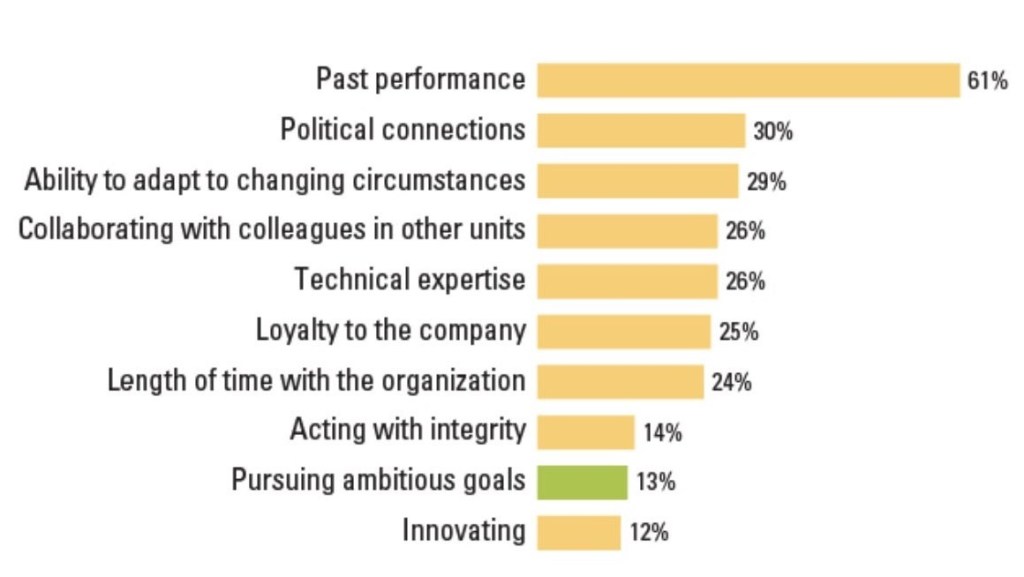
How to Get Promoted (Source: Sull, D., and Sull C (2018) With Goals, FAST beats SMART. MIT Sloan Management Review, June)
In an era of shareholder returns and the holy grail of managing lag indicators (such as earnings) fueled by toxic ‘strategy’ mechanisms such as yearly budgeting processes, the time is here for a re-think for most organizations. The elements of a high performing culture are a market, knowledge and learning orientation. As Peter Drucker once said, ‘Culture eats strategy for breakfast’. I will go further. Strategy is the how, it is action not declaration, hence your culture is your strategy as it is the how of achieving objectives.
Leadership then is fundamental as it is leadership that sets the tone and culture of the organization. There is often much more rhetoric than real action within leadership ranks. Even worse, in the language of Chris Argyris (former Harvard professor and author of Overcoming Organizational Defenses), most organizations have huge gaps between espoused values and theories in use (think Douglas McGregor’s Theory X and Y). Political oligarchy has become so entrenched in most organizations that they have seriously failed to tap the collective wisdom of the crowd. According to Mark Bertolini, CEO of Aetna; ‘Creating new business models is a leadership challenge. In order to create those new businesses in any organization, I don’t care how old it is, you have to start to look at what is going to be the operating model that’s going to make that new business commercially viable and sustainable for the long run’.
Relationship between Leadership, Culture, Innovation and Firm Performance (Source: authors own analysis)
By definition, working on BMI means working under uncertainty. The ideas and thinking that got you to where you are today is not the same thinking that will get to where you need to be tomorrow. Traditional strategy processes built on industrial economic thought are much less relevant in a world of competitive arenas, transient competitive advantage, and eco systems. Firms must be cautious not to conflate current digital initiatives with business transformation. In the fitness industry we are seeing a flood of on demand and live content, move to e commerce platforms to benefit from consumer demand driven by COVID, investment in apps etc, but none of this is BMI. According to Leinwand and Mani (HBR, March 2021):
‘Companies need to step back and fundamentally reconceive how they create value. They need to reimagine their place in the world, rethink how they create value through ecosystems, and transform their organizations to enable new models of value creation. The bottom line is companies need to shape their own future, recognizing that the world has fundamentally shifted, and that they must find their purpose in it. If you can’t answer the questions “Why are we here?” or “What unique value do we add for our customers?” then you are likely at best just staying in the game’.
They go on to say that organizations must:
Reimagine your place in the world, instead of focusing on digitizing what you already do. Companies that transform for success in the digital age define their reason for being in terms of the bold value they create for their customers (and their customers’ customers), and why. They take advantage of new technology not to copy what everyone else is doing, but to advance their own missions by investing in the differentiating capabilities that allow them to deliver on their purpose. Filling their new place in the world with life often requires them to shed old business models, assets, and beliefs about value creation.
Create value through ecosystems, rather than trying to do it all alone. Successful companies in the digital age recognize that the way to remain relevant comes from working together with an ecosystem of players in order to deliver the ambitious value propositions that customers want and to quickly innovate and scale up the incredible capabilities that are needed. Operating in this way requires leaders to think about value creation more boldly, question what their organization must truly own, and be prepared to open up to competitors and give up traditional sources of revenue in order to address some of the most fundamental customer needs.
Re-imagine your organization to enable a new model of value creation, rather than asking people to work in new ways within the confines of the old organizational model. Winners in the digital era break up old power structures so that new ideas and capabilities can be scaled more collaboratively. They put in place outcome-oriented teams tasked with collaborating across the organization and work with their ecosystem partners to deliver the differentiating (and often cross-functional) capabilities they need to win.
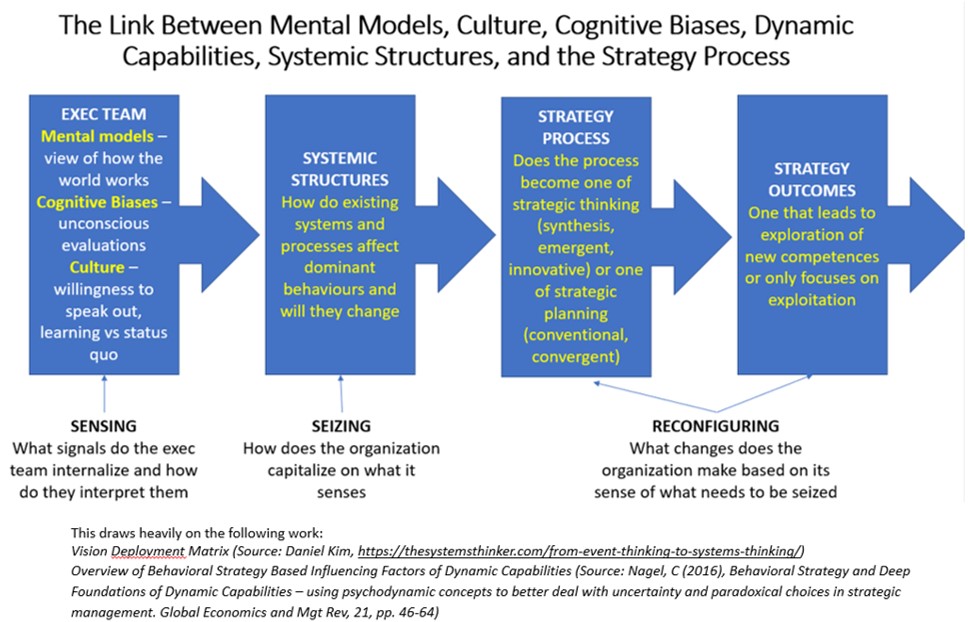
In traditional organizations and theory, strategy has been considered the domain of top management and that their job is to strategize and once developed, sell the strategy and get buy in from the rest of the organization. There are problems with this type of approach. Firstly, top management are themselves immersed in the day to day management of the organisation and hence have limited capacity to scan and interpret the market. Secondly, an increasing number of industries are driven by knowledge workers, these highly intelligent and independent workers do not take well to what they perceive as undue top down influence and control. David Maister (ex Harvard Professor), an expert in working with knowledge intensive firms, suggests that organisations take a bottom up approach to strategy meaning that people at all levels have a major say in the strategy process.
There are many concepts and tools that can aid in bringing this new approach to life including lean start up, innovators method, agile, design thinking, bossa nova, the fifth discipline, systems thinking, cybernetics, complexity thinking, scenario planning etc. There are some great tools available now such as those developed by Strategy Tools and Strategyzer. Again, without the right culture and structure, none of these are likely to make much impact.
As Steve Blank points out in his frequently cited article in HBR, often organizations know they need to change but play a game of organizational ‘whack a mole’ in a futile attempt to swat every problem that pops up without understanding the root cause. He calls this innovation theatre. He goes on to say that organizations must build a mind set, culture and process that becomes innovation doctrine. In their article (How Leaders Delude Themselves about Disruption, MIT Sloan Management Review, 2020), Scott Anthony and Michael Putz describe the 4 lies that leaders tell themselves including that their organization is immune (we are safe) and that their people are not up to the task. Cognitive bias affects leaders as much as it does anyone else. Assuming people are not up to the task creates a self-fulfilling prophecy. Leaders, and organizations, need to become much more self aware in order to create strategic clarity.
Critically, organizations need to stop thinking along the lines of everything is knowable and get used to less than concrete concepts that do not fit in with arbitrary yearly budgets, targets, or hurdle rates that have nothing to do with the future sustainability of the business.
The idea that marketing is a key factor in superior organizational performance is not new and substantial research now demonstrates that a market orientation is the bed rock of company performance. This has been demonstrated in both manufacturing and service industries including the professional services. However few firms seem to adopt the idea of marketing holistically.
To tackle this issue requires a process that must be undertaken by various parties within the firm. Firstly, marketers need to make clear that promotion is only a very small part of marketing and that a market orientation (note the use of the word market as opposed to marketing-this is not just semantics) is a much broader concept that entails an organizations posture to the market. This includes the type of customers the organization will serve and with what kinds of services, how it will maintain relationships with its existing clients and attract new ones, and crucially, what type of people should the firm hire and how to retain them. One of the challenging aspects of organizations today is that not only are they competing for new customers, they are very frequently competing to attract and retain talent. As one well known professional once put it ‘my most important assets walk out the day and go down the lift everyday’. Senior staff within an organization must take responsibility for the strategic direction of their firm and assign resources to understand and build marketing capability. They must take the lead in communicating the need for a strong customer centric organization and break the resistance and apathy that has so often gripped incumbents by harnessing forces for change.
Marketing is as much a mind set as anything else, it is an organizational culture that should pervade the entire organization and people within a firm should realize that any organization is a customer satisfying entity. Since the ‘re-birth’ of the marketing concept prompted by the writings of such people as Frederick Webster in 1988, marketing has once again been placed as an important consideration for organizational performance, and hence has caught the attention of senior management in many businesses that are typically not considered prime prospects for marketing (such as non profit groups, governmental and quasi governmental bodies, and religious organizations). Even the bastions of the educational sector have taken on board some of marketing’s trappings.
This is good and bad. There is a substantial difference between the trappings of marketing (such as having a person designated as a marketer) and the substance of marketing, which is concerned with the value that is created for the customer. One may use the analogy of promotion orientation and market orientation to gain a better understanding of the difference between trappings and substance.
A promotion orientation takes the perspective that the organization will sell what it has and that persuasive communications are the key to marketing success. This orientation takes an inside out perspective and is a short term tactical approach to marketing that is unlikely to be sustainable in the longer term as customers no longer want to buy what you are selling and in the form you offer it. The trappings of marketing are not necessarily unimportant but in isolation do not make up what marketing is and means.
In contrast, the substance of marketing is analogous to what is known as a market orientation. This is not the same as a marketing orientation and the difference is more than semantic. Marketing orientation places the emphasis for marketing in the function of the marketing department and hence artificially separates marketing activities from the rest of the organization. It also carries the negative associations of the term marketing that so often seem to exist in the minds of organizational members. A market orientation can be defined according to the two seminal works in this area by Kohli and Jaworski and Narver and Slater. These academics (Jaworski is now a consultant at Monitor Group) have done much to operationalize the implementation of the marketing concept in the form of market orientation.
According to Kohli and Jaworski (1990):
‘market orientation is the organization wide generation of market intelligence pertaining to current and future customer needs, dissemination of the intelligence across departments, and organization wide responsiveness to it’ (p.6)
According to Slater and Narver (1995):
‘a business is market oriented when its culture is systematically and entirely committed to the continuous creation of superior customer value’ (p.22)
In addition, Narver and Slater (1990) state that market orientation consists of three behavioural components of customer orientation, competitor orientation, and inter-functional co-ordination.
There are several key points to take from these definitions. Market orientation is both a culture (values and beliefs about customers, a business philosophy) and a set of behaviours. That is, there is a difference between accepting the marketing concept and implementing it. Moreover, the responsibility of responding to market needs falls on the entire organization and not only on the marketing function. Empirical support for the market orientation construct is strong both in Asia and the western world as organizations that exhibit higher degrees of market orientation show business performance levels above their peers. Organization wide action is the key to satisfying customers and an understanding of a customer’s entire value needs is what we mean by the substance of marketing. Trappings count for nothing if you have chosen the wrong value. Customer value migrates and pushing what you have will not provide long term profit driven sustainability. Innovation is a key word and this consists of a combination of market driving and market driven management.
I Marketing Culture – what it looks like
It should be clear now that adopting a marketing culture is not about the marketing function or sales team. It is about a firm wide commitment and adoption of the belief that clients and client value should be at the heart of the firms activities and processes. In other words, marketing is ‘how we do things around here’, it is an organizational culture. More formally, organizational culture can defined as a shared pattern of beliefs and behaviour that are both explicit and implicit.
Research by Morgan, Foreman and Poh (1994) state that the 4 major hurdles to implementing a marketing effort are:
Ensuring all staff are trained in the fundamental advocacy of marketing in satisfying customer needs
Recognizing the need for an integrated marketing approach using grounded market intelligence on which optimal decisions should be made
Firms top management and partners providing a consolidated commitment to marketing
Active involvement at all hierarchical levels in the formulation of marketing plans so that successful implementation can be enhanced
One can see from such requirements it is not simply a 1-2-3- step process, rather it requires attitude and behaviour modification. This highlights the very important fact that instilling a marketing culture is as much a management and leadership issue as a marketing one. One cannot expect a firm wide adoption of the marketing concept without top management support and strong leadership. What firm is going to change its structure to a client centered without it being pushed through by the most senior people within the firm? The lack of expertise can be overcome with outside help as well as the hiring of marketing professionals. These professionals can act as change agents or catalysts for the changes that are needed with the support of top management.
Most successful marketing efforts ensure that somebody within the firm has overall responsibility for the marketing function. This is usually with the appointment of a marketing director or manager. Moreover, adopting a marketing culture requires integration of people and information across the entire firm and at all levels. This will not happen by itself and certainly cannot be the sole responsibility of the marketing department. Another area that comes up is the coupling of marketing and sales. In some firms it is deemed the same thing, in others they are separate departments. Marketing sets the tone for sales. In other words, marketing creates the right culture and sets the strategic direction of the firm in terms of markets the firm should serve and the services it should provide. Once you have a good understanding of these issues the firm should be more be able to sell effectively. Sales without marketing is like shooting in the dark, you will hit your target every now and then but with a huge waste of resources and in the process you will probably upset a number of potential customers by trying to sell them something they neither need nor recognize the value of.
II Firm Structure, Marketing Culture & Performance
As has been stressed a number of times here, marketing is a process and business philosophy that requires a fundamental change in the way senior leaders think and act. In order to fully embrace a marketing culture, a firm must have the right foundations upon which it can act and respond appropriately to the changing demands of customers and the business environment in general.
When one considers the ideas of team based structures or market oriented eco systems one must consider the fundamental change that must occur within an organization for this to be successful. Going back to the initial definitions of market orientation cited at the onset of this piece, it becomes apparent that in order to set up and implement effective teams, a firm must become deeply engaged in target market segments and develop an in depth understanding of the needs of the customers within these segments. However, information collection is only the starting point, generation and dissemination of this information that is actionable and implanted across organizational departments such as product development, service and sales etc will determine whether such an effort is worthwhile. This idea of cross functional coordination is not unusual but is often poorly executed. Overcoming fiefdoms and the idea that my department is my department is absolutely vital if the development of a true marketing culture is to progress. The benefits of using such teams are many. Organizational members share and develop news skills whilst developing a big picture view of their customers business as well as their own. Additionally, the inter functional coordination necessary enhances organizational communication to the point where using market intelligence becomes the basis for decision making and innovation. In essence, market oriented teams become marketing teams and if you can develop the skills necessary to implement such practices effectively, you will have developed competencies that keep you ahead of your competition.
III Conclusion
Marketing and management become strongly intertwined when discussing the ideas of implementing a marketing culture. It is a firm wide effort that as much as anything requires a basic change of attitude amongst firm seniors that must have strong leadership to effect such change. Crossing these organizational barriers is never easy but one will reap the rewards if one is prepared to take the risk. Firm leadership is crucial and in many ways can be described as marketing leadership. Marketing is so fundamental to a firm that thinking of it as something separate or as something you do when business is slow is a sure fire way to lead your firm to extinction.
There are no universally accepted definitions of a value proposition but there are a growing number of tools that can help in the development of compelling value propositions. Rather than try to focus on a single definition the following list of characteristics by Alex Osterwalder provides a solid guide:
Are embedded in great business models
Focus on few pain relievers and gain creators, but do those extremely well
Focus on jobs, pains, or gains that a large number of customers have or for which a small number is willing to pay a lot of money
Align with how customers measure success
Focus on the most significant jobs, most severe pains, and most relevant gains
Differentiate from competition in a meaningful way
Address functional, emotional and social jobs all together
Outperform competition substantially on at least one dimension
Are difficult to copy
Focus on unsatisfied jobs, pains, and gains.
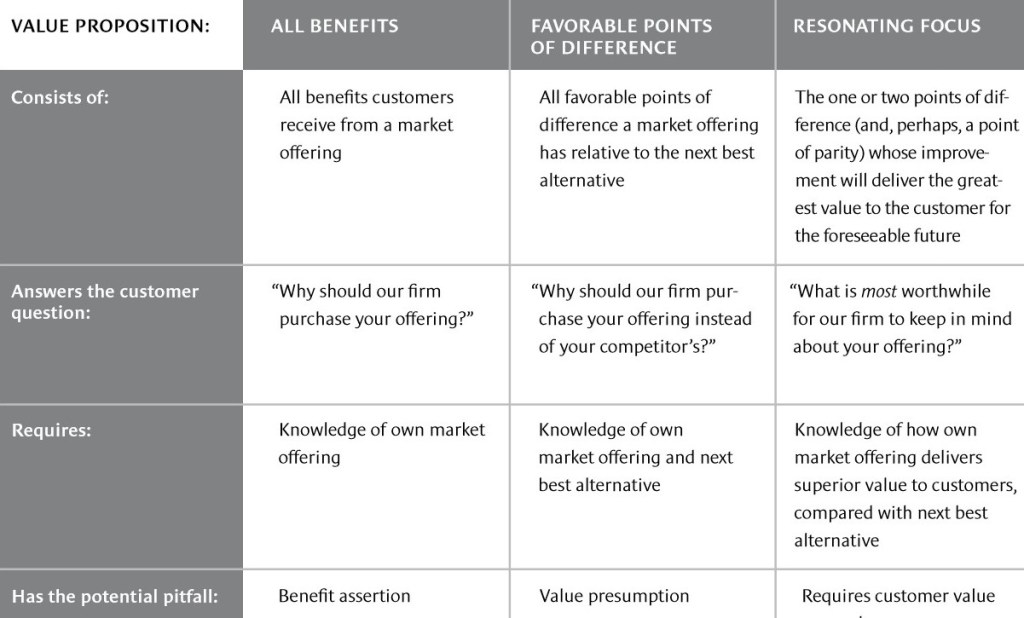
James Anderson and colleagues (in a HBR article from March 2006), explain there are 3 kinds of value propositions which are depicted in the diagram below. They argue that a resonating focus approach is the most compelling and hardest to develop as they require a deep understanding of customer and stakeholder needs. In other words, a problem solving approach.
3 Types of Value Proposition (Source: Anderson, J.C., Narus, J.A., and van Rossum, W (2006) Customer value propositions in business markets. Harvard Business Review, March)
The resonating focus approach helps a company narrow down the value being sought by customers to the most important elements. It may also suggest that different customers within the buying organization have different needs and hence it makes sense to create different communication strategies aimed at different buying centre constituents. For example, a club owner maybe more concerned with capital investment costs and ROI whereas a fitness director may focus on benefits related to ease of use and education support. You cannot cover all these value factors in one statement, but you can customise these communications based on who you are talking to. According to Hub Spot, the value proposition explains how your solution solves customer problems/improves their situation, what specific benefits they can expect, and why customers should buy from you over your competitors. It is not a slogan or positioning statement. Below is what I consider to be the current value proposition (VP) of the major commercial fitness equipment manufacturers:
‘We provide a complete range of cardiovascular, functional and strength equipment to meet all your customer needs. Based on the latest science and advances in technology, our premium equipment is designed to offer the best user experience in terms of biomechanics, safety, and content. Known for industry leading reliability and service, our solutions will make sure your facility stands out from the crowd.’
If this VP sounds generic, it’s because it is. Go to the web site of any major manufacturer, remove the brand name and pictures, and you will be hard pressed to tell one brand from another. If we explore this VP from the perspective of the resonating focus and some of the 10 characteristics above, it doesn’t perform very well. It is most likely the local entity on the ground (such as the distributor or direct office) that forms the bulk of the VP. When thinking about BMI, manufacturers will have to explore in depth how to partner more closely (adapt the BM) to create a more compelling VP across geographies that links the entity and corporate brand more closely together in order to meet the pains, gains and jobs to be done.
Below are a few VPs from traditional manufacturing firms which have adopted BMI using a PSS:
Hilti – Hilti offers holes not hammers. With its Tool Fleet Management System, the company provides guaranteed availability, maximum uptime, with no upfront costs. Customers get access to the best tools whenever and wherever they need them.
Kone cranes – At Konecranes, we are not just lifting things, but entire businesses. We have real-time knowledge of how millions of lifting devices perform. We use this knowledge, around the clock, to make our customers’ operations safer and more productive.
Otis Elevators – Using smart, internet of things (IoT) technology, Otis ONE™ brings you and your passengers the next generation of service. With 24/7 real-time, connected service combined with our foundational historic data your elevator experience will be transformed as you receive new insights. Transparent, proactive, predictive: this is Otis ONE™.
Royal DSM – the new resin addresses the growing market demand for powder coatings that can be cured quicker or at lower temperatures. In particular, the Uralac® EasyCure P 3225 resin can either be cured in just 5 to 6 minutes at 180ºC, compared to the 10 to 12 minutes of market alternatives, or in 12 minutes at 160ºC. In this way, the resin enables higher production output and can help prevent bottlenecks, as well as lowering energy consumption, reducing natural gas usage by up to 30%.
Siemens Health Care – We assist you in reducing risk. We increase machine uptime and increase your profitability.
What is striking about these VPs is how similar they are despite coming from very different industries. They focus on a few key resonating points which act almost as unique selling propositions (USP) whilst aligning with customer measures of success, namely reductions in cost and improved productivity. They are also embedded in strong business models which make imitation difficult. As Didier Bonnet and George Westerman explain (The New Elements of Digital Transformation, MIT Sloan Management Review, 2021), as some firms are still implementing traditional automation approaches such as ERP and product life cycle management, others are moving far ahead by digitally reinventing operations. ‘Thanks to the growing availability of cheap sensors, cloud infrastructure, and machine learning, concepts such as Industry 4.0, digital threads, and digital twins have become a reality. Digital threads connecting machines, models, and processes provide a single source of truth to manage, optimize, and enhance processes from requirements definition through maintenance (p.4)’.
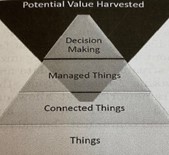
Business Value Realization (Source: Barkai, J. (2016) The Outcome Economy)
If we consider the current status of traditional manufacturers, they are basically at the level of selling things (some with connected things, especially those targeting the consumer market). The VP examples above are much more heavily concentrated on managing things and decision making. That is how they deliver compelling VPs to their customers. Studying what those are doing in other industries is known as analogous research. Other approaches common include stakeholder mapping, customer journey mapping, exploratory research, ethnographic research, in depth interviews, desk research and quantitative approaches.
The VPs essentially address a mix of business, technical and personal value. This idea is very similar to the value proposition canvas (from Alex Osterwalder) which focuses on gain and pain points. We can use this tool to analyse the VP sought by equipment buyers and develop a new BM. The completion of the canvas would involve substantial stakeholder input including customer research.
The Value Proposition Canvas (Source: Strategyzer)
Customer jobs – this is based on the seminal ideas of Clayton Christensen (author of The Innovators Dilemma). The concept is that customers don’t simply buy a product but rather ‘hire’ it to do a job. The classic example he gave was that of a McDonalds milkshake (hired to make the commute to work). For Hilti customers it could be executing contracts and for a firm like Slack enabling real time collaboration (or Zoom, virtual collaboration)
Gains – predictable costs and access to latest tools would be customer gains/needs for Hilti. In the case of remote diagnostics for medicine, customers would gain medical advice at their convenience
Pains – Hilti customer pains (to be overcome by the new VP) would include high upfront costs and risk of project delays. For Slack they aim to alleviate lost and messy communications via long email threads and other channels
Pain relievers – the aim here is to overcome some of the pains. Hilti, for example, offers subscription based services to eliminate high up front costs. Home medical diagnostics reduces the pain of travelling and waiting for medical services
Gain creators – Hilti offers immediate repairs or access to new equipment to ensure near 100% uptime. Slack offers real time project management to enhance productivity together with a fast learning curve
Products/services – the online fleet management system is the core of the solution for Hilti together with their inventory management system for tools. For Peloton it would be the content which leads the physical product allowing customers to access world class training when it suits them in their own home
Some authors have modified this canvas to change the value map to benefits, features and experience whist on the customer profile, the elements are named needs, wants, and fears. Both models are useful and can aid thinking. You should not get hung up on the methodology as the intention is to spur different lines of thought. Aside from using this model for an organization’s own analysis, it can be very revealing to study the BMI of companies in other industries:
Strategy/Company
Caterpillar
Siemens Healthcare
GM
Subscription Portfolio
Smart Machines-wide range of connected industrial equipment CAT connect-onboard sensors to help optimize equipment management and productivity
Laboratory as a Business (LaaB)-consulting services that to help customers achieve business objectives Upgrade services-a suite of software applications expanding the lifespan of equipment and reducing TCO
Maven-a peer to peer rental service that allows GM owners to rent out cars using a digital platform
Transformation Strategy
Acquired Yard Club (a peer to peer rental platform to share and manage heavy equipment
Repositioned digital groups under a head of Digital Enabled Services
Deploy AI-leverage data to help automate and standardize complex diagnostics
Acquired Cruise-a dedicated business unit for development of autonomous vehicles Book by Cadillac-an on demand subscription service that lets users choose from a range of curated vehicles and allows them to change vehicles up to 18x year
Other highlights
500K connected assets
55% of revenue is recurring
Over 150,000 Maven members. More then 5m On Star connected vehicles on the road
Below are some examples of organizational issues (taken from The Outcome Economy by Joseph Barkai) when servicing and maintenance are considered secondary and hence neglected early on which are indicative of what happens in the supply of fitness equipment:
Fault diagnostic tools are unable to isolate the root cause of equipment down to a single field replaceable unity (FRU). This leads to longer repair times, multiple parts being replaced and increasing costs
Service tech is unfamiliar with the configuration of the equipment and does not have the proper service information or parts on hand, resulting in multiple trips
The stage gate approach to product development ‘freezes’ the design before service planners can evaluate the design and improve its serviceability
To overcome using IIOT:
Onboard and remote diagnostics are designed to meet mutually agreed service level agreements (SLAs)
These diagnostics are aligned with hardware modularity, FRUs and part inventory management policies. These allows failures to be mapped to spare parts in country
Remote monitoring and diagnostic systems help maximise the utilisation of tech staff and allows more efficient allocation
Back end systems are designed to take advantage of machine generated data to assist in capturing operations and failure data. This is then used to improve design of existing and new products
Based on all the methods available for the ideation and preparation phases, an organization will start to get a feel for the possible value propositions that could be developed. There is a plethora of customer value models available which can be incredibly useful in delineating what value is to a customer. It is also important to note that customer needs are not always well expressed by customers so a mix of inside out and outside in thinking is required. Together with an iterative process and a big enough pool of on going projects, the firm should be well positioned to explore new opportunities.
It seems like everyone is trying to figure out what the metaverse is and what it may mean for them. There are some who believe it is hype and many more who believe it will be a fundamental part of business as usual – but by when is unclear. McKinsey research suggests that the metaverse could be worth US$5 trillion by 2030. Gartner predicts that 25% of people will spend at least one hour per day on the metaverse by 2026.
According to a new study by PwC, two thirds of company leaders have moved beyond experimentation and within a few years, the metaverse will be an integrated part of their business. Whilst this sounds impressive, PwC state that it’s important to keep in mind that the “ultimate” version of the metaverse (fully immersive, with seamless and secure transitions among a multitude of metaverse environments) doesn’t exist yet. Some metaverse elements are entering everyday business activities, but it is still in the early stages…download full paper below:
Add on – core product is priced competitively with the option of numerous extras (i.e. SAP, SFDC, Ryanair): an equipment manufacturer could offer content and digital solutions on a turn key basis similar to a freemium model. In turn the operator could offer mirrored services to the end user either on a subscription basis, pay as you go, or tiered membership structure (whether in or out of the gym services)
Hidden revenue – sources of revenue come from a third party such as advertisers or other service providers (i.e. JC Decaux, YouTube): instead of the B2B buyer paying full price for hardware, software or content, the manufacturer could build an advertiser base who would target in facility users or perhaps the actual operator on back end CRM interfaces. Another option would be adding partners to the eco system of a platform that impact a consumers health journey (for example insurance companies or other health care providers). This is similar to the banking as a market place concept
Revenue sharing – sharing revenues with other stakeholders such as complementors or even rivals (i.e. Apple app store, Amazon Kindle): manufacturers could work with app developers to offer comprehensive solutions to facilities that impact ROI such as member retention. In particular AI and ML based training will have a huge impact on adherence to exercise and the way trainers interact with customers. Suppliers could work with operators on developing journeys that tangibly affect their business and create outcome based contracts where revenues generated are shared among the stakeholders. This could also be applied to operational efficiency whereby a manufacturer is able to demonstrate better TCO (total cost of ownership) based on analytics which improve equipment uptime and decrease usage costs.
Affiliate programs – usually based on some kind of pay per sale or pay per display (i.e. American Express, Amazon affiliate program) – a manufacturer could work with B2B customers on selling in home fitness equipment and solutions on a commission basis
Fractionalized ownership – sharing of assets among a group of owners (i.e. Netjet, mobility car sharing): with equipment being one of the most capital intensive parts of setting up a facility, including the need to update/refresh (usually around the 5-7 year point) equipment to offer new or changing solutions to customers, suppliers can offer options to swap certain equipment between one customer and another much more frequently than the typical refresh date. This would motivate suppliers to offer comprehensive solutions around maintenance and upkeep whilst offering customers renewed options to members who seek different experiences. This could also be applied based on peak usage times. A hotel for example could get more equipment during the peak season as needed
Ingredient branding – refers to a specific component or ingredient originating from another specific brand (i.e. Intel, Bosch): Les Mills is the classic example of a supplier creating brand pull for the facility. Peloton could be the next player in the commercial space to achieve this with content (perhaps a mix of live and virtual). How can incumbent suppliers use this to engage B2B buyers and more importantly the end user? For now, this seems exceptionally challenging
Aikido – offering something that is essence opposite of what the market has been doing (i.e. Swatch, Southwest Airlines, Nintendo): so called lower quality (featured) products can do well if the value offered is based on features that are demanded in the market (the strategy canvas from Blue Ocean strategy maybe useful here). If, especially for cardio equipment, products are becoming highly commoditized and the battle ground is moving to the platform and eco system then manufacturers could consider making scaled down hardware with easily interchangeable consoles which act as the platform to deliver a differentiated offer. An obvious benefit is low cost production and scale economies
Cash machine and mass customization – in the cash machine the customer pays upfront for the product which leads to improved liquidity (i.e. Dell). In mass customization (again Dell but we have seem many others including Nike and Scholl), modular products and production systems enable the efficient individualization of products: Many facility operators are looking for ways to differentiate their club from the one 1000 metres down the road. Whilst service and programming form a large basis of this differentiation, so could mass customized equipment. With the technology enabled infrastructure of IIOT and advances in e commerce capabilities along with 3D printing developments (and rapid prototyping), it is feasible to see many components of fitness equipment (without moving parts) being customized to order. There are already some examples in the car industry (such as BMW and Porsche). The overall adoption of 3D printing in mass customization is still low and challenging for traditional manufacturers. One possible alternative is to use 3D printing to print moulds used for injection moulding techniques. Not specifically related to this pattern example, I can also see in country service departments 3D printing replacement parts at much lower costs than currently and of course drastically improving after sales metrics for customers
Flat rate subscription – here a supplier charges a customer a flat fixed fee over the tenure of a contract regardless of usage (i.e. Spotify, Netflix, Vodafone, Hilti, Porsche): This would involve a supplier having detailed TCO models and the capabilities to manage install bases across large geographies and customer types plus the willingness to accept the lower returns initially involved in this type of business model (see the Hilti example above). Recurring revenue model businesses seem to outperform traditional transactional driven firms and create certainty of expenses for operators. Such models may also involve guaranteed availability and uptime
Guaranteed availability – in this model the customer risk is minimized by a supplier offering almost zero down time (i.e. Hilti, IBM, SAP, AWS, Otis): This is often combined with the subscription model. Using equipment sensors, big data and data analytics, manufacturers are able to monitor and respond even before equipment breaks down. The benefits for the operator and the end user are clear. If a piece of equipment cannot be fixed the supplier will replace it immediately with in country stock. This requires well developed predictive and prescriptive analytic models to accurately forecast and manage part needs. This type of service could be bundled into an all inclusive pricing model or one which separates hardware costs vs service fees, perhaps on some kind of outcome based contract
Leverage customer data – value is created by using customer data and preparing it in beneficial ways (i.e. Airbnb, Apple app store, Facebook, Google ad words): information collected by a digital eco system about member usage and operations could provide many benefits for a business owner. Understanding how often a member uses the facility, which facilities he/she uses, and being able to test A/B interventions for different personas/user groups could have a significant impact on retention and secondary spend. This would be driven by improved member experiences where an evidence based customer journey is developed and then hyper personalised. This information can also be fed to third parties (such as health insurers and physicians) who have a stake in the adherence to a healthier lifestyle of a user. Again, the emphasis here for an operator should be on ROI and they should be asking for demonstrable evidence that the data collected is useful
Lock in – when customers are locked into a vendor’s family of products and solutions (i.e. Dropbox, Microsoft, HP): if a manufacturer builds an eco system of connected fitness products supported by a digital application that manages not only the information from its products but the information from various 3rd party providers that both operators and consumers use then switching to another vendor would involve considerable time, energy, psychic and monetary costs
Prosumer – vendors enable customers to be producers themselves and can be integrated into the value chain (i.e. block chain, YouTube, Instagram, Smart Grids): obvious examples would include software support so that operators can add their own content to a suppliers digital offerings such as on demand workouts. Extending this further and fitting in with the concept of peer to peer interaction (another BM pattern), exercisers could connect with exercisers anywhere in the world (assuming they are on the same digitized offering) who have similar goals and challenges to share success stories and tips. This would be driven by AI and creates strong social bonds, another nudge towards exercise adherence
Performance based contracting – the price is determined by the value delivered in terms of outcomes as instead to the cost of the physical product (i.e. Rolls Royce, Phillips Lighting, Xerox): whatever solution a vendor installs including equipment, digital, education or concepts, the vendor will be motivated to either reduce usage costs and/or improve revenue for the customer. This differs substantially from the more traditional fixed price service or extended warranty contracts. The term power by the hour was coined around 20 years ago by Rolls Royce and such contracts are used by firms such as GE. This type of contract has a variety of options form part fixed cost and part performance based to full performance based. This type of approach requires a deep understanding of costs and performance capabilities in order to be profitable. Of all the BMI examples, this pattern probably creates the greatest cultural challenge
Solution provider – the vendor offers a full suite of products and services to cover the end to end needs of customers building closer and in depth relationships (i.e. Tetra Pak, Salesforce, SAP): an equipment vendor can add education, training, consulting services etc to the hardware it sells. Once the life of equipment is over the vendor can also take care of trade in and disposal. This could be extended to the operators customers in the forms of health and wellness advice/services
Orchestrator – the company’s focus remains on its core competencies in the value chain and then actively outsources and coordinates the other activities (i.e. Nike, Uber, Osim, P&G): a fitness equipment manufacturer could focus on the traditional hardware manufacturing activities it is good at and then outsource the rest whilst managing the total value chain in order to deliver a solution/product to a customer. For example, instead of building their own digital platform or making their own content, a manufacturer could contract with a number of partners/suppliers to create the solutions needed and offer this as a seamless solution for the customer. In a more extreme example, a vendor could focus on only parts of the manufactured product (say the consoles or motors on cardio equipment) and outsource the rest to other OEMs who may have better efficiencies
Integrator – alternatively to the orchestrator, the integrator owns most of the activities in the value chain and if the capabilities exist may benefit from economies of scale and scope. The integrator should also benefit from lower costs and value chain stability (i.e. Zara, Exxon Mobil, Netflix): instead of partnering with content providers and digital solutions vendors the manufacturer would own these elements and be responsible for developing the solutions and products needed by customers pretty much in their entirety. This strategy could help the company be more responsive to customer needs and reduce cycle times due to internal control
Self service – part of the value process is passed on to the customer in order to lower costs. This maybe areas that deliver little perceived value but incur high costs (such as installation or repairs). The customer can add this step and hence add to the efficiency of a process (i.e. Ikea, Car 2 Go, Fast food restaurants): manufacturers could offer online portals for B2B customers that provide technical training on simple repairs and maintenance without voiding warranty conditions. CAD files of needed parts could be delivered on line and customers can use local 3D printing firms to make parts quickly and cheaply compared to ordering and shipping ‘original’ parts. The same could be done for installation with modular products and specially designed packaging which makes install much more simple then it is currently. This may not apply to all products but could certainly apply to a significant portion
Pay per use/dynamic pricing – in this model the customer actually pays for what they use (like a metred concept) which offers different types of customers flexibility based on the facility (i.e. mobility car or bike sharing, workout pods in China): it doesn’t seem reasonable that a high usage club and a low usage hotel should pay the same price for equipment when the usage levels will be drastically different. This also applies to warranty and service contracts. The benefits to the customer are clear and the operator could pass a similar pay per use model to its users (we already see this in boutiques and alternative facilities). For a manufacturer to offer this type of business model would involve a deep understanding of repair rates and costs based on a wide variety of usage data (such as average weight of user, average speed, average use per day etc)
There is a massive amount of confusion regarding the role of marketing in organizations. This confusion grows when you add in sales and how the two are related. It is no accident that marketing is known as a cost and relegated to a support function since many organizations believe it to be exactly that. Even more so, firms see little intersection between the overall value delivery process and how marketing actually adds value to the customer. Marketing and sales teams are often artificially separated both in work processes and in mind sets.
In his seminal article from the Harvard Business Review in 1991, Regis Mckenna stated that marketing is everything and everything is marketing – it is not a function but a way of doing business. We can even go back to the traditional text book definitions of marketing, such as those by Philip Kotler, that essentially state marketing is about the creation and delivery of customer value. Tim Ambler from the London Business School points out that trying to measure the ROI on marketing as whole is like trying to measure the ROI on eating, if you don’t do it you die! Clearly then, the measure of marketing ROI is firm profitability, although it hardly works that way in most companies.
Market Orientation
Let’s take this one step further and make it more concrete so we can conceptualize what it means when say marketing is a business process that permeates the entire organization. The market orientation literature that blossomed from around 1990 helps us to operationalize and specifically identify what it is to have a marketing culture (i.e. be market oriented). It is both a set of behaviours and a culture. This is depicted in the diagram below which also shows the how marketing and sales should be integrated.
The figure shows the explicit link between marketing (as strategy, in other words the orientation and culture of the firm), firm behaviours, and the link to the manifestations of marketing, BD, and the areas of sales team work that it affects. What this figure details is that aside from technical advice, customers demand an increasing amount of business advice and industry knowledge that is linked to the technical advice sales people provide. For a firm to effectively differentiate themselves in the eyes of the customer, they must be able to deliver a level of value (whether through industry and technical know how, responsiveness, pro-activity etc) to customers that is different from what other providers can offer. Additionally, since a marketing culture is associated with job satisfaction and engagement, it acts as a motivator for sales people to engage in individual level market oriented behaviours which are aligned with the needs of customers. In this sense, marketing in its truest form becomes a key pillar in the work of sales teams and what they deliver to customers as it is the key pillar of f
Breaking Down the Silos
This conceptualisation is good but it does not necessarily help with the wicked problem of breaking down the functional barriers between marketing and sales. It does help with both mind set and behaviours but does not go far enough in terms of practicalities.
Kotler et al in an article from the Harvard Business Review (2006), found four major themes when looking at this disconnect:
The marketing function takes different forms in different companies at different product life-cycle stages—all of which can deeply affect the relationship between Sales and Marketing.
The strains between Sales and Marketing fall into two main categories: economic and cultural.
It’s not difficult for companies to assess the quality of the working relationship between Sales and Marketing (they provide a diagnostic tool in the article).
Companies can take practical steps to move the two functions into a more productive relationship, once they’ve established where the groups are starting from.
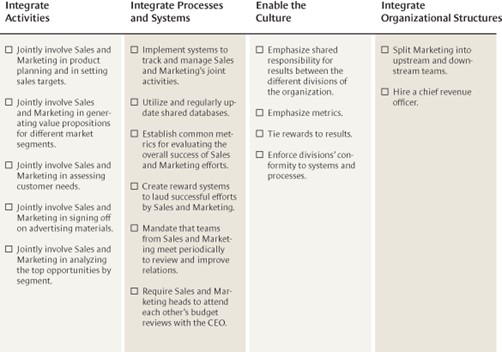
The authors provide the following check list as a guide:
(Source: Kotler, P., Rackham, N., and Krishnaswamy, S (2006) Ending the War Between Sales and Marketing. Harvard Business Review)
The list suggests that there a number of things that an organization can consider when looking to integrate the two functions including a more defined communication process, joint decision making, cross disciplinary work (job rotations), team based structures and project based assignments. We can also see many organizations fully integrate these functions under some type of sales or channel enablement roles. These can only realise their full potential when enablement roles are not set up as distinct functions, doing so puts too much emphasis on the individual’s skill set in bridging the two functions (people are good but that is almost asking the impossible).
In another HBR article from 2019, Casciaro et al make the point that silos can be broken down most effectively by identifying activities that facilitate boundary spanning. They state,
“We’ve found that people can be trained to see and connect with pools of expertise throughout their organizations and to work better with colleagues who think very differently from them. The core challenges of operating effectively at interfaces are simple: learning about people on the other side and relating to them. But simple does not mean easy; human beings have always struggled to understand and relate to those who are different. Leaders need to help people develop the capacity to over- come these challenges on both individual and organizational levels. That means providing training in and support for four practices that enable effective interface work.”
They suggest four ways to do this:
Develop and deploy cultural brokers
Encourage people to ask the right questions
Get people to see the world through others eyes
Broaden your employees vision – i.e. through use of cross functional teams
Further research from de Waal et al (2019), published in the journal Sustainability, identifies 5 factors that are strongly correlated with breaking down silos:
Organizational values
Collaborative operating model
Collaborative environment
Leadership
People reward and development
All of these examples converge around a few key ideas of networked organizations, knowledge sharing, learning, and flat team based structures. This then clearly converges on change. Very broadly there are two ways to lead change. One is to change mind sets, which is exceptionally hard, and the other is to change behaviors which then leads to mind set change. For example, instead of spending considerable time on culture and change workshops (when done correctly these can be effective but time consuming and often have little impact if not integrated into firm processes), why not experiment with asking those in marketing and sales what the issues are facing both and how they could be solved. Then ask them to create cross functional teams to identify and solve the issues. This is effective because the protagonists take ownership of the issues and co create the solution. Buy in happens simultaneously – it does not need to be sold to them, nor should it be. The organization must also ensure that it itself supports this approach through training/L&D, performance management, and changing organizational forms.
The below framework provides an overview of what has been discussed. Now it is a matter of execution and that is true strategy – the how and the process.
Integrating Marketing and Sales (Source: authors analysis)





 Strategy & Competitiveness