Relationship marketing is a relatively new domain of study within the services sector but is growing increasingly important. Firms from every industry are attempting to build closer, more collaborative relationships with clients to better understand their needs in order to provide greater value and hence a greater share of wallet from the customers spending.
In order to benefit from relationship and retention strategies firms must be cognizant of a number of factors. One of these factors relates to client loyalty. Many firms believe that loyal clients are profitable clients and that retaining them is extremely important. There is certainly some truth to this supposition but research conducted by Werner Reinartz and V Kumar published in the Harvard Business Review showed that up to 40% of loyal client were barely profitable. Firms should be able to analyze and determine not only the current profitability of a client but also their potential lifetime value. Another factor is the idea that it costs substantially more to gain a new client than it does to keep existing clients. This extra cost is normally associated with pricing discounts, promotional efforts and other resources used to secure new business. Again, research supports this contention and hence firms should not only be thrilled by the chase of new business but by the gratification of making existing clients more loyal, assuming they provide a certain level of value to the firm. Additionally, the ability to create satisfied clients adds to the likelihood of referral work and positive word of mouth. In the Asian context (of which most are collectivist societies), word of mouth is of particular importance because Asian’s rely more heavily on finding information and providers through networks of contacts than is common in the west. This is one of the reasons that service firm advertising in Asia tends to be less effective as collectivist societies do not tend to seek information from such sources, or at least give less weighting to such promotional activities in the business to business context.
Value is a notion that is varied and should not focus solely on monetary issues. Customers maybe valuable for a number of reasons:
- Strategically valuable – some customers can help you gain access to key markets or other firms business through referrals. The work they do may help you build competencies that are of benefit in the longer run and can enhance your competitive advantage.
- Loyal – some customers are valuable because they supply a steady stream of work even if it is not highly challenging. They are moderately profitable and easy to serve.
- Significant – some clients can help raise your profile and reputation which can be of real value in building the brand of your firm and lead to premium pricing down the road.
- Revenue generating – some customerss generate large revenues for your firm. They pay quickly and reliably and help maintain a healthy cash flow even if they are not the most profitable clients.
There are many aspects to the relationship marketing construct since one may be interested in the ability to measure strengths of client relationships as well as different aspects such as trust and communication. Additionally, there are many elements to relationships between customer and firm such as links with individual actors, the firm itself, and the possible impact on external perceptions such as reputation or competitive position.
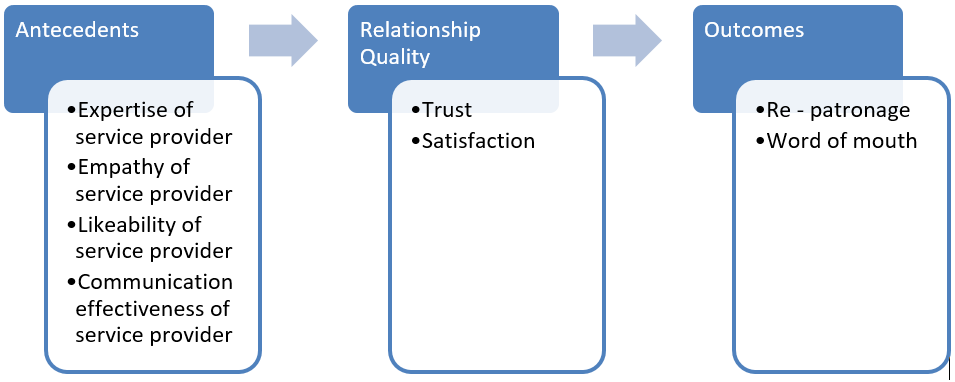
Figure 1 Relationship quality model in high credence services
(Source: Chen, ZX., Yizheng, S., and Da-Hai, D. An empirical study of relationship quality in a service setting, Marketing Intelliegence and Planning, Vol 26, No 1, 2008)
Figure 1 identifies the relationship between the antecedents of relationship quality and its outcomes in research conducted in Hong Kong by Chen and colleagues. They studied this framework in the health care service sector in Hong Kong and found that among the four antecedents, empathy, expertise, and communication effectiveness are positively correlated to trust, and communication effectiveness, empathy, and likeability are found to be significant predictors of customer satisfaction, while likeability and expertise of the service provider are not significant in influencing trust and customer satisfaction, respectively. It is interesting to note that expertise is a crucial indicator of trust but not satisfaction. The authors posit that satisfaction is likely to built after experiencing a service whereas expertise is knowledge that customers attempt to ascertain prior to purchase. This has important implications. Firstly, thought leadership is becoming an increasingly powerful way to demonstrate expertise and to some extent is indicative of the IQ of a firm. However, it is functional quality (service quality) which is a significant predictor of satisfaction because in many cases customers find it hard to judge the detailed technical quality of a product and hence use functional quality as an important indicator. To some degree, this is reflective of the firm’s EQ and has been shown to be a key measure of relationship strength and customer satisfaction. The findings in this study are similar to many found in other contexts and strongly suggest that firms need to focus on building relationships through a deeper understanding of customer value and needs. Additionally, research tools based on frameworks such as those depicted in the figure above can be extremely useful.
Service (Functional) Quality
Customers not only care that you do your job properly and that you are proficient at what you do, they also care how you deliver your services. It is reasonable to expect that in different settings customers would give different weighting to the importance of service quality, at least in terms of their intention to continue doing business with a firm as well as whether they would recommend the firm to others. Satisfaction and customer retention are strongly correlated and being able to identify the key variables that satisfy clients is worthwhile because a firm can then focus its efforts on those variables without wasting time on extraneous factors which are not so critical to the customer.
Since the technical quality of some products is hard to judge due to the information asymmetry between provider and customer, customers are likely to look at service quality to judge the relationship with the service provider. In this case, it could be argued that in relationships where the client is less knowledgeable about the services being provided should stress the service quality and social aspects of the interaction in order to relay quality perceptions to the customer. As customers become more familiar with expectations in terms of technical quality this criteria relevance may increase and hence the firm should look to ways to communicate the technical quality of what it is doing. If a customer is familiar with the technical jargon of professional speak then perhaps it isn’t so bad to use technical language with the customer.
Measuring service quality: SERVQUAL and other Scales
Even though the SERVQUAL scale is the most widespread tool for analyzing service quality its application in non western cultures and business to business markets has been questioned. Some studies have found the five dimensions above to be poor predictors of service quality in the Asian context. For instance, reliability is often considered to be one of the most important predictors of service quality in the west but less so in Asia where customers often have lower expectations of services. There are also additional dimensions relevant to Asia (such as politeness) that are not covered in the SERVQUAL scale. Aside from the cultural issues with the scale, there are also problems associated with its applicability to the B2B market.
Gounaris proposes a model called INDSERV which in his study of B2B services was a better measure of service quality. The four dimensions combine to make up the industrial customer’s perception of service quality:
- Potential quality. This relates to the search attributes that customers use in order to evaluate the provider’s ability to perform the service before the relationship has actually begun. Potential quality is particularly important for business-to-business services because of the increased complexity and degree of customization that characterizes them, which results in a greater degree of uncertainty regarding the performance of the service, even if the provider is selected from a list of existing providers.
- Hard quality. This pertains to what is being performed in the service process. It refers to the service blueprint the provider uses, the accuracy with which the service is delivered and so on.
- Soft quality. This is concerned with how the service is performed during the service process. It relates to the front-line personnel and the interaction they develop with the customer’s employees. It captures how open the service provider is to ideas and suggestions from the customer, the service provider’s benevolence and communicated willingness to watch the customer’s best interest. These qualities help to develop a positive climate during the service encounter and facilitate the process of aligning the provider’s service with the customer’s specific requirements.
- Output quality. This explains the customer’s concern regarding the actual offering delivered. It captures not only the results of the technical efforts to deliver the service, but also the impact that the service delivered eventually produces for the buying organization.
A Note on Cultural Differences
Whilst it is tempting to look at Asian cultures as homogeneous and indeed that culture can be studied at the national level (as in the work of Geert Hofstede discussed in previous chapters) it is important to note that Asia is highly diverse and that the parsimonious either/or cultural analysis frameworks of western contexts may not fit altogether well in Asian contexts which exhibit a certain dualism. In addition, since many corporations in Asia have extremely diverse work forces it may be erroneous to attempt to treat all potential relationships the same way since an Asian national working in Singapore for example may well have been educated in the US and the impact of organizational culture could well take precedent over national cultural origins. Cultural differences and nuances should be kept in mind when developing a practice in Asia but caution should be used when making generalizations for the purposes of market segmentation considering the diversity within Asia and potential client firms. Firm leaders should be aware of these cultural differences but take a customized approach to different situations. For example, James Barry and his colleagues looked at relationships strength in B2B services by not only examining the different facets that affect the strength of a relationship but also by looking at the cultural differences. They found that perceived value and switching costs were key indicators of relationship quality and strength but found no differences based on cultural dimensions.
There are a few reasons for such outcomes and why some research based on national culture shows differences and other studies do not. Part of this can be explained by the level of analysis. National cultural analysis examines the nature of difference at a highly aggregate level while culture can manifest itself at different levels. For example, ethnic culture, regional culture, as well as firm culture can impact a persons perceptions and behaviours and in some cases prove a more powerful indicator than national culture. Leaders in Asia wishing to use relationship tools to enhance their standing with clients should be prepared to delve more deeply into cultural variations within Asian countries as well as within different types of firms. This should better enable the development of relationship strategies and network formations than if the firm attempts to use a blanket approach.

 Strategy & Competitiveness