In my recently released whitepaper, What if Apple makes a treadmill: or doesn’t! I described a scenario of how big tech could come in and disrupt the fitness industry as firms such as Apple and Amazon compete for dominance in the US$10T health industry. In a related piece around strategy, I described the limitations of approaches such as those espoused in Playing to Win (published by HBR in 2013). These limitations are essentially the premise that strategy can be conceived through a linear deterministic approach drawing on industrial economic concepts popularized by Michael Porter. Porters concepts were developed in a very different time.
So what approach is most suitable in dynamic and uncertain environments? The answer to this question will depend upon your view of strategy. If your view is similar to what you may have learned on some MBA course which revolves around finding a unique position in the market that leads to sustainable competitive advantage – in the words of Yoda, you need to unlearn what you have learned. That in itself is a strategy as it infers that organizational culture and mental models play a definitive role in what strategy is and how it is carried out.
In an era of shareholder returns and the holy grail of managing lag indicators (such as earnings) fueled by toxic ‘strategy’ mechanisms such as yearly budgeting processes, the time is here for a re-think for most organizations.
Culture is Strategy
If there is one topic that can get me going it is culture. How many managers and organizations emphasize the importance of culture in firm performance without really:
- Understanding what it is
- Paying more than lip service to it, especially when pesky quarterly targets take over
- Making any effort to actually study culture and develop it within their firm
In other words, there is a lot more rhetoric than real action. Even worse, in the language of Chris Argyris (former Harvard professor and author of Overcoming Organizational Defenses), most organizations have huge gaps between espoused values and theories in use (think Douglas McGregor’s Theory X and Y). Political oligarchy has become so entrenched in most organizations that they have seriously failed to tap the collective wisdom of the crowd. Removing the CEO won’t help but addressing the mental models and culture of the firm will. You may not know when you have reached this state but a good sign is when your most passionate and vocal employees become quiet.
Culture is often considered some gooey abstract concept that is some magical property which high performing organizations are able to capture and others not. It may be true that some firms have great cultures and others do not but it is hardly an unknowable or untestable concept. The features of a high performing culture have been clearly operationalized and delineated. Some of these are well articulated in the book by Doshi and McGregor, Primed to Perform. Much more is available in the literature on innovation and market oriented cultures.
The elements of a high performing culture are a market, knowledge and learning orientation. As Peter Drucker once said, ‘Culture eats strategy for breakfast’. I will go further. Strategy is the how, it is action not declaration, hence your culture is your strategy as it is the how of achieving objectives.
A marketing culture is as much a mind-set as anything else; it is an organizational culture that should pervade the entire organization, and people within a firm should realize that any organization is a customer satisfying entity. Since the ‘re-birth’ of the marketing concept prompted by the writings of such people as Frederick Webster in 1988, marketing has once again been placed as an important consideration for organizational performance. This is good and bad. There is a substantial difference between the trappings of marketing (such as having a person designated as a marketer) and the substance of marketing, which is concerned with the value that is created for the customer. A market orientation can be defined according to the two seminal works in this area by Kohli and Jaworski, and Narver and Slater. These academics have done much to operationalize the implementation of the marketing concept in the form of market orientation.
According to Kohli and Jaworski (1990):
‘market orientation is the organization wide generation of market intelligence pertaining to current and future customer needs, dissemination of the intelligence across departments, and organization wide responsiveness to it’
According to Slater and Narver (1995):
‘a business is market oriented when its culture is systematically and entirely committed to the continuous creation of superior customer value’
In addition, Narver and Slater (1990) state that a market orientation consists of three behavioral components of customer orientation, competitor orientation, and inter-functional co-ordination. There are several key points to take from these definitions. Market orientation is both a culture (values and beliefs about customers, a business philosophy) and a set of behaviors. That is, there is a difference between accepting the marketing concept and implementing it. Moreover, the responsibility of responding to market needs falls on the entire organization and not only on the marketing function. This type of marketing cannot be measured by traditional marketing metrics. The ROI on this is company profitability. As Tim Ambler from the London Business School proclaims, ‘it is like the ROI on eating, if you don’t do it you die!’
In relation to a knowledge orientation and learning:
‘a process that creates or locates knowledge and manages the sharing, dissemination and use of knowledge within the organization. When knowledge is used, learning takes place, which in turn, improves the stock of knowledge available to the firm’ (Darrach and McNaughton, 2001)
There is a huge amount of evidence that a market and knowledge orientation have the most significant impact on firm performance of any variable and directly impacts innovation capability. One must be cautious not to confuse correlation with causation and Phil Rosenzweig (in his excellent book The Halo Effect) explains the danger in this type of research, nonetheless, the evidence is instructive. Think about these buzz words that fly around boardrooms, exec meetings and popular management publications/books:
- Nimble
- Agile
- Adaptable
- Digital transformation
- Talent management
- Lean
- Innovation and creativity
- Environmental scanning and SWOT
- Optimization and efficiency
- Customer centric
- Change capable
- Live by our core values
I could go on but you get the message. For the sake of argument let’s assume all the above are relatively important depending upon the context and all critical to successful strategy development and execution. Now ask yourself a question: how is any of this doable in an effective way without the right culture? Easy answer, it isn’t. Some may say this is more about strategy execution than development to which I would argue that is a false dichotomy. Planning is not strategy. In dynamic environments, strategy is about process, doing, and learning.
Firms need to move from a know it all culture to a learn it all culture in the words of Satya Nadella (Microsoft CEO).
David J Teece (in his book Dynamic Capabilities) identifies dynamic capabilities as sensing, seizing and managing threats/transforming. He also criticizes concepts such as the five forces as being overly static in nature. His ideas highlight the very real need to consider organizational culture in the role of strategy. How can one become ‘capable’ at sensing or transforming if the culture of the organization is insulated, siloed and hierarchical?
At the end of this article you will see some simple examples of inventories used for measuring market and knowledge orientations as well as sources for innovation maturity assessment.
Strategic Foresight
There are dozens of well known companies that have been disrupted by new entrants that didn’t even come from within their standard definition of industry analysis. Uber, Amazon, Apple, Airbnb, and Netflix are well known examples. Even firms which were sitting on disruptive innovations such as Kodak (digital film) and Xerox (GUI) were unable to let go of legacy business models to exploit these opportunities. Firms need to get better at ‘seeing around corners’ according to Columbia Business School Professor Rita McGrath.

Source: http://strategy-business.com/practicingstrategy ©2021 PwC. All rights reserved
Having addressed some of the key issues around changing behaviors based on culture above, we can focus on extending strategic frameworks. Getting away from the fixation on the positioning school of strategy will help. As Gary Hamel states, the forces for perpetuation are much stronger than for innovation.
Amy Webb, a professor of strategic foresight at NYU Stern School of Business, provides some unique tools for practicing strategy in uncertain environments. As founder of the Future Today Institute, she works with numerous organisations on improving their future thinking abilities. These tools can be very useful for improving strategic dialogue and getting organisations to think differently about strategy that focuses much less on traditional competitive analysis and much more on signals and technology that may lead to inflection points (among other patterns). The term was coined by Andy Grove of Intel who said that such change was 10x larger than traditional change organisations usually encountered. A good example in the health and fitness industry is probably that of Nike and their cumulative bets that eventually led to a direct to consumer model which seems to be the core of their strategy. Fortune magazine states this was most likely linked all the way back to 2001 with the release of the iPod which ended in the collaboration that led to Nike+. Like the ideas of core competencies in managing multiple external partnerships and acquisitions that played a major role in the success of NEC in the 1990s, organisations may now need to rely on a portfolio approach to business models in order to not only see coming disruptions, but to react to them.
Research by Rene Rohrbeck and Jan Oliver Schwartz (published in Technological Forecasting and Social Change) demonstrates that improved capabilities in strategic foresight can:
- Enhance capacity to perceive change
- Enhance capacity to interpret and respond to change
- Help influence other actors
- Enhance organizational learning

The above diagram shows how organisations need to become ambidextrous. That is, they need to be able to manage their core business which drives revenue today and maybe 1-3 years from now whilst concurrently working on new value propositions and business models that provide future sustainability. Competitive advantages in this environment are transient and hence organisations must consider change and transformation as something which is normal and ongoing. Innovation comes in many forms and it must be tied into the overall strategy of the firm. As discussed above, a marketing culture is an antecedent to innovation. If you don’t change the culture, any efforts you make in trying to adopt innovation practices are likely to be short lived or completely futile.
Knowledge based strategies need cultures that have a strong market and learning orientation. This means that culture is no longer some mystical hard to grasp concept. It is something which is both operational and concrete. We know what a high performing culture looks like – we just need to actually start doing. Strategy is action, not declaration.
Coming Alive in Practice
Assuming your mind set has been challenged, the organization can now build the necessary culture and behaviors needed to compete and see strategy development and execution as one. Not only this, organizations can reframe the strategy process to include cannibalizing their own business before someone else does.
Another great saying from Andy Grove – “When spring comes, snow melts first at the periphery, because that is where it is most exposed”. According to Rita McGrath, for people running organizations, this has important ramifications – if snow melts from the edges, how do we make sure we see when this is happening?
In traditional organizations and theory, strategy has been considered the domain of top management and that their job is to strategize and once developed, sell the strategy and get buy in from the rest of the organization. There are problems with this type of approach. Firstly, top management are themselves immersed in the day to day management of the organisation and hence have limited capacity to scan and interpret the market. Secondly, an increasing number of industries are driven by knowledge workers, these highly intelligent and independent workers do not take well to what they perceive as an undue top down influence and control. David Maister (ex Harvard Professor), an expert in working with knowledge intensive firms, suggests that organisations take a bottom up approach to strategy meaning that people at all levels have a major say in the strategy process.
The ‘edges’ then refer to people (parts) in disparate parts of the organization (environment) that may have perspectives which are important to the strategic survival of the organization. These are often employees who are in the market every day talking with customers. They maybe geographic units in places far from the HQ that are in markets which are moving faster or differently than these closer to the domestic business. They may even be people who are not part of your organization but critical stakeholders such as distributors, partners, vendors, or of course customers. The point is, you need some type of mechanism that will get these voices heard. That won’t usually come from a typical hierarchical, siloed, and top down driven structure.
Whether structure follows strategy or the other way round becomes less of a dichotomy as now strategy and execution go hand in hand. You could follow the old school way but that will only mange the business for today. In a business model portfolio context driven by a market and innovation culture, you have no choice but to look for alternatives that can simultaneously draw on the intellectual capital of the entire firm and engage those responsible for implementing strategy on a day to day basis.
As I stated in my article, Playing to Win – the bible of strategy, should it be in your organization?, adhocracy and other self emergent systems are much better suited to the job than typical structures. In fact, toxic ‘strategy’ mechanisms such as yearly budgeting can be eliminated almost entirely by beyond budgeting approaches which involve the concepts of sociocracy. Anyone interested in the concepts of Beyond Budgeting can check out the book by Robin Fraser and Jeremy Hope.
There are many concepts and tools that can aid in bringing this new approach to life including lean start up, innovators method, agile, design thinking, bossa nova, the fifth discipline, systems thinking, cybernetics, complexity thinking, scenario planning etc. There are some great tools available now such as those developed by Strategy Tools and Strategyzer. Again, without the right culture and structure, none of these are likely to make much impact or even work as they should.
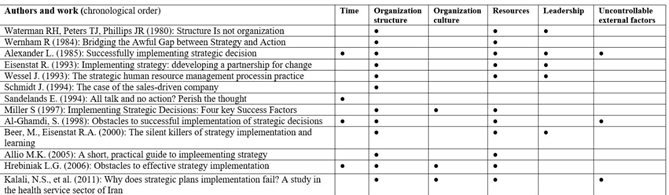
Issues in Strategy Implementation (Source: Valentina Ivančić, Faculty of Economics, University of Rijeka)
Critically, organizations need to stop thinking along the lines of everything is knowable and get used to less than concrete concepts that do not fit in with arbitrary yearly budgets, targets, or hurdle rates that have nothing to do with the future sustainability of the business. The cone approach from the Future Today Institute is a good starting point.

Source: Amy Webb, Future Today Institute
Appendix – tools and links
- Steve Blank – Lean and start up tools
- Rita McGrath – Building a Proficiency for Game-Changing Innovation and Growth
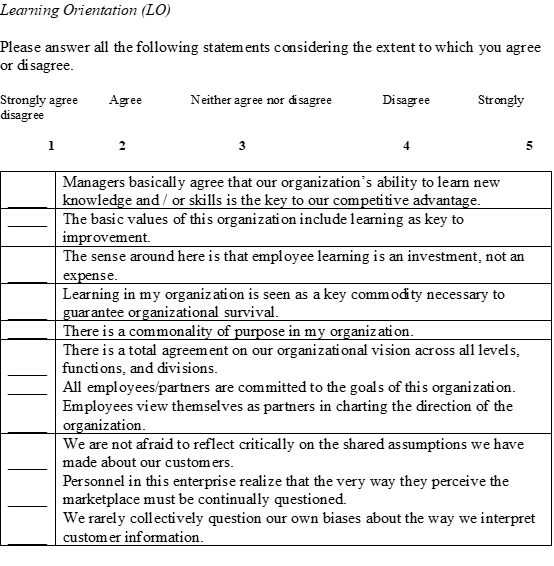
Market Orientation Scale
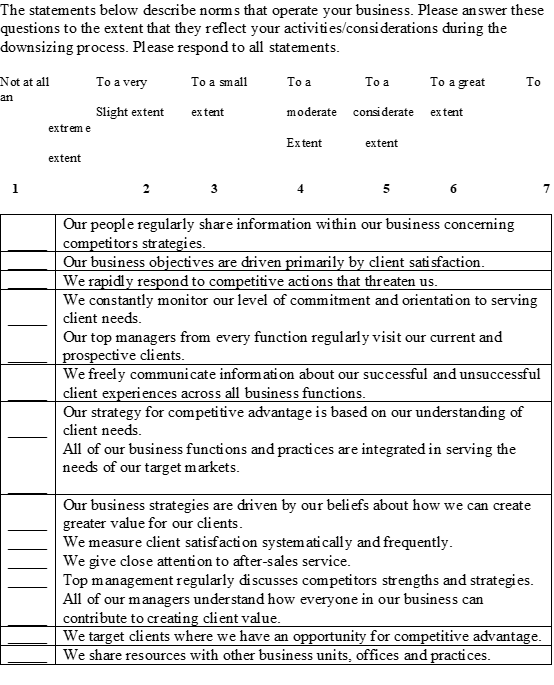

 Strategy & Competitiveness